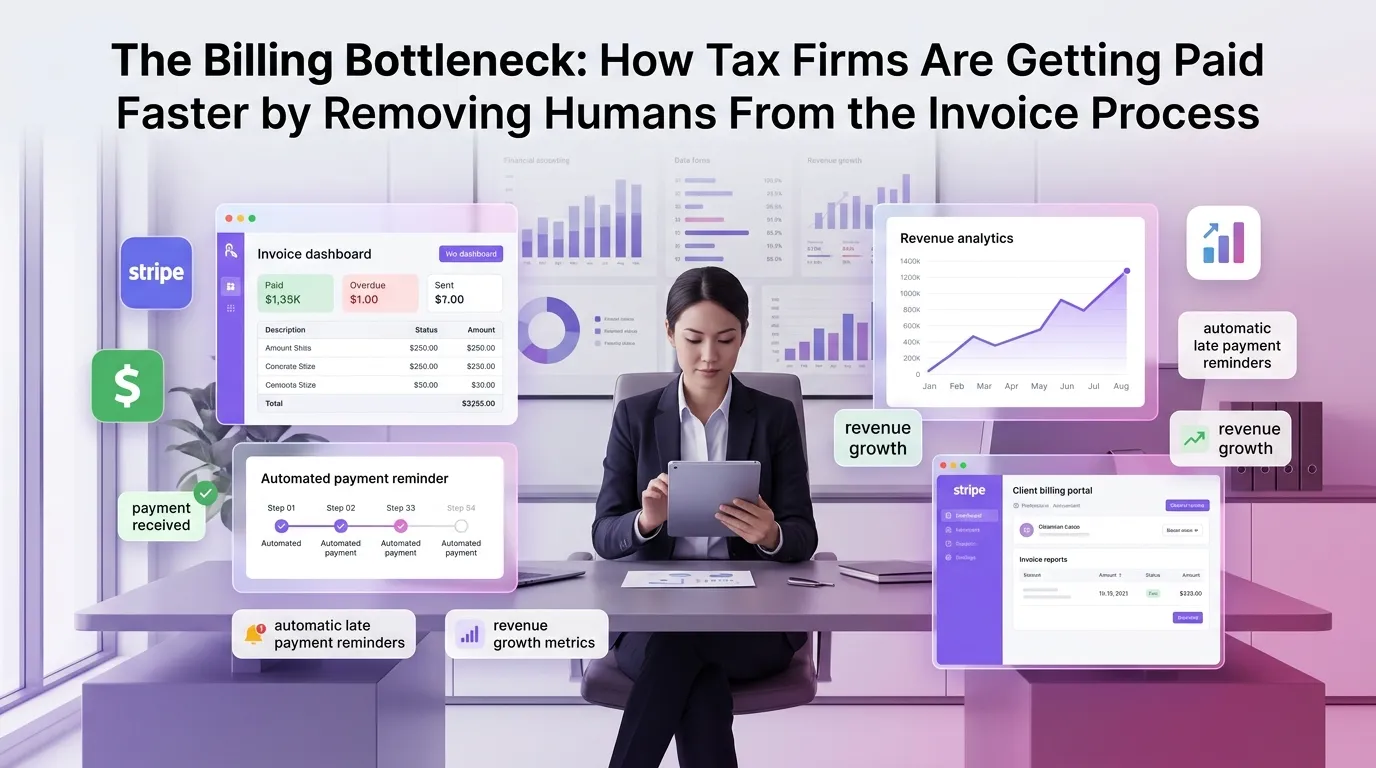
The Billing Bottleneck: How Tax Firms Are Using Invoice and Payment Automation to Get Paid Faster, Reduce Write-Offs, and Eliminate the Follow-Up Grind

For most tax firms, the work doesn't end when the return is filed or the advisory call wraps up. It ends — or stalls — when the invoice goes unpaid. Chasing down clients for payment, manually generating bills, and reconciling accounts receivable can consume hours every week that should be spent on billable work. Invoice automation for tax firms is rapidly changing this reality, giving practices of every size the tools to bill faster, collect sooner, and eliminate the uncomfortable follow-up cycle that strains client relationships and firm morale alike.
The Hidden Cost of Manual Billing in Tax Practices
Most tax professionals underestimate how much time and revenue manual billing processes silently consume. A partner spending 30 minutes each day on invoicing, payment reminders, and accounts receivable reconciliation loses more than 120 hours per year — time that could otherwise generate significant billable revenue.
Beyond the time cost, manual billing introduces errors. Incorrect invoice amounts, missed line items, and delayed send dates all create friction that slows payment and erodes client trust. According to the AICPA, billing disputes and delays are among the top contributors to write-offs at accounting and tax firms.
The result is a billing bottleneck — a point in every engagement where firm revenue gets stuck while staff scramble to push it through manually. Automating this process doesn't just save time; it fundamentally changes the economics of running a tax practice.
What Invoice Automation for Tax Firms Actually Looks Like
Invoice automation isn't just about generating a PDF faster. It encompasses the entire billing lifecycle: creating and sending invoices, applying retainers, accepting online payments, sending reminders, and reconciling collections — all without manual intervention at each step.
A modern tax firm automation platform like TaxFlow integrates billing directly into the workflow. When a client engagement reaches a billing milestone — a completed return, a signed engagement letter, or a scheduled advisory session — the system can automatically generate and dispatch an invoice with the correct line items, rates, and due dates already populated.
Automated Invoice Generation and Delivery
The first bottleneck most firms hit is the gap between completing work and sending an invoice. Staff forget, get pulled onto other tasks, or wait until end-of-month batch billing. Automated generation eliminates this gap entirely.
When billing is triggered by workflow completion — rather than a manual reminder — invoices go out within minutes of the work being done. Clients receive a professional, itemized invoice while the engagement is still fresh in their minds, which measurably improves payment speed.
Online Payment Portals and Multiple Payment Methods
One of the most impactful changes a tax firm can make is giving clients a frictionless way to pay. Mailed checks and wire transfer instructions create unnecessary delays. An integrated online payment portal — accessible directly from the invoice — removes every barrier between the client and their payment.
Supporting multiple payment methods (ACH, credit card, debit card, and even installment plans) further reduces friction. Clients who can pay the way they prefer pay faster. This single change alone can reduce average collection times by several days per invoice cycle.
Automated Payment Reminders That Don't Feel Pushy
Following up on unpaid invoices is one of the most universally disliked tasks in a tax practice. It feels uncomfortable, takes time, and risks damaging the client relationship if done poorly. Automated reminders solve this by sending polite, professionally worded follow-ups at preset intervals — without any staff involvement.
A well-configured reminder sequence might send a courtesy notice three days before the due date, a gentle reminder on the due date, and an escalating follow-up sequence thereafter. Because the messages come from the firm's branded system rather than a frustrated staff member, they maintain a professional tone consistently.
How Invoice Automation Reduces Write-Offs
Write-offs are a significant but often underreported problem at tax firms. When invoices go unpaid for too long, many firms eventually write off the balance rather than pursue collections — essentially providing free services. The Journal of Accountancy has noted that improving AR processes is one of the highest-ROI operational changes an accounting firm can make.
Automation reduces write-offs through several mechanisms. First, invoices sent promptly after work completion are less likely to be disputed — the client remembers the engagement and the value delivered. Second, consistent reminders prevent invoices from falling through the cracks on the client's end. Third, when a payment plan or retainer is in place and managed automatically, the risk of a large unpaid balance accumulating is dramatically reduced.
Retainer Management and Pre-Authorized Payments
Many tax firms work on retainer with ongoing clients, but managing those retainers manually — tracking balances, applying hours, billing for overages — is tedious and error-prone. Automated retainer management keeps running balances current in real time and triggers top-up requests when a retainer falls below a threshold.
Pre-authorized payment agreements take this further by allowing clients to authorize recurring charges for ongoing services. With the client's consent captured once at engagement start, the firm can bill monthly advisory fees, tax planning retainers, or subscription-style service packages without any per-invoice friction.
The Client Experience Advantage
It's worth emphasizing that invoice automation doesn't just benefit the firm — it significantly improves the client experience. Clients increasingly expect the same digital-first billing experience from their professional service providers that they get from their SaaS subscriptions and utility companies.
A clean, mobile-accessible invoice with a one-click payment option reflects professionalism and modernity. Clients who can see their billing history, download receipts, and manage their payment methods through a self-service portal report higher satisfaction — and are more likely to refer the firm to others.
Transparency Builds Trust
Billing surprises are one of the most common sources of client dissatisfaction in professional services. When clients can see itemized invoices that clearly connect charges to specific services rendered, disputes decrease and trust increases.
Automated invoicing systems that pull data directly from time-tracking and engagement management tools ensure that every charge is documented and defensible. This transparency doesn't just reduce disputes — it reinforces the value the firm delivers with every billing cycle.
Integration with Tax Workflow and Practice Management
The full power of invoice automation for tax firms is only realized when billing is integrated with the broader practice management system. Standalone invoicing tools help, but they still require manual data entry to connect billing to the work being done.
When billing is embedded in the same platform that manages client onboarding, engagement letters, document collection, and workflow routing, data flows automatically between systems. A completed tax return triggers an invoice. A signed engagement letter triggers a retainer request. A scheduled advisory call triggers a time entry that rolls into the next billing cycle.
This end-to-end integration is the foundation of what TaxFlow delivers — a single platform where the work and the billing are inseparable, eliminating the manual handoffs that create billing bottlenecks. You can explore our blog for more insights on how integrated automation transforms tax practice operations.
Measuring the Impact: What Firms Are Seeing
Tax firms that implement comprehensive invoice automation consistently report measurable improvements across key financial metrics. Average days to payment (DSO — Days Sales Outstanding) typically drops by 30–50% within the first few billing cycles after implementation. Write-off rates decrease as invoices are sent promptly and reminders run consistently.
Staff time spent on billing administration — generating invoices, sending reminders, reconciling payments, answering billing questions — often drops by 70–80%. That time gets redirected to billable work, client service, or business development. For a firm billing $500,000 annually, even a 5% improvement in collection rates represents $25,000 in recovered revenue.
The IRS has also been pushing for greater digital adoption in tax administration, and firms that embrace digital-first billing align well with the broader industry direction. Reviewing guidance from the IRS's Strategic Operating Plan makes clear that digital transformation is the direction of the entire tax ecosystem — and billing is no exception.
Getting Started with Invoice Automation
For firms considering the transition to automated billing, the good news is that implementation doesn't require a major technology overhaul. The key steps are straightforward: audit your current billing process to identify the specific bottlenecks, choose a platform that integrates billing with your existing workflow tools, configure your invoice templates and reminder sequences, and set up your payment portal.
Most firms see measurable improvement within the first billing cycle after setup. The learning curve is minimal, and the ROI is immediate. If you're ready to see what automated billing looks like in practice, you can start your free trial of TaxFlow and configure your first automated invoice workflow in under an hour.
Frequently Asked Questions About Invoice Automation for Tax Firms
What is invoice automation for tax firms, and how does it differ from standard invoicing software?
Invoice automation for tax firms goes beyond simply generating invoices digitally. It integrates billing triggers directly into your tax workflow — so invoices are created and sent automatically when specific work milestones are completed, without any manual steps. It also includes automated payment reminders, online payment portals, retainer management, and reconciliation, all within a system designed for the specific billing patterns of tax and accounting practices.
Will automated invoice reminders damage my client relationships?
When configured thoughtfully, automated reminders actually improve client relationships by maintaining consistent, professional communication without the awkwardness of personal follow-up calls. The key is using a professional tone, spacing reminders appropriately, and ensuring the messaging reflects your firm's brand voice. Most clients appreciate timely, clear billing communication rather than sporadic or delayed invoicing.
How quickly can a tax firm implement invoice automation?
Most firms can configure a basic automated billing workflow within a single day using a platform like TaxFlow. Initial setup involves creating invoice templates, setting reminder sequences, configuring payment methods, and connecting billing triggers to your workflow stages. More advanced configurations — such as retainer management and tiered service billing — may take a few additional days to fine-tune.
What payment methods should a tax firm support to maximize collection speed?
At a minimum, tax firms should support ACH bank transfers (which have low processing fees and are preferred by many business clients) and credit or debit card payments. Offering installment payment plans for larger tax bills — such as back-tax resolution work or comprehensive planning engagements — can also significantly reduce collection friction and write-offs.
Does invoice automation integrate with accounting software like QuickBooks or Xero?
Most modern tax firm automation platforms, including TaxFlow, offer integrations with popular accounting software so that payment records, invoice data, and accounts receivable balances sync automatically. This eliminates duplicate data entry and ensures your financial records are always current without manual reconciliation.
Ready to Eliminate Your Billing Bottleneck?
The firms growing fastest today aren't necessarily the ones with the most clients — they're the ones collecting efficiently on the clients they already have. Invoice automation transforms billing from a time-consuming administrative burden into a seamless, revenue-accelerating system that runs in the background while your team focuses on delivering exceptional work.
MultidexTech's TaxFlow platform gives you everything you need to automate your entire billing lifecycle — from invoice generation to payment collection to reconciliation — integrated directly into your tax workflow. Start your free 14-day trial today and experience the difference that automated billing makes, or view our pricing plans to find the right fit for your firm's size and needs. No credit card required, no complex setup — just faster payments and fewer write-offs, starting now.