
The Branch Manager Problem: How Multi-Office Accounting Firms Are Eliminating Inconsistency, Communication Gaps, and Rogue Workflows Across Every Location
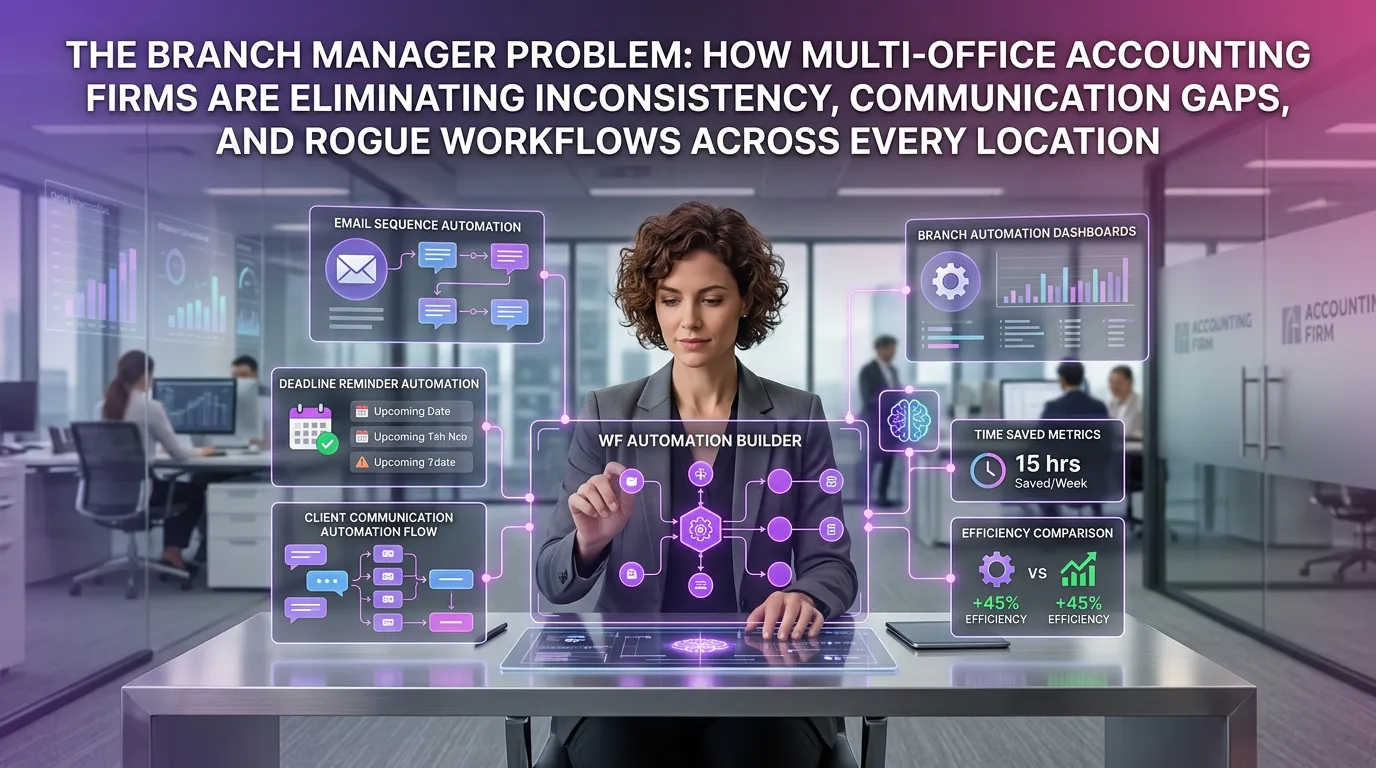
Running a single accounting office is challenging enough. But when your firm spans multiple locations — each with its own branch manager, staff, workflows, and client base — the complexity multiplies fast. For growing multi-office accounting firms, the biggest threat to profitability isn't a lack of clients or talent. It's inconsistency: inconsistent processes, inconsistent communication, and inconsistent service quality that slowly erodes client trust and staff morale alike.
The good news? These problems are entirely solvable. Firms that invest in the right systems and infrastructure are eliminating the chaos of decentralized operations and replacing it with something far more powerful — unified, scalable, and repeatable workflows that work the same way whether you have two offices or twenty.
Why Multi-Office Accounting Firm Management Is Harder Than It Looks
On paper, expanding to multiple locations seems straightforward. You replicate what works at headquarters, hire good people, and trust your branch managers to execute. In practice, it rarely works that cleanly.
Each office develops its own micro-culture. Branch managers interpret firm policies differently. Staff at one location use spreadsheets while another uses a different tool entirely. Clients who work with multiple offices of the same firm receive noticeably different experiences — and they notice.
According to the American Institute of CPAs (AICPA), one of the top operational challenges for growing accounting firms is maintaining quality control across service lines and locations. This isn't just an administrative inconvenience — it's a direct risk to client retention and firm reputation.
The Branch Manager Bottleneck
Branch managers are typically your most experienced people. They're trusted, capable, and deeply knowledgeable about their local markets. But they're also human — and when firm-wide systems are weak, they fill the vacuum with their own judgment.
One branch manager might require clients to submit documents via email. Another uses a client portal. A third accepts walk-ins and paper forms. Multiply this across five or ten locations and you don't have a firm — you have a loose federation of independent practices wearing the same logo.
This creates downstream problems that are hard to quantify but easy to feel: duplicated effort, compliance gaps, training inconsistencies, and a firm-wide inability to generate reliable reporting on performance across locations.
The Four Core Inconsistencies That Hurt Multi-Office Firms
Before you can fix the problem, you need to name it precisely. Most multi-office accounting firms struggle with four specific types of inconsistency that compound over time.
1. Workflow Inconsistency
When there's no standardized workflow for common tasks — onboarding a new client, processing a tax return, handling an amended filing — each office invents its own. This makes training new staff harder, makes quality reviews nearly impossible, and creates serious liability exposure when steps get missed.
The IRS has clear expectations for accuracy and timeliness in tax preparation and filing. Firms that can't enforce consistent internal processes are far more likely to generate errors that trigger Circular 230 compliance issues or client complaints.
2. Communication Gaps Between Locations
In a single-office firm, communication happens organically. In a multi-office environment, information silos form almost immediately. The headquarters team doesn't know what the branch team is working on. Branch managers don't know when firm-wide policy changes. Staff at different offices working on the same client account are sometimes duplicating work — or worse, contradicting each other.
These gaps aren't just inefficient. They're expensive. Rework, client-facing errors, and missed deadlines all trace back to communication failures between locations.
3. Rogue Technology Choices
Without a firm-wide technology mandate, individual offices adopt whatever tools their managers or staff prefer. One office swears by a particular project management app. Another runs entirely out of email and shared drives. A third has invested in a local tool that doesn't integrate with anything at headquarters.
The result is a fragmented technology stack that makes consolidated reporting, firm-wide billing, and centralized client management effectively impossible.
4. Inconsistent Client Experience
Clients expect the same quality and professionalism from every location of a firm they've chosen to trust. When that expectation isn't met — when the experience at your downtown office is noticeably better than the suburban branch — clients don't just complain. They leave, and they tell others.
What Strong Multi-Office Accounting Firm Management Actually Looks Like
Firms that have solved the multi-location problem share several characteristics. They've moved from informal coordination to structured systems. They've replaced tribal knowledge with documented, enforced processes. And they've adopted technology that gives leadership real-time visibility into every location without micromanaging every decision.
Centralized Workflow Templates With Local Flexibility
The best multi-office firms operate on a hub-and-spoke model for their workflows. Headquarters defines the core process — the required steps, the compliance checkpoints, the client-facing deliverables. Branch offices execute those processes but retain some flexibility in how they communicate with local clients or schedule their teams.
This balance is critical. Too rigid and you alienate branch managers who feel micromanaged. Too loose and you're back to the federation problem. The goal is standardization where it matters (compliance, quality, client experience) and autonomy where it doesn't (local marketing, scheduling preferences, community involvement).
A Single Source of Truth for Client Data
Every office should be working from the same client record. When a client moves cities and transfers to a different branch, their entire history — documents, notes, prior returns, communication logs — should transfer seamlessly. When a manager reviews firm-wide performance, they should be pulling from one unified database, not cobbling together reports from five different systems.
This is where a purpose-built tax firm automation platform changes everything. Instead of patching together generic tools, firms gain a system designed specifically for the workflows, compliance requirements, and client management needs of accounting and tax practices — across every location, simultaneously.
Real-Time Visibility Without Micromanagement
Firm leadership needs to know what's happening across all locations without having to call every branch manager each morning. Dashboards that show task completion rates, pending client deliverables, billing status, and workflow bottlenecks by location give leadership the information they need to intervene early — before small problems become client complaints.
The Journal of Accountancy has highlighted that firms investing in operational visibility tools report significantly higher partner satisfaction and lower staff turnover — two metrics that directly impact growth capacity.
Building a Technology Stack That Scales Across Locations
Technology is the backbone of any successful multi-office operation. But choosing the wrong tools — or letting each office choose their own — creates more problems than it solves.
What to Look for in Firm-Wide Software
When evaluating tools for multi-office accounting firm management, prioritize platforms that offer role-based access control (so branch managers see what they need without accessing what they shouldn't), centralized billing and invoicing, cross-office task assignment, document management with version control, and robust reporting by location, team, and service line.
Generic project management tools rarely check all these boxes. They're built for teams, not for the compliance-heavy, deadline-driven, client-sensitive environment of a professional tax and accounting firm.
Automation as a Consistency Engine
One of the most powerful benefits of firm-wide automation is that it enforces consistency without requiring anyone to police it manually. When a workflow is automated, every step happens in the right order, every time, at every location. Reminders go out automatically. Documents get requested on schedule. Review steps can't be skipped. Compliance checkpoints are built into the process itself.
This is especially valuable during peak tax season, when staff are stretched thin and the temptation to cut corners is highest. Automated workflows protect your firm from the human errors that happen when people are tired, rushed, and under pressure.
Change Management: Getting Branch Managers On Board
Even the best system fails if the people responsible for executing it aren't bought in. Branch managers who feel that centralization threatens their autonomy will find ways — consciously or not — to work around firm-wide systems.
Frame Standardization as Support, Not Control
The most effective change management approach positions firm-wide systems as tools that make branch managers' jobs easier, not as oversight mechanisms. When a branch manager doesn't have to reinvent onboarding for every new hire, doesn't have to manually chase clients for documents, and can see their team's workload at a glance — they become advocates for the system, not resistors.
Involve branch managers in the selection and configuration of firm-wide tools. Give them a voice in how workflows are designed. When people help build the system, they're far more likely to use it.
Training That Travels
Multi-office firms need training programs that are consistent, scalable, and not dependent on a single trainer being physically present. Video walkthroughs, documented SOPs, and in-platform guidance tools allow any new hire at any location to get up to speed using the same materials as everyone else.
This also protects the firm when key staff leave. When processes live in people's heads rather than in documented systems, every departure is a knowledge crisis. When processes are documented and enforced through technology, turnover becomes manageable.
Measuring Success Across Every Location
You can't manage what you can't measure. Multi-office firms that have achieved operational consistency track a common set of metrics across all locations: average time to complete a return, client satisfaction scores, billing realization rates, workflow completion rates, and staff utilization by office.
These metrics should be visible to firm leadership in real time and reviewed in regular cross-office performance conversations. Branch managers who see their location's metrics relative to firm averages are naturally motivated to close gaps — especially when the data is transparent and consistent across all offices.
If you're ready to see what unified, data-driven multi-office management looks like in practice, start your free trial of TaxFlow and experience the difference a purpose-built platform makes across your entire firm.
Frequently Asked Questions About Multi-Office Accounting Firm Management
What is the biggest operational challenge for multi-office accounting firms?
The most common challenge is maintaining consistent workflows, communication, and client experience across all locations. Without firm-wide systems, each office tends to develop its own processes, which creates quality control gaps, compliance risks, and fragmented client experiences.
How can accounting firms standardize workflows across multiple offices?
Firms can standardize by implementing a centralized practice management or tax firm automation platform that enforces consistent workflow steps across all locations. Combining documented SOPs with automated task management ensures that every office follows the same process without requiring manual oversight.
Should branch managers have autonomy or follow strict firm-wide processes?
The most effective approach balances both. Core processes — especially those tied to compliance, billing, and client deliverables — should be standardized firm-wide. Branch managers can retain autonomy in areas like local marketing, scheduling, and community engagement. This preserves consistency where it matters most while respecting local expertise.
What technology features are most important for managing multiple accounting office locations?
Look for platforms with centralized client records, role-based access control, cross-office task assignment, automated workflows, real-time dashboards by location, and integrated billing. Tools built specifically for accounting and tax firms will be better suited to your compliance requirements than generic project management software.
How long does it take to standardize operations across multiple accounting firm locations?
With the right platform and a structured change management approach, most firms see meaningful consistency improvements within 60 to 90 days of full deployment. Involving branch managers early, providing consistent training, and starting with the highest-impact workflows (like client onboarding and tax return processing) accelerates adoption significantly.
Ready to bring consistency, visibility, and control to every office in your firm? TaxFlow by MultidexTech is built specifically for multi-office accounting and tax practices that are serious about scaling without sacrificing quality. With automated workflows, centralized client management, and real-time performance dashboards across every location, TaxFlow gives firm leadership the tools to manage with confidence — and branch managers the support to deliver exceptional results. Start your free 14-day trial today — no credit card required — and see why growing firms across the country trust MultidexTech to power their operations. You can also view our pricing plans to find the right fit for your firm's size and structure.