
The Document Collection Playbook: How Growing Tax Firms Are Cutting Client Intake Time in Half Without Sacrificing Accuracy
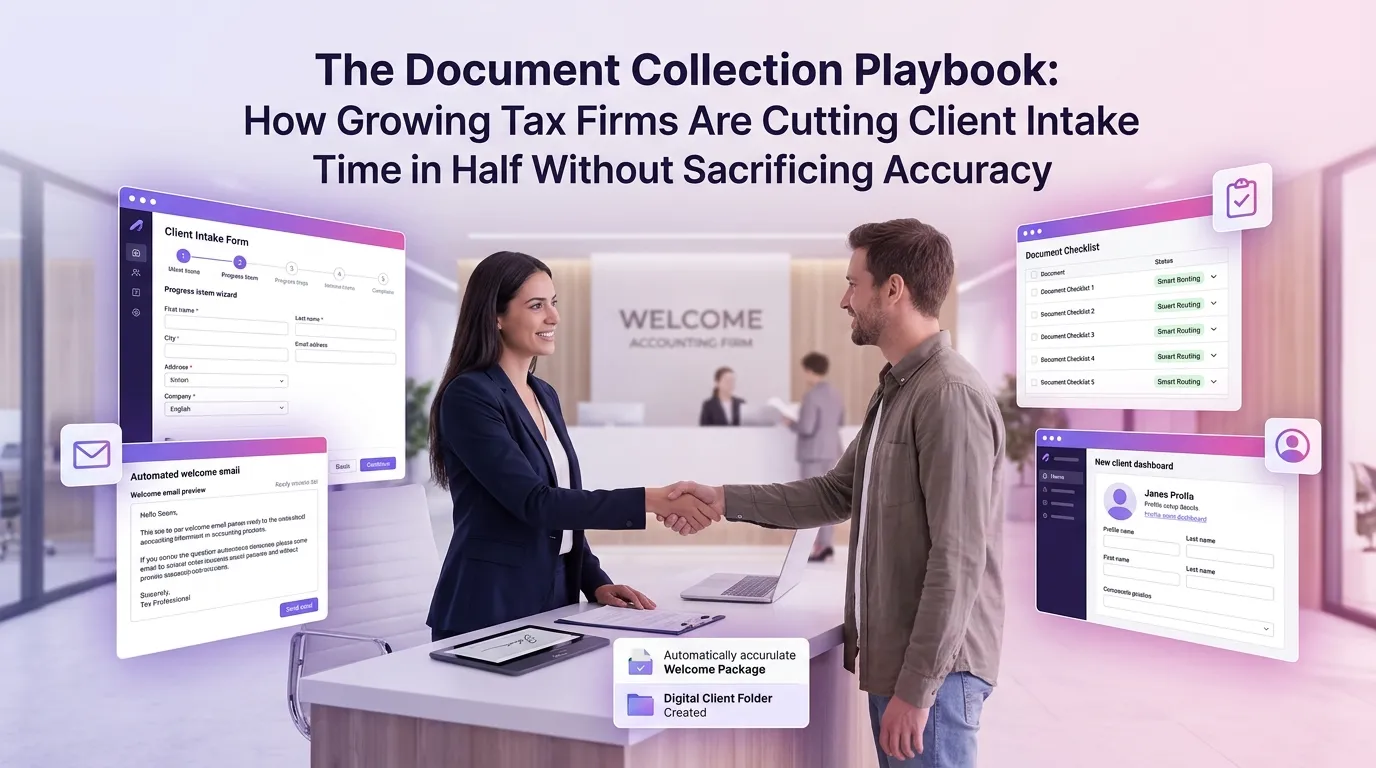
Tax season doesn't have to feel like a fire drill. Yet for thousands of growing tax firms, the weeks leading up to filing deadlines are defined by frantic follow-up emails, missing W-2s, and clients who can't remember where they saved last year's return. The bottleneck isn't your staff's expertise — it's the document collection for tax firms process itself. When intake is manual, inconsistent, and dependent on client initiative, accuracy suffers and billable hours evaporate. The firms that are scaling efficiently in 2024 have cracked a different code: a structured, technology-assisted document collection playbook that cuts intake time dramatically without introducing errors.
Why Traditional Document Collection Is Costing Your Firm More Than You Think
Most tax professionals dramatically underestimate the hidden cost of manual document collection. According to the AICPA's research on technology in the accounting profession, firms that rely on ad hoc intake processes spend an average of 30–40% more time per client engagement than those using structured digital workflows.
That time isn't just spent chasing documents — it's spent context-switching. Every time a staff member stops to send a reminder email, field a phone call about what to upload, or manually sort through a cluttered email attachment folder, they lose momentum on higher-value work. Multiply that across 200 clients and you've lost weeks of productive capacity.
The accuracy problem is equally serious. When documents arrive in dribs and drabs through multiple channels — email, fax, physical drop-off, text message — the risk of something getting missed skyrockets. A missing 1099-INT or an outdated depreciation schedule can cascade into amended returns, penalty exposure, and damaged client relationships.
The Real Cost of a Disorganized Intake Process
Consider a mid-sized firm handling 500 individual returns. If each client engagement requires an average of three follow-up touchpoints to collect complete documentation, that's 1,500 manual interactions your team is managing. At a conservative 10 minutes per touchpoint, you're looking at 250 hours of staff time — just on document chasing.
That's time that could be spent reviewing returns, advising clients on tax strategy, or onboarding new business. Streamlined document collection for tax firms isn't just an operational nicety — it's a direct driver of profitability and capacity.
The 5-Stage Document Collection Playbook for Growing Tax Firms
The firms cutting their intake time in half aren't working harder — they're working from a repeatable system. Here's the playbook they're using.
Stage 1: Build a Master Document Checklist Tailored to Client Type
One-size-fits-all document requests create unnecessary friction. A W-2 employee with a single mortgage needs a very different checklist than a self-employed freelancer with rental income and foreign assets. Start by segmenting your client base into 4–6 distinct profiles and building corresponding document checklists for each.
Your checklists should include not just document names but context: why each document is needed and where clients typically find it. This reduces the "I don't know what that is" responses that clog your inbox. The IRS provides reference resources that can help clients understand common tax documents — linking to these in your intake communications builds trust and reduces confusion.
Stage 2: Launch Your Intake Request Early and Automatically
The single biggest mistake firms make is waiting until January to begin the document collection conversation. By then, clients are already overwhelmed with year-end statements arriving in the mail and competing demands on their attention.
The most effective firms send a preliminary engagement communication in late November or early December — before the flood begins. This communication sets expectations, provides the document checklist, and opens the secure upload portal. Clients who upload even a portion of their documents early dramatically reduce the peak-season crunch for your team.
Automation is critical here. Rather than relying on a staff member to remember to send onboarding emails, use a tax firm automation platform that triggers intake requests automatically based on engagement status, client type, and your firm's defined timeline.
Stage 3: Use a Secure, Centralized Client Portal — Not Email
Email is the enemy of organized document collection. Attachments get buried, versions get confused, and there's no systematic way to track what has and hasn't been received. More critically, sending sensitive financial documents over unencrypted email creates real compliance and security risks.
A dedicated client portal solves all of these problems simultaneously. Clients upload to a structured environment where each document type has a designated location. Your team can see at a glance what's been submitted and what's outstanding — without digging through email threads.
The Journal of Accountancy has highlighted cybersecurity risks for CPA firms as a growing concern, and client portals with encryption and access controls are now considered a baseline security standard, not a premium feature.
Stage 4: Automate Follow-Up Without Sounding Robotic
The follow-up problem is where most manual processes collapse. Staff either over-communicate (annoying clients) or under-communicate (documents never arrive). Automated reminders solve this — but only if they're configured thoughtfully.
Effective automated follow-up sequences are triggered by what's missing, not by a fixed calendar. If a client has uploaded 8 of 10 required documents, the reminder specifically references the two outstanding items. This level of precision would be impossible to maintain manually across hundreds of clients, but automation handles it effortlessly.
Personalization tokens — the client's name, their specific missing documents, their assigned preparer's name — make automated messages feel human. Clients are far more likely to respond to a message that says "Hi Sarah, we're still missing your Schedule K-1 from Riverside Partners LLC" than a generic "Please complete your document submission."
Stage 5: Validate Documents at the Point of Upload
Receiving a document and receiving the right document are two different things. A common intake failure mode is when clients upload the wrong year's tax return, a blurry photo of a document instead of a PDF, or a bank statement from the wrong account. These errors often aren't caught until a preparer sits down to work on the return — by which point valuable time has been lost.
Modern document collection platforms can apply basic validation rules at the point of upload: file type requirements, completeness checks, and even AI-assisted document classification that flags potential mismatches. Catching these issues in real time — while the client is still engaged in the upload process — is dramatically more efficient than catching them after the fact.
How Technology Transforms Document Collection for Tax Firms
The playbook above is powerful on its own, but technology is what makes it scalable. A firm handling 50 clients might be able to execute this playbook manually. A firm handling 500 cannot — not without automation.
What to Look for in a Document Collection Platform
Not all practice management software is built with the same priorities. When evaluating tools to support your document collection workflow, look for these specific capabilities:
- Automated intake workflows that trigger based on engagement status and client profile
- Customizable document checklists that can be tailored to individual client situations
- Real-time completion tracking visible to both staff and clients
- Conditional follow-up sequences triggered by missing document status
- Secure client portal with encryption, access controls, and audit trails
- Integration with your tax preparation software to eliminate redundant data entry
- Mobile-friendly client experience so clients can upload from their phones
TaxFlow by MultidexTech is built specifically around these requirements. Rather than bolting document collection onto a general-purpose project management tool, TaxFlow's workflow engine is purpose-built for the seasonal rhythms and compliance requirements of tax practice. You can start your free trial and have your first automated intake workflow running within a single afternoon.
Measuring the Impact: Metrics That Matter
If you're going to invest in improving your document collection process, you need to know whether it's working. Track these metrics before and after implementing a structured playbook:
- Average days from engagement open to complete document receipt — this is your primary intake efficiency metric
- Number of follow-up touchpoints per client — lower is better; aim for one automated sequence, not five manual emails
- Percentage of returns started within 48 hours of complete document receipt — measures how quickly your team can act on complete files
- Rate of amended returns due to missing documents — a direct quality metric tied to intake completeness
Firms that implement structured document collection workflows consistently report 40–60% reductions in average intake time. More importantly, they report significant improvements in staff satisfaction — because chasing documents is one of the most demoralizing aspects of tax season work.
Common Mistakes to Avoid When Redesigning Your Intake Process
Even well-intentioned process improvements can backfire if not implemented carefully. Here are the pitfalls to watch for.
Over-Complicating the Client Experience
Your intake process needs to be simple for clients, even if it's sophisticated on the backend. If uploading documents requires more than three steps, completion rates will suffer. Test your portal with a few clients who are less tech-savvy before rolling it out firm-wide.
Launching Without Staff Training
New systems fail when staff aren't confident using them. Before tax season begins, run internal training sessions so every team member understands how to monitor intake status, interpret the dashboard, and handle exceptions. A great platform only delivers value when your team knows how to use it.
Forgetting to Communicate the "Why" to Clients
Clients who understand why you're asking for specific documents — and why you've moved to a portal instead of email — are far more cooperative. A brief client communication explaining the change, emphasizing security benefits, and providing a how-to guide dramatically improves adoption rates.
Frequently Asked Questions About Document Collection for Tax Firms
How early should tax firms start the document collection process?
The most effective firms begin their intake outreach in late November or early December, well before the January rush of year-end documents. This gives clients time to locate documents, set up portal access, and upload materials before peak season pressure sets in. Early starters consistently report smoother, faster intake cycles.
Is a client portal really more secure than email for document collection for tax firms?
Yes, significantly so. Encrypted client portals offer controlled access, audit trails, and document-level permissions that email cannot provide. The IRS and major accounting bodies strongly recommend against transmitting sensitive financial documents over standard email, which is typically unencrypted in transit and at rest. A secure portal is now considered a professional standard, not an optional upgrade.
How do automated follow-up reminders improve document collection without annoying clients?
The key is precision and timing. Automated reminders that reference specific missing documents feel relevant and helpful rather than spammy. When configured correctly, clients receive reminders only for what they haven't yet submitted, and the frequency decreases as the deadline approaches rather than escalating. Most clients appreciate being reminded about specific items they may have genuinely forgotten.
What types of documents should be on a standard tax firm intake checklist?
The specific list varies by client type, but a baseline individual return checklist typically includes: income statements (W-2s, 1099s of all types), prior year tax return, Social Security numbers for all household members, mortgage interest statements (Form 1098), investment account statements, retirement contribution records, charitable donation receipts, and health insurance coverage documentation. Self-employed clients and those with rental properties, foreign assets, or business interests require additional document categories specific to their situations.
Can small tax firms benefit from automating document collection, or is it only for large practices?
Automation delivers proportional benefits at any firm size. In fact, small firms often see the greatest relative impact because they lack the administrative staff to manage manual follow-up at scale. A solo practitioner handling 150 returns who implements automated intake workflows can recover dozens of hours during tax season — time that translates directly to additional capacity, better work-life balance, or the ability to take on more clients.
The firms winning in today's competitive tax landscape aren't necessarily the ones with the most experienced preparers — they're the ones with the most efficient systems. A structured document collection playbook, supported by purpose-built automation, is one of the highest-leverage investments a growing tax practice can make. If you're ready to stop chasing documents and start building a scalable intake process, start your free trial of TaxFlow by MultidexTech today. With a 14-day free trial and no credit card required, you can experience firsthand how the right platform transforms document collection from your biggest bottleneck into one of your strongest competitive advantages. Want to explore more strategies for scaling your practice? Explore our blog for guides, case studies, and actionable insights built specifically for growing tax firms.
Related Posts
The Document Collection Upgrade: How Tax Firms Are Replacing Scattered Files, Missed Requests, and Manual Tracking With One Centralized System
11 min read
The Document Request Treadmill: How Tax Firms Are Breaking the Back-and-Forth Cycle That Kills Productivity
12 min read
The Document Request Treadmill: How Tax Firms Are Finally Breaking the Cycle of Repeated Follow-Ups, Incomplete Submissions, and Last-Minute Scrambles
12 min read