
The Recurring Revenue Reality Check: How Bookkeeping Firms Are Using Automation to Protect Margins, Standardize Monthly Deliverables, and Stop Losing Time to Work That Should Run Itself
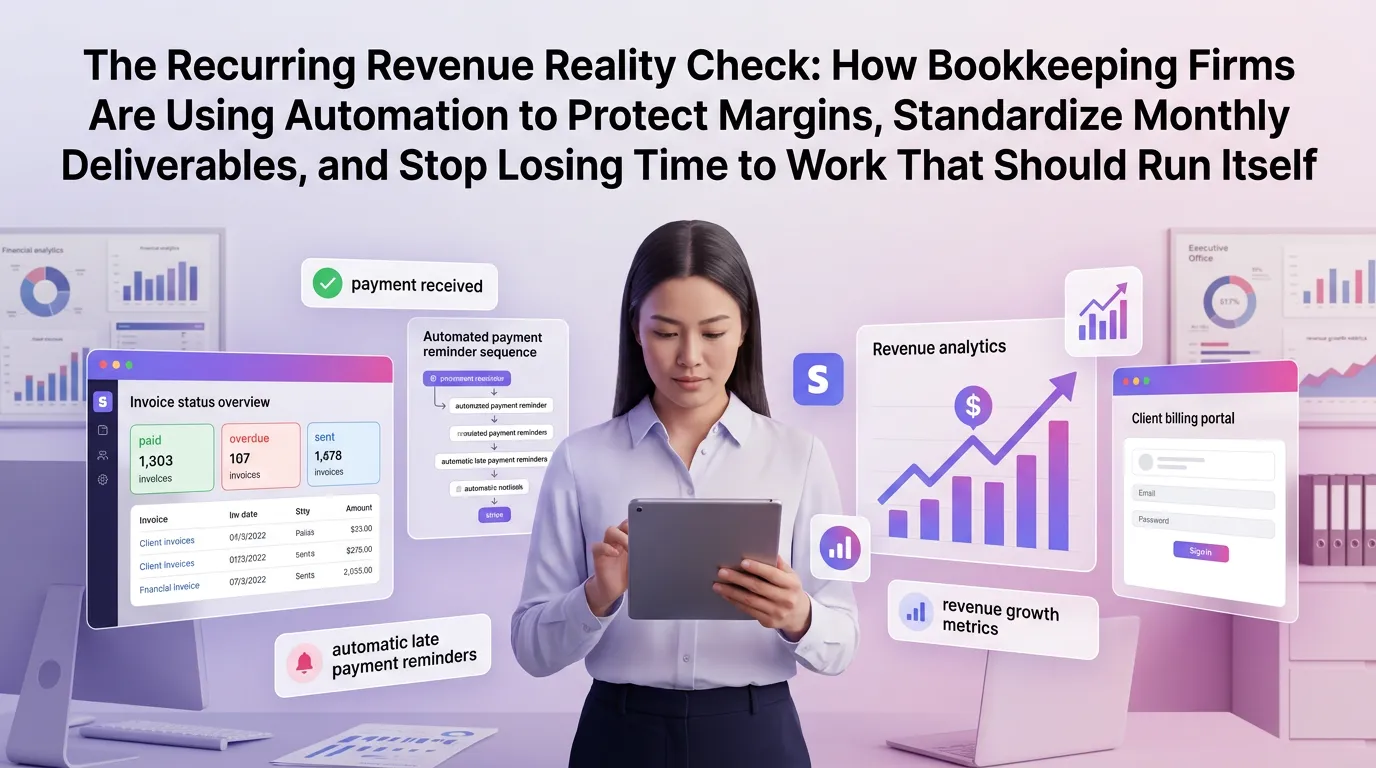
Bookkeeping firms built on recurring revenue should, in theory, be some of the most stable businesses in professional services. Monthly clients, predictable work, steady cash flow — it sounds like the ideal model. But the reality for most firm owners is far messier: margins erode quietly, deliverables slip through the cracks, and staff spend hours each month on low-value tasks that repeat themselves with mechanical predictability. The firms that are pulling ahead right now aren't working harder. They're deploying tax firm automation platform tools to systematize the work that never should have required human attention in the first place.
Why Recurring Revenue Doesn't Automatically Mean Recurring Profit
There's a dangerous assumption baked into the recurring revenue model: that because the invoice repeats, the effort required to deliver the service stays flat. In practice, the opposite tends to happen. As client counts grow, so does the complexity of managing them — tracking deliverable statuses, chasing bank feeds, sending reminders, and producing consistent reports across dozens of accounts simultaneously.
According to the AICPA's annual top issues survey, capacity and staffing constraints consistently rank among the top concerns for accounting and bookkeeping firms. That's not a hiring problem — it's a workflow design problem. When manual processes scale linearly with client volume, you hit a ceiling long before revenue justifies adding headcount.
The math is straightforward: if a bookkeeper spends 45 minutes per client per month on administrative coordination — sending reminders, updating trackers, formatting reports — and you have 80 clients, that's 60 hours of monthly overhead that produces no billable value. Multiply that across a team, and the margin leak becomes a flood.
The Three Margin Killers Hiding in Plain Sight
1. Untracked Time on Administrative Coordination
Most bookkeeping firms track billable hours but rarely account for the coordination overhead that surrounds them. Sending a client a reminder to upload their bank statement isn't billable. Following up when they don't respond isn't billable. Reformatting a P&L because the template changed isn't billable. These tasks are invisible in the P&L but very visible in your team's calendar.
Automation eliminates this category of work almost entirely. Triggered reminders, automated document requests, and standardized report templates mean your staff spend their time on analysis and advisory — the work clients actually pay premium rates for.
2. Inconsistent Monthly Deliverables
When every bookkeeper on your team produces slightly different outputs — different report formats, different narrative summaries, different delivery timelines — you create a quality control problem that compounds over time. Clients notice inconsistency even when they can't articulate exactly what's wrong. It erodes trust and makes upsells significantly harder.
Standardized workflow templates, built around your firm's defined monthly deliverables, solve this at the process level rather than the training level. The system enforces consistency so your team doesn't have to rely on memory or personal checklists.
3. Reactive Client Communication
Firms that operate reactively — responding to client questions rather than proactively delivering status updates — spend enormous time on low-value communication. A client who emails asking "Is my bookkeeping done for October?" has already lost confidence in your process. That email triggers a search, a response, a follow-up, and a thread that could have been avoided entirely with a simple automated status notification.
Proactive communication, delivered automatically at defined milestones, reduces inbound inquiries, increases perceived value, and frees your team from inbox management that adds no revenue.
What Bookkeeping Firm Automation Actually Looks Like in Practice
The term "automation" gets used loosely in professional services, and it's worth being specific about what it means in a bookkeeping context. Effective bookkeeping firm automation isn't about replacing accountants with software. It's about removing the repetitive, rule-based tasks that currently consume skilled professionals' time.
Automated Client Onboarding Sequences
The first month with a new bookkeeping client sets the tone for the entire relationship. It's also typically the most chaotic — gathering credentials, establishing bank feeds, collecting historical records, and setting expectations. An automated onboarding sequence delivers each step in the right order, at the right time, without requiring a team member to manually manage the process.
This isn't just an efficiency gain. It's a client experience differentiator. A new client who receives a structured, professional onboarding sequence — with clear next steps and automated reminders — starts the relationship with a dramatically higher level of confidence in your firm.
Monthly Close Workflow Automation
The monthly close is the heartbeat of a bookkeeping firm, and it's also the most common source of bottlenecks. Automating the task sequence — triggering document requests on the first of the month, escalating reminders for non-responses, routing completed work through internal review, and triggering client delivery upon approval — transforms the close from a manual project management exercise into a self-running process.
Firms using structured workflow automation consistently report shorter close cycles and fewer errors. The Journal of Accountancy has documented how automation adoption in accounting practices directly correlates with improved capacity utilization and client satisfaction scores.
Standardized Report Delivery
Automated report generation and delivery — triggered upon close completion — ensures every client receives their deliverables in a consistent format, on a predictable schedule, without requiring manual distribution. When combined with automated delivery confirmations and read receipts, your firm gains visibility into client engagement that was previously invisible.
Protecting Margins Through Process Standardization
Margin protection in a bookkeeping firm isn't primarily a pricing problem — it's a scope creep and inefficiency problem. Clients who receive inconsistent service ask more questions. Clients who receive inconsistent deliverables require more revision cycles. Clients who aren't managed through a structured process generate disproportionate administrative overhead.
Standardization is the foundation of margin protection. When every client engagement runs through the same workflow — with the same touchpoints, the same deliverables, and the same communication cadence — your cost to serve becomes predictable and manageable. You can accurately price new engagements, identify which client segments are most profitable, and make data-driven decisions about where to invest in growth.
Building Service Tiers That Automation Can Deliver Consistently
One of the most powerful applications of bookkeeping firm automation is enabling clearly differentiated service tiers. When your workflows are standardized and automated, you can define exactly what's included at each tier — and deliver it consistently without relying on individual judgment calls.
A basic tier might include automated bank reconciliation, monthly P&L delivery, and a single review call. A premium tier adds cash flow forecasting, automated budget-vs-actual reporting, and priority response SLAs. When automation handles the delivery infrastructure, your team can focus on the advisory layer that justifies premium pricing.
Capacity Planning With Predictable Workflows
When workflows are standardized and automated, capacity planning becomes a math problem rather than a guessing game. You know how many hours each tier of service requires from your team, which means you know exactly how many clients each team member can support. This eliminates the common scenario where a firm takes on new clients without realizing they've already exceeded their team's effective capacity.
The IRS recordkeeping guidelines underscore why consistent, well-documented bookkeeping processes matter beyond just client satisfaction — they're foundational to audit readiness and compliance accuracy. Automation supports this by creating auditable workflow trails for every client engagement.
Choosing the Right Automation Stack for Your Bookkeeping Firm
Not all automation tools are built for the specific demands of bookkeeping firms. Generic project management software can be adapted, but it typically lacks the accounting-specific workflow logic, client communication templates, and reporting infrastructure that professional bookkeeping requires.
When evaluating platforms, prioritize these capabilities: workflow templates designed for monthly close cycles, automated client communication with customizable triggers, document collection and management built into the workflow, and reporting that gives firm owners visibility into team capacity and deliverable status across all clients simultaneously.
Integration With Your Existing Tech Stack
Your automation platform should connect seamlessly with the tools your team already uses — accounting software, document management systems, and client communication platforms. The goal is to add automation as an orchestration layer, not to replace the specialized tools that your team depends on for the actual accounting work.
If you're ready to see what purpose-built automation looks like for a bookkeeping firm, you can start your free trial and explore how TaxFlow's workflow templates map directly to the monthly deliverable cycles your firm already runs.
Measuring the ROI of Bookkeeping Firm Automation
The return on automation investment in a bookkeeping firm shows up in three places: recovered staff time, reduced error rates, and improved client retention. Each of these has a direct financial value that's straightforward to calculate.
If automation recovers 10 hours per team member per month and your average billable rate is $85/hour, that's $850 per person in recovered capacity — either converted to additional client revenue or returned to the firm as margin. Across a team of five, that's over $50,000 in annual capacity recovery from a single workflow improvement.
Client retention improvements compound this further. A bookkeeping client who stays an additional 12 months at $500/month represents $6,000 in revenue that would otherwise have been lost to churn driven by inconsistent service. Firms that track retention carefully consistently find that process quality is the primary driver of long-term client relationships.
Frequently Asked Questions
What is bookkeeping firm automation and how does it differ from general accounting software?
Bookkeeping firm automation refers to workflow tools that systematize the operational and administrative processes of running a bookkeeping practice — including client onboarding, monthly close sequences, document collection, and report delivery. Unlike general accounting software, which handles the actual financial data, automation platforms orchestrate the processes and communication surrounding that work.
How long does it take to implement automated workflows in a bookkeeping firm?
Implementation timelines vary depending on firm size and the complexity of existing processes, but most firms can deploy core monthly close workflows within two to four weeks. Platforms like TaxFlow offer pre-built templates designed for bookkeeping firms, which significantly reduces setup time compared to building workflows from scratch in general-purpose tools.
Will automation reduce the need for bookkeeping staff?
Automation reduces the time staff spend on administrative coordination, not on the skilled accounting work that delivers client value. Most firms use recovered capacity to serve more clients at existing headcount levels rather than reducing staff. The practical effect is usually revenue growth and margin improvement, not workforce reduction.
How does workflow automation help with client retention in bookkeeping firms?
Consistent, proactive service delivery is one of the strongest drivers of bookkeeping client retention. Automation ensures every client receives their deliverables on schedule, in a consistent format, with proactive communication at each milestone. This reduces the friction and uncertainty that typically drives clients to evaluate alternative providers.
What should I look for when choosing an automation platform for my bookkeeping firm?
Prioritize platforms with accounting-specific workflow templates, automated client communication capabilities, document management integration, and firm-wide visibility dashboards. You can view our pricing plans to see how TaxFlow structures its feature tiers for firms at different growth stages. Also consider the quality of onboarding support and whether the platform integrates with your existing accounting software stack.
Ready to stop losing margin to work that should run itself? MultidexTech's TaxFlow platform gives bookkeeping firms the workflow automation infrastructure to standardize monthly deliverables, protect margins, and scale recurring revenue without scaling overhead. Start with a 14-day free trial — no credit card required — and see how purpose-built bookkeeping firm automation changes the way your team works. You can also explore our blog for more resources on building efficient, profitable bookkeeping practices.