
The Regulatory Shift: How Tax Firms Are Staying Ahead of IRS Deadline Changes Without Rebuilding Their Workflow Every Filing Season
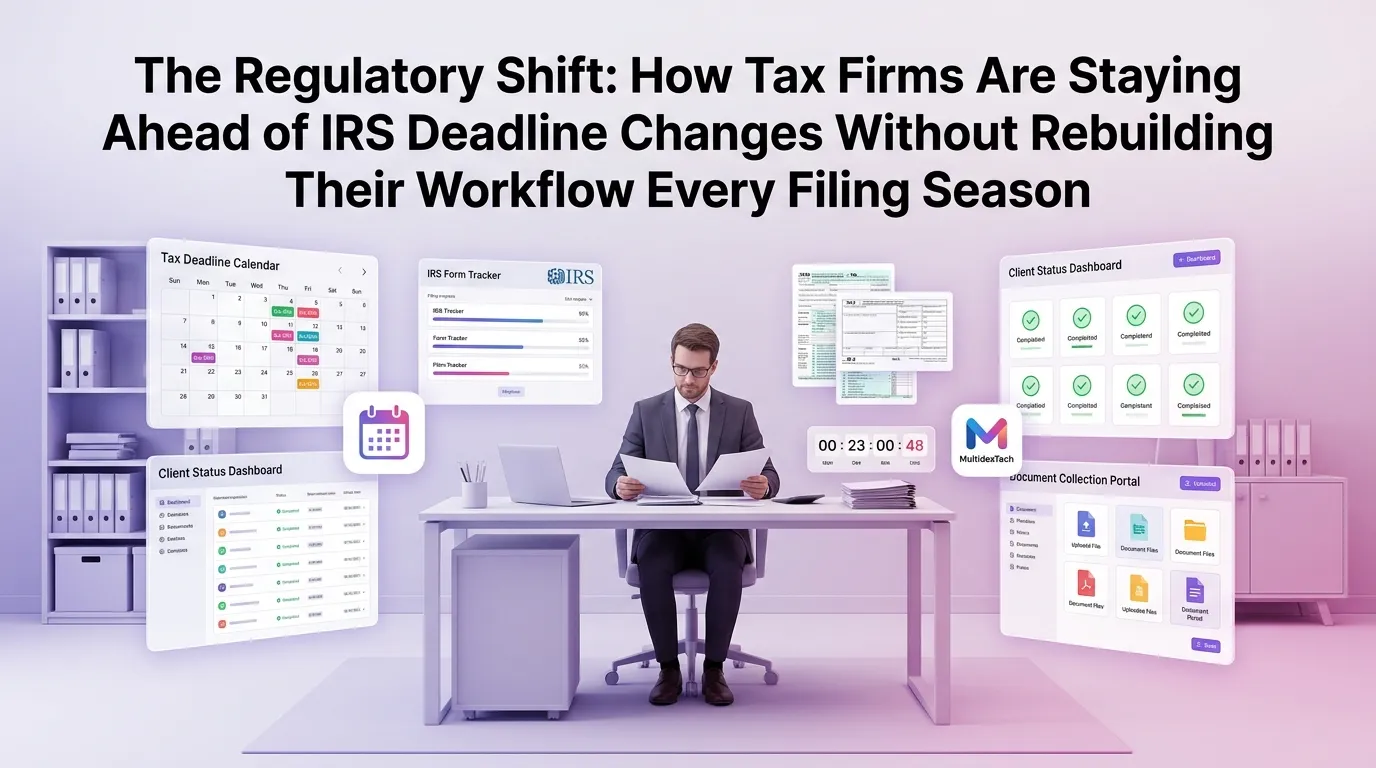
Every filing season, tax professionals brace for the inevitable: IRS deadline changes, new regulatory guidance, and procedural updates that arrive with little warning and demand immediate action. For firms managing dozens or hundreds of client accounts, even a single missed update can cascade into penalties, damaged client relationships, and reputational harm. The question is no longer whether the IRS will adjust its deadlines — it's whether your firm has the systems in place to absorb those changes without scrambling to rebuild your entire workflow from scratch.
Why IRS Deadline Updates for Tax Firms Are Becoming More Frequent
Over the past several years, the IRS has issued deadline extensions, relief notices, and procedural updates at an accelerating pace. The COVID-19 pandemic triggered a wave of emergency extensions, but even in post-pandemic filing seasons, the IRS has continued to revise deadlines in response to natural disasters, legislative changes, and administrative backlogs.
In 2023 alone, the IRS issued multiple deadline extensions for taxpayers in disaster-affected states, including California, Georgia, and Alabama, pushing certain filing and payment deadlines well beyond the standard April 15 cutoff. These weren't isolated events — they reflect a broader pattern of regulatory fluidity that tax firms must now treat as a permanent operating condition.
According to the IRS Tax Relief in Disaster Situations resource, the agency regularly updates deadline guidance based on federally declared disaster areas. For firms with clients across multiple states, tracking these variations manually is no longer sustainable.
The Hidden Cost of Manual Deadline Tracking
Many tax firms still rely on spreadsheets, shared calendars, or practice management tools that require manual updates when the IRS announces changes. This approach creates a dangerous dependency on one or two team members who monitor IRS notices — and it assumes those updates will be caught, communicated, and acted upon in time.
The reality is that manual tracking introduces compounding risk at every step. A staff member misses an IRS notice. The shared calendar isn't updated. A client's amended return is filed under the old deadline. The result is a penalty that was entirely preventable.
Beyond the direct financial impact, there's also the operational cost: the hours spent auditing your deadline calendar after every IRS announcement, the internal communications required to alert your team, and the client calls needed to explain what changed and why. These hidden costs quietly erode firm profitability season after season.
What Manual Processes Cost You Per Filing Season
Research from the AICPA's Tax Practice Management resources consistently highlights deadline management as one of the top pain points for small and mid-sized tax firms. The firms that struggle most are those whose compliance infrastructure hasn't scaled alongside their client base.
Consider a firm managing 400 active clients. If a single IRS deadline change affects 60 of those clients — say, due to a state-specific disaster relief extension — the firm must identify the affected accounts, update their status, notify clients, and adjust internal workflows. Without automation, that process can consume an entire workday or more.
Multiply that by three or four deadline changes per season, and you begin to understand why workflow disruption is one of the leading causes of burnout and staff turnover in tax practices.
How Leading Tax Firms Are Adapting Their Compliance Infrastructure
Forward-thinking firms are no longer treating deadline management as an administrative task — they're treating it as a core operational capability. This means investing in systems that can absorb regulatory changes without requiring a full workflow rebuild each time the IRS updates its guidance.
The shift involves three key principles: centralized deadline visibility, automated client segmentation, and real-time alert systems. When these three elements work together, a firm can respond to an IRS announcement in minutes rather than hours — without pulling senior staff away from billable work.
Centralized Deadline Visibility Across All Client Accounts
The foundation of a resilient compliance workflow is a single source of truth for all client deadlines. This means every tax return, extension request, estimated payment, and compliance filing is tracked in one place — with status, due date, and responsible team member clearly visible at a glance.
When the IRS announces a change, a centralized system allows practice managers to apply updates across affected accounts in bulk rather than updating each file individually. This alone can reduce the administrative burden of deadline changes by 70% or more.
Automated Client Segmentation for Targeted Updates
Not every IRS deadline change affects every client. Disaster relief extensions are typically limited to specific counties or states. Legislative changes may only affect certain entity types or income thresholds. The ability to quickly segment your client base by location, entity type, or filing status is essential for responding to these targeted changes efficiently.
Automated segmentation means your firm can identify affected clients instantly, generate filtered task lists, and trigger client communications — all without manual data sorting. This capability is increasingly becoming a differentiator between firms that manage growth well and those that struggle under the weight of their own client volume.
IRS Deadline Updates for Tax Firms: Building a Proactive Monitoring System
Reactive deadline management — waiting for the IRS to announce a change and then scrambling to respond — is the norm for most firms. But the most competitive practices are building proactive monitoring systems that give them advance visibility into likely changes and enough lead time to prepare.
This involves subscribing to IRS news feeds and announcement channels, monitoring legislative activity that could trigger deadline modifications, and establishing internal protocols for rapidly assessing the impact of new guidance on your specific client portfolio.
The Journal of Accountancy's Tax section regularly publishes analysis of IRS procedural changes and their practical implications for practitioners. Building a habit of monitoring these resources — or using a platform that aggregates them — is a low-cost way to stay ahead of the curve.
Integrating Regulatory Alerts Into Your Daily Workflow
The challenge with external monitoring is that it often lives outside the systems where your team actually works. Staff may receive an IRS alert in their email, but if that information doesn't flow into your practice management system, it may never translate into an updated deadline or a client notification.
The most effective firms close this gap by integrating regulatory alerts directly into their workflow tools. When an alert triggers an action — updating a deadline, flagging an account, or generating a client communication — that action happens inside the same system where the work gets done.
The Role of Automation in Deadline Compliance
Tax firm automation has matured significantly over the past five years. Early tools focused primarily on document collection and e-signature workflows. Today's platforms address the full compliance lifecycle — including deadline tracking, status monitoring, automated reminders, and reporting.
A modern tax firm automation platform should do more than store documents. It should actively manage the compliance calendar, alert your team to upcoming deadlines, flag accounts that are at risk of missing a filing date, and provide the reporting visibility that firm owners need to make confident decisions about capacity and staffing.
Automating Client Communications Around Deadline Changes
One of the most time-consuming aspects of responding to IRS deadline changes is client communication. Clients need to know when their deadline has changed, what it means for their situation, and what (if anything) they need to do. Drafting and sending individualized emails to affected clients can take hours.
Automation changes this entirely. When a deadline is updated in your system, templated client communications can be triggered automatically — personalized with the client's name, the specific deadline change, and any relevant action items. What used to take a half-day of administrative work can be completed in minutes.
Reporting and Audit Trails for Regulatory Compliance
Beyond managing deadlines in real time, tax firms increasingly need to demonstrate their compliance processes to clients, partners, and regulators. An automated system provides a complete audit trail: when a deadline was set, when it was updated, when the client was notified, and when the filing was completed.
This documentation capability is particularly valuable in the event of a client dispute or a regulatory inquiry. Rather than reconstructing a timeline from emails and spreadsheets, your firm can produce a clear, timestamped record of every action taken.
Choosing the Right Technology Stack for Deadline Management
Not all practice management tools are built with the same depth of deadline management capability. When evaluating platforms, tax firms should look for several core features: customizable deadline templates, bulk update functionality, client segmentation by jurisdiction and entity type, automated notification workflows, and real-time compliance dashboards.
Integration with existing tools — tax preparation software, document management systems, and client portals — is also critical. A deadline management system that operates in isolation creates its own set of data synchronization problems.
If you're ready to see how a purpose-built solution handles these challenges, you can start your free trial and explore TaxFlow's deadline management capabilities firsthand — no commitment required.
Building a Culture of Compliance Readiness
Technology is only part of the solution. The firms that navigate regulatory change most effectively have also built internal cultures where compliance readiness is a shared responsibility, not the sole domain of a single compliance officer or senior partner.
This means establishing clear protocols for how IRS announcements are assessed and acted upon, designating team members responsible for monitoring regulatory updates, and conducting brief seasonal reviews of your deadline management processes to identify gaps before they become problems.
It also means investing in training so that every team member understands not just what the deadlines are, but why they matter and what the consequences of missing them look like — both for the client and for the firm.
Frequently Asked Questions
How often does the IRS change filing deadlines?
The IRS issues deadline changes multiple times per year, typically in response to natural disasters, legislative updates, or administrative relief measures. In recent filing seasons, firms have seen between four and eight significant deadline modifications affecting various client segments. Tax firms should treat IRS deadline updates as a recurring operational reality rather than an exception.
What's the best way for tax firms to track IRS deadline updates?
The most reliable approach combines automated monitoring through a practice management platform with direct subscriptions to IRS news releases and announcements. Firms should also follow publications like the Journal of Accountancy and AICPA resources for practitioner-focused analysis. Centralizing all deadline data in a single system ensures that updates are applied consistently across your entire client portfolio.
Can automation really reduce the risk of missing IRS deadline updates?
Yes — significantly. Automated deadline tracking systems eliminate the manual steps where errors most commonly occur: missed announcements, uncommunicated updates, and inconsistent calendar maintenance. When deadline changes trigger automatic workflow updates and client notifications, the window for human error narrows considerably. Firms using automation report measurable reductions in deadline-related errors and the staff hours spent managing compliance calendars.
How do disaster relief extensions affect clients in multiple states?
When the IRS grants disaster relief extensions, they typically apply to taxpayers in specific federally declared disaster areas, identified by county. Firms with clients across multiple states need to quickly identify which accounts fall within affected areas and apply the appropriate deadline adjustments. Automated client segmentation by location makes this process fast and reliable, whereas manual tracking significantly increases the risk of overlooking affected accounts.
What should tax firms look for in a deadline management tool?
Key features to evaluate include: customizable deadline templates for different return types, bulk update capability for applying changes across multiple accounts, automated client notification workflows, real-time compliance dashboards, and integration with your existing tax preparation and document management software. Audit trail functionality is also important for demonstrating compliance processes to clients and regulators. To explore how TaxFlow addresses these requirements, view our pricing plans and find the right fit for your firm's size and workflow needs.
Ready to Stop Rebuilding Your Workflow Every Filing Season?
IRS deadline changes are not going away — and neither is the pressure on tax firms to respond to them quickly, accurately, and without disrupting client service. The firms that thrive in this environment are those that have invested in the right infrastructure: centralized deadline visibility, automated client segmentation, proactive monitoring systems, and workflow automation that absorbs regulatory changes without requiring manual rebuilds.
TaxFlow by MultidexTech is built specifically for this challenge. Our platform gives tax firms the deadline management capabilities, automation tools, and compliance visibility they need to stay ahead of IRS updates — filing season after filing season. Start your free 14-day trial today and experience firsthand how the right technology transforms deadline management from a source of stress into a competitive advantage. No credit card required, no long-term commitment — just 14 days to see what a purpose-built tax firm automation platform can do for your practice.
For more insights on compliance management, workflow automation, and tax firm growth strategies, explore our blog — updated regularly with practical guidance for modern tax professionals.
```