
The Silent Revenue Leak: How Tax Firms Are Recovering Billable Time Lost to Manual Deadline Management
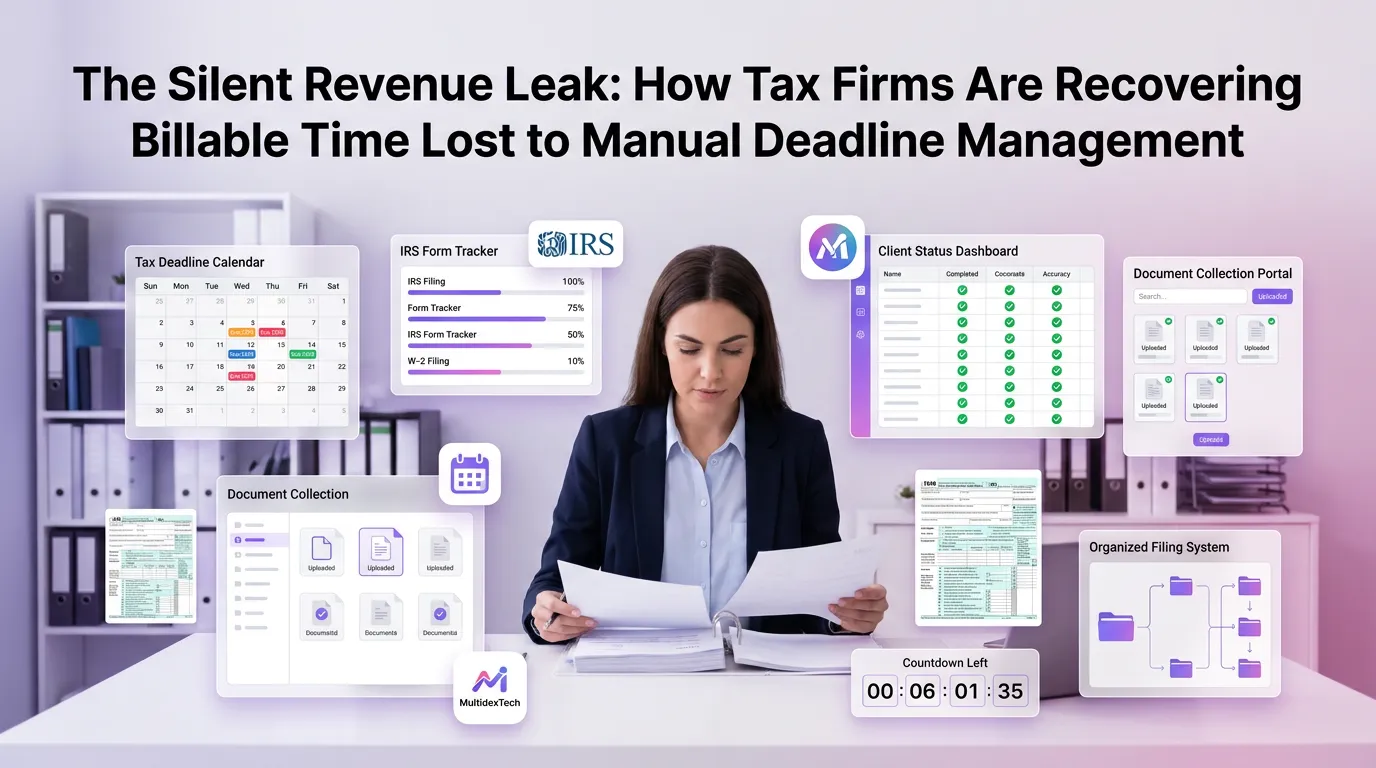
Every tax firm has a version of the same story: a staff member spends forty-five minutes on a Monday morning cross-referencing spreadsheets, email threads, and a wall calendar just to confirm which clients have extensions due that week. Multiply that by five days, fifty weeks, and a team of six professionals, and you are looking at thousands of hours per year that never appear on a single invoice. This is the silent revenue leak — and most firm owners have no idea how deep it runs. Automated deadline tracking for tax firms is no longer a luxury reserved for large regional practices; it is the operational baseline that separates growing firms from stagnant ones.
The Real Cost of Manual Deadline Management
Before a firm can fix a problem, it has to see it clearly. Manual deadline management hides its costs across dozens of micro-inefficiencies that individually feel minor but collectively erode profitability in a significant way.
Time Theft Nobody Talks About
A 2023 survey by the AICPA found that accounting professionals spend an average of 30 to 40 percent of their workday on administrative tasks rather than billable client work. Deadline tracking, follow-up reminders, status updates, and compliance calendar maintenance sit squarely in that administrative bucket.
When a senior CPA with a billing rate of $250 per hour spends two hours each week managing a manual deadline system, that is $500 in unbillable time — every single week. Over a full year, one professional alone represents $26,000 in lost revenue opportunity, and that figure does not account for the downstream cost of errors or missed deadlines.
The Compounding Effect of Human Error
Spreadsheets do not send alerts. Paper calendars do not update themselves when the IRS adjusts a filing deadline. Human memory is not a compliance system.
The IRS penalty framework is unforgiving: failure-to-file penalties begin at 5 percent of unpaid taxes per month, capped at 25 percent. A single missed deadline for a business client can result in thousands of dollars in penalties — and a serious hit to your firm's reputation. Even when no penalty is assessed, the time spent investigating, correcting, and communicating about an oversight is time that will never be recovered.
What Automated Deadline Tracking for Tax Firms Actually Looks Like
The term "automation" gets used loosely in professional services, so it is worth being precise about what a purpose-built deadline management system actually does for a tax firm.
Centralized Compliance Calendars
A modern tax firm automation platform maintains a living compliance calendar that is pre-loaded with federal and state filing deadlines, automatically updated when regulatory changes occur, and linked directly to each client's profile. Staff members are never starting from a blank spreadsheet — they are working from a single source of truth.
This centralization eliminates the version-control nightmare that plagues firms running multiple spreadsheets across departments. When one person updates a deadline, everyone sees it instantly.
Intelligent Alerts and Escalation Workflows
Automated systems do not just track deadlines — they anticipate them. A well-configured platform sends layered alerts: a 30-day warning to the client relationship manager, a 14-day reminder to the assigned preparer, a 7-day flag to the reviewer, and a 48-hour escalation to the firm principal if a task remains incomplete.
This escalation logic removes the social friction of manual follow-up. Staff members no longer have to decide whether to "bother" a colleague about an overdue task — the system handles that conversation automatically, without emotion or hesitation.
Client-Facing Communication Automation
One of the most underappreciated time sinks in a tax firm is client communication around deadlines: reminding clients to submit documents, confirming receipt, and updating them on filing status. Automated deadline tracking systems can trigger personalized, branded emails and text messages to clients at predefined intervals without a single staff member lifting a finger.
This not only saves time but also dramatically improves the client experience. Clients feel informed and cared for, which directly supports retention and referrals.
How Firms Are Quantifying the Recovery
It is one thing to argue that automation saves time. It is another to show how firms are measuring the recovery of that time in real dollars.
Tracking Recovered Hours
Forward-thinking firms are beginning to treat recovered administrative hours as a KPI alongside traditional metrics like realization rate and utilization. When a firm implements automated deadline tracking, it can measure the before-and-after delta in time spent on compliance calendar management.
A mid-sized firm with eight professional staff might recover 15 to 20 hours per week collectively. At a blended billing rate of $175 per hour, that is $2,625 to $3,500 in weekly revenue capacity that previously existed only as wasted potential. Annualized, that is between $136,500 and $182,000 in additional billable capacity — without hiring a single new employee.
Reducing Write-Offs Related to Deadline Errors
Many firms write off time spent correcting errors because billing a client for a firm-side mistake is not defensible. When deadline mismanagement leads to a rush filing, a missed extension, or a client penalty, the write-off often follows. Automated systems reduce these incidents dramatically, which means fewer write-offs and a higher realization rate on the work already being performed.
The Journal of Accountancy has reported consistently that firms investing in workflow automation see measurable improvements in both realization rate and client satisfaction scores within the first year of implementation.
The Integration Advantage: Connecting Deadline Tracking to the Broader Workflow
Standalone deadline trackers have limited value. The real power emerges when deadline management is woven into the broader fabric of a firm's operational workflow.
Linking Deadlines to Task Assignment and Capacity Planning
When a deadline is logged, the system should automatically generate the associated tasks, assign them based on staff capacity and expertise, and surface them in each team member's daily work queue. This connection between deadline and task eliminates the manual translation step that many firms perform — and often perform inconsistently.
Capacity planning becomes more accurate as well. A partner who can see that 14 returns are due in the next 10 days — and that three preparers are already at capacity — can make resourcing decisions proactively rather than reactively.
Document Collection as Part of the Deadline Ecosystem
A deadline for a tax return is meaningless if the client has not yet submitted their source documents. Integrated automation platforms connect document collection workflows to deadline timelines, so that a 90-day-out reminder triggers a document request to the client, a 60-day reminder follows up if documents are incomplete, and the preparer is only assigned the return once the document package is marked complete.
This kind of connected workflow prevents the common scenario where a return sits in a queue for two weeks before anyone realizes the client never sent the W-2s.
Why Tax Firms Resist Automation — And Why That Resistance Is Costly
Despite the clear benefits, many small and mid-sized tax firms continue to rely on manual systems. Understanding the reasons behind this resistance helps explain why the revenue leak persists.
The "We've Always Done It This Way" Trap
Familiarity is a powerful force. A senior partner who has managed deadlines on a yellow legal pad for 25 years has survived — and that survival feels like validation of the method. But survival is not the same as optimization, and what worked for a five-client practice in 1998 is not an adequate system for a fifty-client practice in 2025.
The hidden cost of familiarity is that it prevents firms from asking what is possible. When a team does not know what automated deadline tracking for tax firms can deliver, they cannot make an informed decision about whether to adopt it.
Implementation Fear and the Learning Curve Myth
Many firm owners assume that switching to an automated system requires weeks of downtime, extensive IT involvement, and a painful migration process. Modern cloud-based platforms have largely eliminated these barriers. Onboarding is typically measured in hours, not weeks, and most platforms offer concierge setup support to ensure the transition is smooth.
The learning curve for a purpose-built tax firm platform is significantly shorter than the learning curve for the workarounds firms currently use to compensate for the limitations of manual systems.
Choosing the Right Automated Deadline Tracking Solution
Not all automation platforms are created equal. Tax firms evaluating solutions should apply a specific set of criteria to ensure the platform they choose will actually deliver on its promise.
Key Features to Evaluate
Look for a platform that offers pre-built federal and state compliance calendars with automatic updates, multi-layer alert and escalation workflows, client-facing communication tools, and integration with your existing document management and billing systems. Reporting dashboards that surface deadline status at the firm, team, and client level are also essential for management visibility.
Security and data privacy are non-negotiable. Any platform handling client tax data must comply with relevant data protection standards and offer robust access controls so that staff members only see the client information relevant to their role.
Scalability and Pricing Transparency
A platform that works well for ten clients should also work well for two hundred. Evaluate whether pricing scales reasonably with firm growth, and whether the feature set remains accessible at each tier. To see how TaxFlow structures its plans for firms at every stage, view our pricing plans and find the right fit for your practice.
Frequently Asked Questions
What is automated deadline tracking for tax firms?
Automated deadline tracking for tax firms is a software-driven system that manages federal and state tax filing deadlines, sends multi-tiered alerts to staff and clients, triggers associated workflow tasks, and escalates overdue items — all without requiring manual calendar management. It replaces spreadsheets, wall calendars, and ad hoc reminders with a centralized, real-time compliance engine.
How much time can a tax firm realistically save with deadline automation?
While results vary by firm size and current process maturity, firms typically report recovering 15 to 25 hours per week collectively across their professional staff after implementing a purpose-built automation platform. For a team of six professionals, this can translate to over 1,000 hours of recovered capacity per year — time that can be redirected to billable client work.
Is automated deadline tracking secure enough for sensitive client tax data?
Yes, provided you choose a platform built with enterprise-grade security standards. Look for SOC 2 compliance, end-to-end encryption, role-based access controls, and a clear data retention and privacy policy. Reputable platforms like TaxFlow are designed specifically for the compliance requirements of professional tax practices.
Can automated deadline tracking integrate with the software my firm already uses?
Most modern tax firm automation platforms offer integrations with commonly used practice management, document management, and billing systems. During your evaluation process, confirm that the platform supports your existing tech stack through native integrations or API access. TaxFlow is built to connect with the tools tax professionals already rely on.
How long does it take to implement an automated deadline tracking system?
For cloud-based platforms, initial setup and onboarding can typically be completed in one to three business days. Migrating existing client data, configuring alert workflows, and training staff may add another week of refinement. Most firms are fully operational within two weeks of starting implementation — far faster than the months-long rollouts associated with legacy practice management software.
Ready to stop losing revenue to manual processes? TaxFlow by MultidexTech is purpose-built for tax firms that want to reclaim billable time, reduce compliance risk, and deliver a better client experience — all from a single platform. Start your free trial today and see exactly how much time your firm is leaving on the table. With a 14-day free trial and no credit card required, there is no reason to wait another tax season to find out. You can also explore our blog for more strategies on building a more efficient, profitable practice.