
The Staffing Trap: How Mid-Size Tax Firms Are Doing More Work With Fewer Errors by Automating What Their Team Shouldn't Be Touching
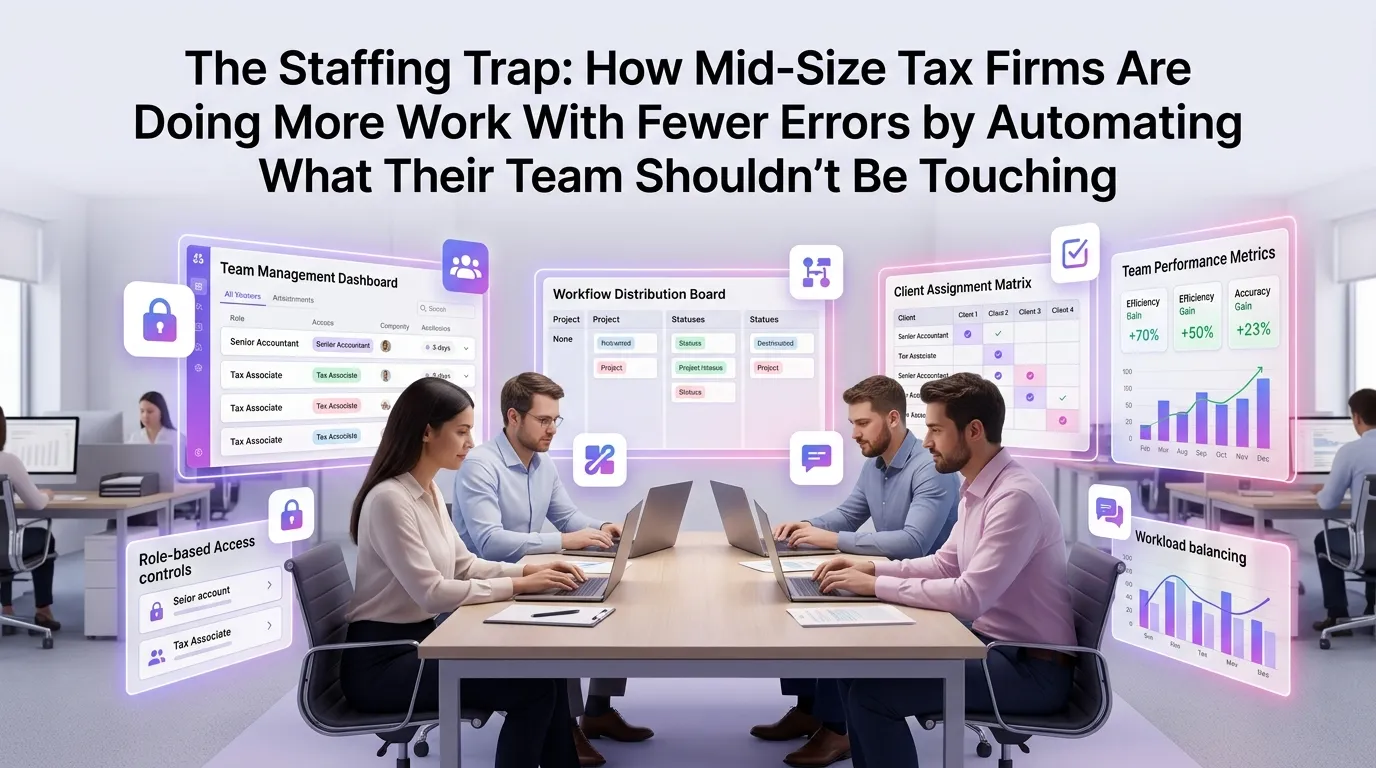
There's a quiet crisis unfolding inside mid-size tax firms across the country. Partners are hiring more staff to manage growing client rosters, yet errors are climbing, deadlines are slipping, and team morale is eroding under the weight of repetitive, manual tasks. The culprit isn't a lack of talent — it's a lack of the right systems. Tax firm workflow automation is rapidly becoming the defining competitive advantage separating firms that scale profitably from those that simply survive each filing season.
The Hidden Cost of Manual Workflows in Tax Firms
When you think about the tasks your team performs every day — chasing client documents, manually entering data, sending status update emails, cross-referencing prior-year returns — none of these activities require a CPA's expertise. Yet CPAs and senior staff are spending hours each week doing exactly that.
According to the AICPA's CPA Firm Technology Survey, firms that rely heavily on manual processes report significantly higher rates of staff burnout and client dissatisfaction compared to those that have adopted modern automation tools. The correlation is hard to ignore.
The real hidden cost isn't just time — it's compounding error risk. Every manual handoff is an opportunity for something to fall through the cracks. A missed document request, a miscommunicated deadline, a data entry typo: each one is a liability your firm carries unnecessarily.
What Manual Processes Are Quietly Draining Your Firm
Most firm leaders know their workflows are inefficient, but few have mapped out exactly where the bleeding occurs. Common culprits include manual client onboarding, paper-based document collection, status updates handled through individual emails, and spreadsheet-based project tracking.
These processes feel manageable when a firm has 50 clients. At 200 clients, they become a logistical nightmare. At 500 clients, they become the primary reason talented staff members leave for more organized environments.
Why Throwing More Staff at the Problem Doesn't Work
The instinctive response to workflow overload is to hire. And while growing your team is often necessary, adding headcount to broken processes doesn't fix those processes — it just gives you more people executing them incorrectly.
Consider the onboarding curve. A new staff accountant typically requires three to six months before they're operating at full productivity. During tax season, that ramp-up period is a liability, not an asset. You're paying a salary for someone who's still learning your firm's idiosyncratic, undocumented processes.
The Journal of Accountancy has reported extensively on the talent shortage facing the accounting profession. Firms competing for the same shrinking pool of qualified candidates cannot afford to make their workplace less attractive by burying skilled professionals in administrative busywork.
The Automation Alternative: Working Smarter, Not Just Harder
Automation doesn't replace your team — it removes the tasks your team should never have been doing in the first place. When routine workflows are handled by software, your CPAs can focus on high-value advisory work, complex tax strategy, and the relationship-building that actually drives client retention.
This is the premise behind TaxFlow, MultidexTech's tax firm automation platform built specifically for mid-size practices. Rather than forcing generic project management tools into a tax workflow context, TaxFlow is designed around how tax firms actually operate — from engagement letters to final delivery.
Tax Firm Workflow Automation: What It Actually Looks Like in Practice
Automation can feel abstract until you see it applied to specific, familiar pain points. Let's walk through what a modernized, automated workflow actually looks like for a mid-size tax firm handling individual and business returns.
Automated Client Onboarding and Document Collection
Instead of manually sending engagement letters, following up on missing signatures, and emailing document checklists, an automated system handles all of this on a predefined schedule. The client receives a branded portal invitation, completes their information, uploads their documents, and signs their engagement letter — without a single staff member touching the process.
When a document is missing or a signature hasn't been obtained by a certain date, the system sends automatic reminders. Staff are only notified when action is actually required from them — not to chase something that software can chase just as effectively.
Automated Workflow Routing and Task Assignment
Once documents are received, automated workflows can trigger task assignments based on return type, client tier, or responsible preparer. A business return with a K-1 attachment automatically routes to the appropriate senior preparer. A simple W-2 return routes to a junior staff member. No manager needs to manually review the queue and delegate — the system does it.
This kind of intelligent routing reduces bottlenecks, prevents tasks from sitting unassigned in an inbox, and gives managers real-time visibility into where every return stands in the pipeline.
Deadline Tracking and Compliance Alerts
Tax deadlines are non-negotiable, yet many firms still track them using spreadsheets or calendar entries that depend entirely on individual staff members to maintain. This is a structural risk.
The IRS maintains strict filing deadlines with real penalties for non-compliance. An automated compliance calendar that integrates with your workflow system ensures that every return has its deadline tracked at the system level — not in someone's personal calendar that disappears when they leave the firm.
Automated Client Communication and Status Updates
One of the most time-consuming tasks in any tax firm is answering the question: "Where is my return?" Clients want status updates, and staff spend hours each week responding to emails and phone calls that could be eliminated entirely with automated status notifications.
When a return moves from "in preparation" to "in review" to "ready for delivery," the client can receive an automatic notification. No staff member needs to compose that email. The client feels informed and cared for, and your team gets that time back.
The Error Reduction Case for Automation
Beyond efficiency, there's a compelling accuracy argument for automation. Human beings make mistakes — especially when performing repetitive tasks under deadline pressure. Automated systems, by contrast, execute consistently every time.
Consider data entry. When client information is manually re-keyed from a source document into your tax software, every keystroke is an error opportunity. When clients enter their own data into a structured portal that exports directly to your workflow system, that error vector is eliminated entirely.
Similarly, when checklists are automated rather than manually applied, nothing gets skipped because a staff member was rushing or distracted. Every return goes through the same quality gates, every time, without exception.
Building a Culture of Quality Through Process, Not Heroics
High-quality output should be the result of well-designed processes, not individual heroics. When your firm's accuracy depends on specific people being especially careful on any given day, you have a fragile system. When accuracy is built into automated workflows with mandatory checkpoints, you have a resilient one.
This shift also changes how you hire and onboard. New staff members stepping into an automated workflow environment can be productive faster because the process guides them — they don't have to reconstruct institutional knowledge from memory or informal conversations.
What Mid-Size Firms Are Getting Wrong About Automation Readiness
Many firm leaders believe they're not ready for automation — that their processes need to be "cleaned up" first, or that their team isn't tech-savvy enough, or that implementation will be too disruptive during busy season. These are understandable concerns, but they're also the reasons firms stay stuck.
The truth is that implementing a workflow automation platform often forces the process clarification that firms have been putting off for years. The act of configuring your workflows in a system requires you to define them explicitly — which is exactly the documentation exercise most firms need anyway.
Modern platforms like TaxFlow are also designed for accounting professionals, not software engineers. The learning curve is measured in days, not months. And with proper implementation support, the transition during a slower season can position a firm to have a dramatically more organized tax season the following year.
Calculating the ROI of Tax Firm Workflow Automation
Automation investments need to make financial sense, and they do — often dramatically so. Start with a simple calculation: how many hours per week does your team spend on tasks that could be automated? Multiply that by your average billing rate or fully-loaded staff cost.
For a firm with ten staff members each spending five hours per week on automatable tasks, at a conservative $75/hour fully-loaded cost, that's $3,750 per week — or roughly $195,000 per year — spent on work that software could handle. Even a 50% reduction in that figure justifies a significant technology investment.
Beyond direct time savings, consider the capacity gains. When your current team can handle more returns without proportional headcount increases, your firm's revenue ceiling rises without a corresponding rise in fixed costs. That's leverage — and it's what separates firms that scale profitably from those that grind.
Ready to see what this looks like for your firm? Start your free trial and experience TaxFlow's automation capabilities firsthand, with no commitment required.
Frequently Asked Questions
What is tax firm workflow automation and how does it work?
Tax firm workflow automation refers to the use of software to handle repetitive, rule-based tasks in a tax practice — such as client onboarding, document collection, task routing, deadline tracking, and status communications. The software executes these tasks based on predefined rules and triggers, freeing staff to focus on higher-value work.
Will automation replace my staff?
No. Automation removes administrative and repetitive tasks from your team's plate — it doesn't replace the expertise, judgment, and client relationships that your people provide. In practice, automation enables your existing staff to serve more clients, reduce errors, and focus on the advisory work that builds long-term client value.
How long does it take to implement a tax workflow automation platform?
Implementation timelines vary depending on firm size and complexity, but most mid-size firms can be fully operational on a platform like TaxFlow within two to four weeks. Implementing during an off-peak period — such as late summer or early fall — allows time to refine workflows before the busy season begins.
Is tax firm workflow automation secure for handling sensitive client data?
Reputable tax automation platforms are built with security as a foundational requirement, including data encryption, role-based access controls, audit trails, and compliance with applicable data protection standards. Always verify that any platform you evaluate meets IRS data security guidelines and your firm's specific compliance requirements.
How do I know if my firm is ready for workflow automation?
If your team is spending significant time on tasks like chasing client documents, manually tracking deadlines, or answering "where's my return?" questions, your firm is ready. You don't need perfect processes before you start — the process of implementing automation often surfaces and resolves the process gaps that have been slowing you down.
Ready to Stop the Staffing Trap? TaxFlow Can Help.
The firms winning the next decade of tax practice aren't necessarily the ones with the most staff — they're the ones with the smartest systems. Tax firm workflow automation isn't a future consideration; it's a present competitive necessity.
MultidexTech's TaxFlow platform is built specifically for mid-size tax firms that are serious about scaling without sacrificing quality. With a 14-day free trial, you can explore every feature, configure your workflows, and see exactly how automation will transform your firm's operations — before spending a dollar.
Start your free trial today and give your team back the hours they deserve. Or view our pricing plans to find the right fit for your firm's size and needs. You can also explore our blog for more strategies on building a more efficient, profitable practice.