The CPA Firm Compliance Stack: How Certified Public Accountants Are Using Automation to Meet Licensing, Reporting, and Client Obligations Without the Manual Overhead
Running a CPA firm in today's regulatory environment means managing an ever-expanding web of licensing requirements, client reporting deadlines, IRS compliance obligations, and internal workflow demands — often with a lean team and limited hours. The pressure is relentless. Firms that rely on spreadsheets, manual reminders, and disconnected tools are not just inefficient; they're exposed to costly errors, missed deadlines, and client dissatisfaction. That's why forward-thinking CPA practices are turning to CPA firm automation software to build a compliance stack that handles the overhead so their professionals can focus on higher-value advisory work.
What Is a CPA Firm Compliance Stack?
A compliance stack is the collection of tools, processes, and systems a CPA firm uses to meet its regulatory, licensing, and client reporting obligations. Think of it as the operational backbone of your practice — the infrastructure that keeps everything running on time and within the rules.
Traditionally, this stack was built on manual effort: calendar reminders, email chains, physical checklists, and tribal knowledge held by a handful of senior staff. That model doesn't scale. As firms grow and regulations multiply, the manual approach becomes a liability rather than a strategy.
A modern compliance stack replaces manual processes with automated workflows, intelligent document management, real-time deadline tracking, and integrated client communication tools — all working together to reduce risk and increase throughput.
The Core Compliance Obligations Facing CPA Firms Today
Before exploring how automation addresses these challenges, it helps to understand exactly what CPAs are up against. The compliance burden spans multiple dimensions simultaneously.
Licensing and Continuing Professional Education (CPE)
Every licensed CPA must meet state-specific CPE requirements to maintain their credentials. Requirements vary significantly by state — some require 40 hours annually, others use a biennial cycle with specific ethics components. Tracking these requirements across a team of licensed professionals is a significant administrative task.
The AICPA's state licensing resource center makes it clear that non-compliance with CPE requirements can result in license suspension — a career-altering consequence that no firm can afford. Automation tools can monitor each team member's CPE status, send proactive alerts, and generate compliance reports on demand.
Federal and State Tax Filing Deadlines
CPA firms are responsible for managing hundreds — sometimes thousands — of individual and business tax return deadlines simultaneously. Missing a filing deadline for a client can trigger penalties under IRC Section 6651, damage the client relationship, and expose the firm to professional liability claims.
The IRS publishes a comprehensive tax calendar outlining federal due dates, but state deadlines add another layer of complexity. Automation software can map every client to their applicable deadlines, assign responsible team members, and escalate tasks that are approaching critical thresholds.
Client Reporting and Engagement Management
Beyond tax filings, CPA firms often manage monthly bookkeeping reports, quarterly financial statements, audit deliverables, and advisory engagements — each with its own timeline and documentation requirements. Keeping clients informed while maintaining internal quality control requires structured, repeatable processes.
Manual management of these engagements leads to inconsistent client experiences and internal bottlenecks. Automated workflow systems ensure that every engagement follows a defined process from intake to delivery, with built-in review checkpoints and client communication triggers.
How CPA Firm Automation Software Transforms the Compliance Stack
The right CPA firm automation software doesn't just digitize manual processes — it fundamentally redesigns how compliance work gets done. Here's how modern platforms are reshaping each layer of the compliance stack.
Intelligent Deadline Management and Task Automation
Automated deadline engines ingest client data — entity type, tax jurisdiction, fiscal year end, and filing history — and generate a dynamic, prioritized task list for every engagement. Tasks are assigned automatically based on team capacity and expertise, with escalation rules that kick in when deadlines are approaching and work hasn't been started.
This eliminates the "someone dropped the ball" scenario that plagues manual systems. Every deadline is owned, tracked, and visible to firm leadership in real time. Status dashboards replace the weekly status meeting as the primary source of truth for where every engagement stands.
Document Management and E-Signature Integration
Compliance work is document-intensive. Tax returns, engagement letters, financial statements, authorization forms, and client correspondence all need to be organized, versioned, and securely stored. Automation platforms provide centralized document repositories with role-based access controls, ensuring that the right people can access the right documents at the right time.
Integrated e-signature capabilities accelerate client approvals without requiring physical meetings or postal mail. Engagement letters can be sent, signed, and filed in minutes rather than days — removing a common bottleneck at the start of every engagement.
Automated Client Communication and Portal Access
Client communication is one of the most time-consuming aspects of running a CPA firm. Chasing clients for missing documents, sending status updates, and responding to "where's my return?" inquiries consumes hours of staff time every week. Automation changes this equation entirely.
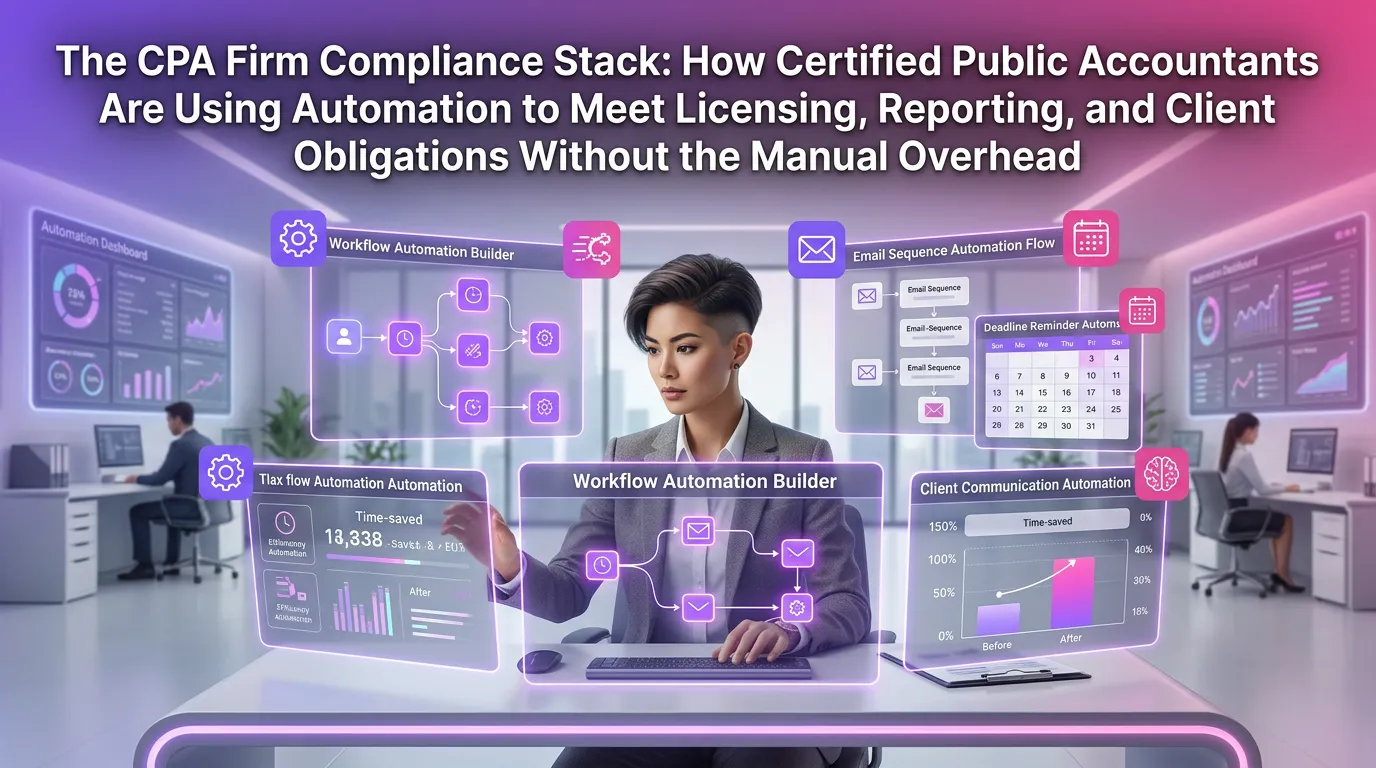
Client portals give clients self-service access to their documents, engagement status, and upcoming deadlines. Automated email sequences can request missing information, confirm document receipt, and notify clients when their returns are ready — all without a staff member lifting a finger. The result is a more professional client experience with significantly less administrative overhead.
CPE and License Tracking for Your Team
Keeping your licensed professionals compliant is as important as keeping your clients compliant. Automation platforms can maintain a real-time dashboard of each team member's CPE hours, license renewal dates, and state-specific requirements. Alerts can be configured to notify both the individual and their manager when hours are falling behind schedule.
This proactive approach eliminates the last-minute scramble that happens when a license renewal deadline suddenly appears on the calendar. It also gives firm administrators the documentation they need for peer reviews and quality control assessments.
Building Your Firm's Automation-First Compliance Strategy
Implementing CPA firm automation software isn't just a technology decision — it's a practice management strategy. Firms that get the most value from automation approach it deliberately, with a clear understanding of where their current processes are breaking down.
Start With a Compliance Audit
Before selecting or configuring any automation platform, map your current compliance obligations across three dimensions: regulatory (licensing, CPE, professional standards), client-facing (filing deadlines, reporting deliverables, engagement timelines), and internal (quality control, peer review, documentation standards).
Identifying where manual processes currently fail — missed deadlines, inconsistent client communication, lost documents — gives you a prioritized list of automation targets. Not everything needs to be automated at once; starting with your highest-risk, highest-volume pain points delivers the fastest return on investment.
Choose a Platform Built for Tax Professionals
Generic project management tools can handle some workflow automation, but they lack the tax-specific features that make a real difference for CPA firms. Purpose-built platforms like TaxFlow — MultidexTech's tax firm automation platform — are designed with the specific workflows, deadlines, and compliance requirements of accounting firms in mind.
Look for platforms that offer pre-built tax deadline libraries, integration with major tax preparation software, client portal functionality, and robust reporting capabilities. The goal is a system that speaks the language of your practice, not one that requires extensive customization to become useful.
Train Your Team and Establish Adoption Standards
Technology only delivers value when it's actually used. Successful automation implementations include structured onboarding for all team members, clear documentation of how each workflow operates, and firm-wide standards for when and how the platform is used.
According to the Journal of Accountancy's technology trends research, firms that invest in formal technology training see significantly higher adoption rates and faster ROI from their automation investments. Don't treat training as an afterthought — it's as important as the platform itself.
The ROI of Automating Your Compliance Stack
The business case for CPA firm automation software is compelling when you quantify the costs of manual compliance management. Consider a mid-sized firm with 10 staff members spending an average of 5 hours per week on administrative compliance tasks — deadline tracking, document chasing, status updates, CPE monitoring. That's 50 staff hours per week, or roughly 2,500 hours annually, consumed by work that generates no direct revenue.
At an average billing rate of $150 per hour, that represents $375,000 in annual opportunity cost — time that could be spent on billable advisory work, business development, or simply delivering better service to existing clients. Automation platforms that recapture even 60% of that time generate a return that dwarfs their subscription cost many times over.
Beyond the direct time savings, consider the risk reduction value. A single missed deadline can result in client penalties, professional liability claims, and reputational damage that far exceeds the cost of any automation platform. The insurance value of a robust, automated compliance stack is difficult to quantify but impossible to ignore.
To explore how TaxFlow's capabilities align with your firm's needs and budget, view our pricing plans and find the tier that fits your practice size and workflow requirements.
What to Look for in CPA Firm Automation Software
Not all automation platforms are created equal. When evaluating solutions for your firm's compliance stack, prioritize the following capabilities:
- Tax deadline library: Pre-loaded with federal and state filing deadlines, updated automatically as regulations change.
- Client portal: Secure, branded access for clients to upload documents, review status, and sign forms electronically.
- Workflow automation: Configurable task sequences that trigger automatically based on engagement type, deadline proximity, or client action.
- Team management: Capacity tracking, task assignment, and CPE/license monitoring for all licensed staff.
- Reporting and analytics: Real-time dashboards showing engagement status, team workload, and compliance metrics across the firm.
- Integration capabilities: Connections to tax preparation software, accounting platforms, and document storage systems your firm already uses.
Platforms that combine these capabilities in a unified interface eliminate the context-switching and data silos that make manual compliance management so burdensome. For a deeper dive into related topics, explore our blog for guides on workflow optimization, client communication best practices, and more.
Frequently Asked Questions About CPA Firm Automation Software
What is CPA firm automation software?
CPA firm automation software is a category of practice management technology designed specifically for accounting firms. It automates repetitive compliance tasks such as deadline tracking, client document collection, engagement workflow management, team CPE monitoring, and client communication — reducing manual overhead and minimizing the risk of errors or missed obligations.
How does automation help with CPE and licensing compliance?
Automation platforms maintain a real-time record of each licensed team member's CPE hours, state-specific requirements, and license renewal dates. The system sends proactive alerts when hours are falling behind or renewal deadlines are approaching, ensuring your firm never faces a licensing compliance gap. Administrators can generate compliance reports instantly for peer reviews or quality control assessments.
Can automation software integrate with the tax preparation tools we already use?
Most purpose-built CPA firm automation platforms offer integration capabilities with major tax preparation software, accounting platforms, and document storage systems. When evaluating a platform, confirm which integrations are available natively and whether API access is provided for custom connections. TaxFlow is designed with integration flexibility in mind to fit into existing firm technology stacks.
Is CPA firm automation software suitable for small or solo practices?
Absolutely. While large firms benefit from automation at scale, small and solo practices often see the most dramatic impact because every hour saved represents a significant portion of their total capacity. Automation eliminates the administrative burden that keeps solo practitioners from focusing on client work and business growth. Many platforms offer tiered pricing specifically designed for smaller practices.
How long does it take to implement a CPA firm automation platform?
Implementation timelines vary depending on firm size and the complexity of your existing workflows. Many firms are operational within a few days to two weeks, particularly with platforms that offer onboarding support and pre-configured templates for common tax firm workflows. Starting with a free trial period — as TaxFlow offers — allows your team to evaluate the platform and begin building workflows before committing to a subscription.
Ready to build a compliance stack that works for your firm instead of against it? MultidexTech's TaxFlow platform gives CPA firms the automation infrastructure they need to manage licensing, reporting, and client obligations without the manual overhead. Start your free trial today and experience 14 days of full platform access — no credit card required. See firsthand how the right automation tools can transform your firm's compliance operations and free your team to do the work that actually grows your practice.