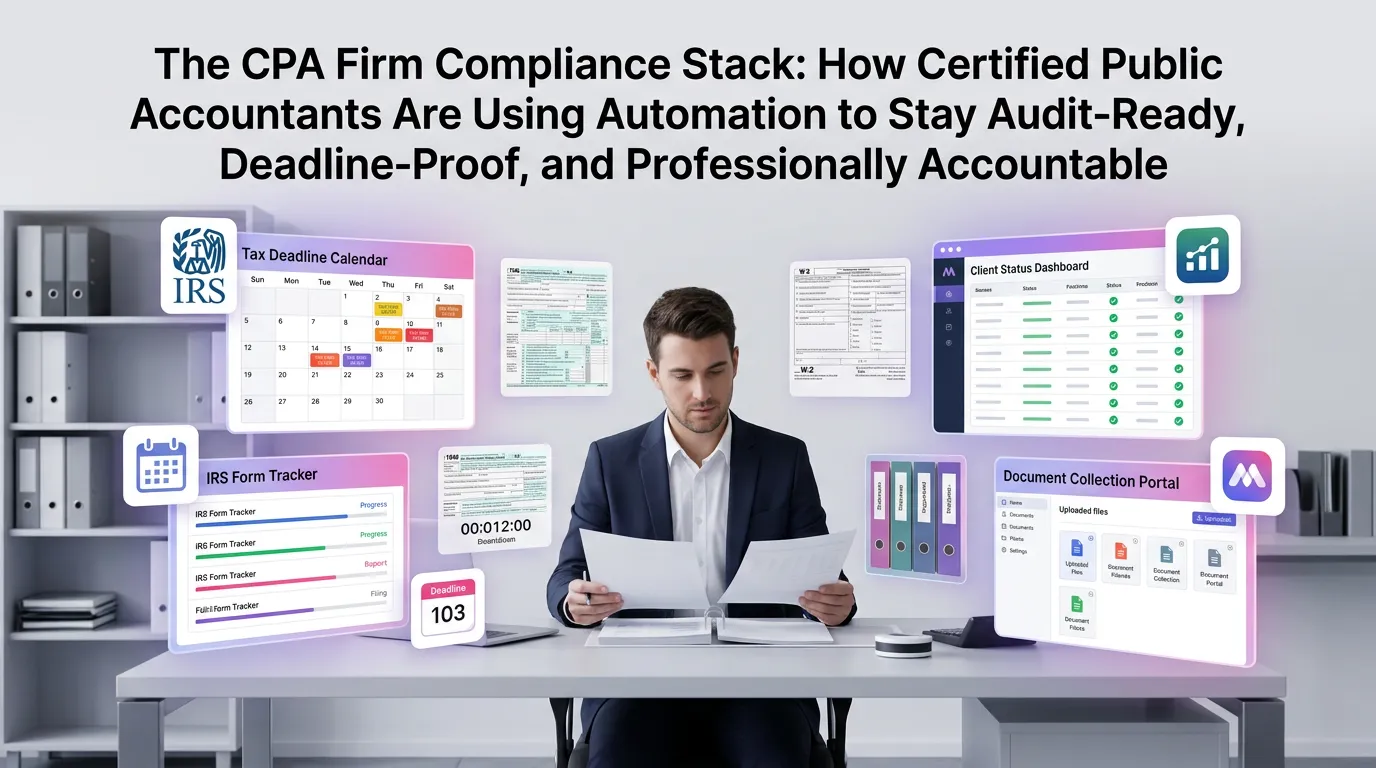
The CPA Firm Compliance Stack: How Certified Public Accountants Are Using Automation to Stay Audit-Ready, Deadline-Proof, and Professionally Accountable
The modern CPA firm operates under relentless pressure. Between evolving IRS regulations, tightening deadlines, and growing client rosters, staying compliant isn't just a best practice — it's a survival requirement. Increasingly, forward-thinking accounting professionals are turning to CPA firm automation software to build what industry leaders are calling a "compliance stack": a layered, integrated system of tools designed to keep firms audit-ready, deadline-proof, and professionally accountable at every turn.
What Is a CPA Firm Compliance Stack?
A compliance stack is the combination of software, workflows, and processes a CPA firm uses to manage its regulatory obligations, internal quality controls, and client deliverables. Think of it as the operational backbone of a modern accounting practice.
Unlike legacy systems that treat compliance as a checklist, a true compliance stack is dynamic. It adapts to changing tax codes, tracks deadlines in real time, and creates a documented audit trail that protects both the firm and its clients.
Building this stack used to require a patchwork of disconnected tools. Today, purpose-built platforms like tax firm automation platform TaxFlow are consolidating these capabilities into a single, cohesive environment.
Why Manual Compliance Processes Are a Liability
Many CPA firms still rely heavily on spreadsheets, shared drives, and email threads to manage compliance workflows. This approach worked when firms were smaller and regulations were simpler — but those days are gone.
According to the American Institute of CPAs (AICPA), human error remains one of the leading causes of professional liability claims against accounting firms. Manual data entry, missed deadline notifications, and inconsistent file documentation are all contributing factors.
The financial and reputational stakes are significant. A single missed filing deadline can trigger IRS penalties, damage client relationships, and expose the firm to malpractice claims. Automation eliminates the single points of failure that make manual processes so risky.
The Hidden Costs of Compliance Gaps
Beyond penalty exposure, compliance gaps carry hidden operational costs. When a partner spends hours reconstructing a client's filing history because documentation was incomplete, that's billable time lost. When an associate misses an extension deadline because no one set a system reminder, the firm absorbs the cost.
These inefficiencies compound over time. Firms that don't address them often find themselves in a reactive posture — always putting out fires rather than growing strategically.
How CPA Firm Automation Software Builds a Stronger Compliance Foundation
The right CPA firm automation software doesn't just speed up existing processes — it fundamentally redesigns how compliance work gets done. Here's how automation strengthens each layer of the compliance stack.
Automated Deadline Tracking and Alerts
One of the most immediate benefits of automation is intelligent deadline management. Rather than relying on calendar reminders or manual tickler systems, automated platforms maintain a live dashboard of every client's upcoming obligations — from quarterly estimates to annual returns and amended filings.
The IRS publishes a detailed tax calendar for businesses and self-employed individuals that changes annually. Automation tools that sync with these schedules ensure no deadline slips through the cracks, regardless of how complex a client's filing profile may be.
Proactive alerts can be configured for partners, managers, and preparers simultaneously — creating multiple layers of accountability without requiring anyone to manually check a spreadsheet.
Document Management and Audit Trail Creation
Audit readiness isn't something you achieve the week before a review. It's built through consistent, disciplined documentation practices throughout the year. Automation platforms enforce these practices by design.
When every client interaction, document upload, review note, and approval is logged automatically, the firm always has a complete, timestamped record. This is invaluable not only during external audits but also during internal quality reviews and peer inspections required for AICPA membership.
Structured document workflows also reduce the risk of version control errors — a common problem when multiple team members work on the same return using shared drives.
Workflow Standardization Across the Firm
One of the most underrated benefits of automation is the ability to standardize workflows across every preparer, reviewer, and partner in the firm. When everyone follows the same process — triggered by the same system rules — quality becomes consistent rather than dependent on individual habits.
Standardized workflows are particularly important for firms that are growing, onboarding new staff, or operating across multiple locations. Automation ensures that a return prepared by a first-year associate in one office follows the same quality gates as one prepared by a senior manager in another.
Staying Audit-Ready Year-Round
The concept of "audit season" is increasingly outdated. With the IRS expanding its audit capabilities and state tax authorities becoming more sophisticated, CPA firms need to maintain audit readiness as a continuous operational state — not a periodic scramble.
Real-Time Compliance Monitoring
Modern automation platforms provide real-time visibility into a firm's compliance posture. Dashboards can surface clients with outstanding document requests, returns approaching review deadlines, or engagement letters that haven't been signed.
This level of visibility allows managing partners to identify and address compliance risks before they become problems. It transforms compliance from a reactive function into a proactive management discipline.
Client Portal Integration
A significant portion of compliance risk originates on the client side — missing documents, unsigned authorizations, and delayed responses. Integrated client portals, built into automation platforms, create a structured channel for client communication that's both efficient and documented.
When clients upload documents directly through a secure portal, those files are automatically associated with the correct engagement, time-stamped, and routed to the appropriate team member. This eliminates the email-attachment chaos that plagues many firms and creates a clean paper trail for every client interaction.
Professional Accountability in a Regulated Environment
CPAs operate under strict professional standards. The AICPA's Code of Professional Conduct, state board regulations, and Circular 230 requirements all demand that practitioners maintain rigorous standards of competence, diligence, and integrity. Automation supports professional accountability in several concrete ways.
Role-Based Access and Approval Workflows
Not every team member should have access to every client file or the ability to approve every deliverable. Role-based access controls, built into automation platforms, ensure that the right people are reviewing and approving work at the right stages.
Multi-step approval workflows create a documented chain of accountability. When a return is reviewed and signed off by a licensed CPA before it leaves the firm, that approval is logged permanently — protecting both the client and the firm in the event of a dispute.
E-Signature and Authorization Tracking
Engagement letters, Form 8879 e-file authorizations, and representation agreements all require client signatures. Tracking these manually is error-prone and time-consuming. Automation platforms integrate e-signature workflows that send, track, and log every authorization automatically.
According to the Journal of Accountancy, firms that implement structured engagement letter processes significantly reduce their professional liability exposure. Automation makes this best practice frictionless to execute at scale.
Performance Metrics and Quality Reporting
Accountability isn't just about preventing errors — it's about continuously improving firm performance. Automation platforms generate data on turnaround times, error rates, client response delays, and preparer productivity. This data enables managing partners to have evidence-based conversations about quality and capacity.
Firms that leverage performance metrics are better positioned to identify training needs, redistribute workloads, and make strategic decisions about staffing and service offerings.
Choosing the Right CPA Firm Automation Software for Your Practice
Not all automation platforms are created equal. When evaluating options, CPA firms should prioritize platforms built specifically for the accounting profession — not generic project management tools adapted for tax work.
Key Features to Look For
The most effective compliance stacks are built on platforms that offer deadline management, document workflow automation, client portals, e-signature integration, role-based access controls, and robust reporting — all within a single system. Fragmented tool stacks create their own integration risks and data silos.
Scalability matters too. A platform that works for a three-person firm should also be able to support a 30-person firm without requiring a complete technology overhaul. Look for pricing models and feature sets that grow with your practice.
To explore how TaxFlow's features align with these requirements, explore our blog for in-depth guides on specific use cases and workflow configurations.
Implementation and Onboarding Considerations
The best software fails if it isn't adopted by the team. When evaluating platforms, assess the quality of onboarding support, training resources, and ongoing customer success programs. A firm that implements automation half-heartedly will see half the results.
Start with a pilot — a subset of clients or a single service line — before rolling out firm-wide. This allows the team to build confidence with the platform and surface any workflow adjustments needed before full deployment.
The Competitive Advantage of a Well-Built Compliance Stack
Firms that invest in building a strong compliance stack don't just reduce risk — they create a competitive advantage. When a firm can demonstrate to prospective clients that it operates with structured, documented, technology-supported processes, it signals professionalism and reliability that manual-process firms simply can't match.
Compliance automation also frees up senior staff to focus on higher-value advisory work. When partners aren't chasing missing documents or manually tracking deadlines, they have more bandwidth for tax planning, business consulting, and client relationship development.
To see how view our pricing plans can fit your firm's budget and scale, TaxFlow offers transparent options designed for practices of every size.
Frequently Asked Questions
What is CPA firm automation software?
CPA firm automation software is a category of technology platform designed to streamline and systematize the compliance, workflow, and document management functions of an accounting practice. These tools automate tasks like deadline tracking, client communications, document routing, approval workflows, and reporting — reducing manual effort and human error.
How does automation help CPA firms stay audit-ready?
Automation creates a continuous, documented record of every client engagement, filing, approval, and communication. This means firms always have a complete, timestamped audit trail available — without requiring a last-minute scramble to reconstruct records. Real-time compliance dashboards also allow firms to identify and address gaps before they become audit risks.
Is CPA firm automation software suitable for small practices?
Absolutely. In fact, small and mid-sized CPA firms often benefit most from automation because they have fewer administrative resources to manage compliance manually. Modern platforms like TaxFlow are designed to scale from solo practitioners to multi-partner firms, with pricing models that reflect the size and needs of the practice.
How long does it take to implement a compliance automation platform?
Implementation timelines vary depending on firm size and the complexity of existing workflows. Many firms can get a core compliance stack operational within two to four weeks. Starting with a free trial period — like the 14-day trial offered by TaxFlow — allows firms to test the platform with real workflows before committing to a subscription.
What professional standards should CPA firm automation software support?
Look for platforms that support AICPA quality management standards, IRS Circular 230 requirements, state board documentation standards, and data security protocols compliant with applicable privacy regulations. The platform should make it easier — not harder — to meet these obligations through built-in workflow controls and documentation practices.
Ready to Build Your Firm's Compliance Stack?
The firms that thrive in today's regulatory environment aren't the ones working harder — they're the ones working smarter. A well-built compliance stack, powered by the right automation platform, transforms compliance from a constant source of stress into a strategic strength.
TaxFlow by MultidexTech is purpose-built for CPA firms that are serious about staying audit-ready, deadline-proof, and professionally accountable. With features designed around real accounting workflows and a team that understands the unique demands of the profession, TaxFlow gives your firm the infrastructure to grow with confidence.
Try it for yourself — start your free trial today and experience 14 days of full platform access, no credit card required. See firsthand how MultidexTech's TaxFlow can become the foundation of your firm's compliance stack.