
The Bookkeeping Firm Growth Trap: How to Serve More Monthly Clients Without Drowning in Recurring Workflows
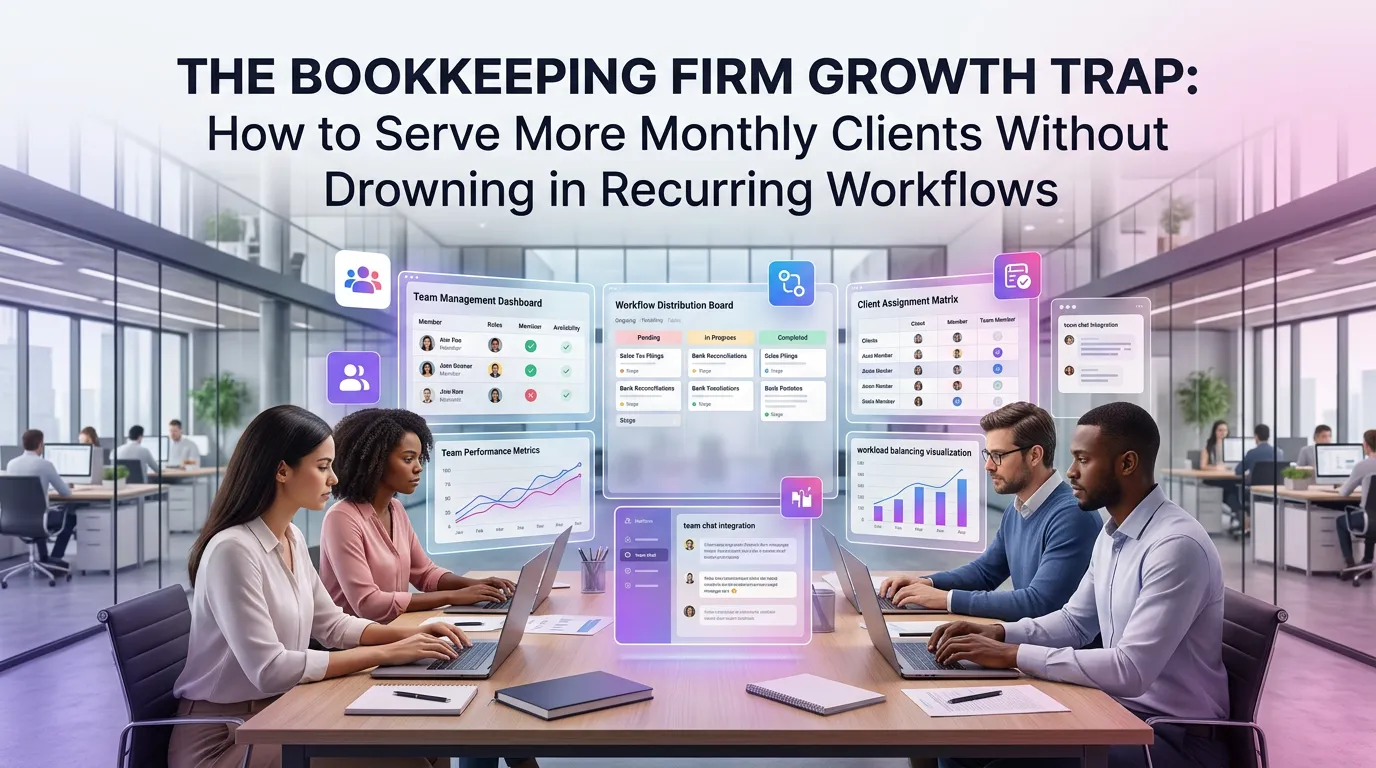
Growing a bookkeeping firm sounds like a straightforward equation: land more monthly clients, generate more recurring revenue, and scale your team accordingly. But anyone who has managed a firm beyond a handful of retainer clients knows the reality is far messier. Recurring workflows — monthly reconciliations, payroll processing, financial reporting, client follow-ups — compound in complexity faster than revenue does. The result is a growth trap where every new client added feels less like progress and more like weight. The solution isn't hiring more staff. It's smarter bookkeeping firm automation.
Why Recurring Monthly Work Is the Hidden Bottleneck in Bookkeeping Firms
Unlike tax season, which is a predictable annual sprint, bookkeeping operates on an unrelenting monthly cadence. Every client on your roster requires the same cycle of tasks — month after month, without exception. This consistency is what makes bookkeeping revenue so attractive, but it's also what makes scaling so deceptively difficult.
The challenge compounds when you realize that most firms still rely on manual task management: spreadsheets to track client deliverables, email threads to chase documents, and mental checklists to ensure nothing slips through. As client count grows from 20 to 50 to 100, these informal systems begin to buckle under their own weight.
According to the AICPA, one of the top operational challenges for accounting and bookkeeping firms is capacity management — specifically, the inability to take on new work without proportionally increasing headcount. This is the bottleneck that automation is uniquely positioned to solve.
The Real Cost of Manual Recurring Workflows
Consider a firm managing 60 monthly bookkeeping clients. Each client requires a task checklist, document request, reconciliation review, and report delivery. Even at 30 minutes of administrative coordination per client per month, that's 30 hours of overhead — before any actual bookkeeping work begins.
That overhead doesn't generate revenue. It doesn't deepen client relationships. It simply keeps the operation from falling apart. And it scales linearly, meaning every new client you add brings an equivalent block of administrative burden with it.
This is where the growth trap closes around firms that don't adapt. They're not failing because they lack clients — they're failing because their infrastructure wasn't built to handle the operational weight of recurring, high-volume service delivery.
What Bookkeeping Firm Automation Actually Looks Like in Practice
Automation in the context of bookkeeping isn't about replacing your accountants with software. It's about eliminating the repetitive coordination work that consumes their time and prevents the firm from scaling. Think of it as building a system that handles the logistics so your team can focus on the work that actually requires expertise.
Effective bookkeeping firm automation typically operates across four core areas: workflow triggering, task assignment, client communication, and progress tracking. When these four areas are automated and connected, a firm's operational capacity can multiply without a corresponding increase in headcount.
Automated Workflow Triggering
Every recurring engagement should start automatically. Rather than a staff member manually creating a new task list at the beginning of each month, an automated system should detect the calendar trigger and instantiate the correct workflow for each client. This means the first of the month becomes a non-event operationally — work simply begins.
Workflow templates can be configured by client type, service tier, or engagement scope. A client on a full-service monthly plan gets a different workflow than one on a basic reconciliation package. The system handles the differentiation automatically, reducing setup time to near zero.
Intelligent Task Assignment and Routing
Once workflows are triggered, tasks need to reach the right person at the right time. Automated assignment rules can route tasks based on staff capacity, specialization, or client relationship ownership. This eliminates the manager overhead of manually distributing work across the team each month.
Deadlines and dependencies can also be built into the workflow. A reconciliation task won't appear in a staff member's queue until the client has submitted their bank statements — a dependency that the system tracks and enforces without human intervention.
Client-Facing Document Requests and Follow-Ups
One of the most time-consuming aspects of monthly bookkeeping is chasing clients for documents. Automated client portals and scheduled reminder sequences can handle this entirely. A client receives a structured document request on day one of the month, a reminder on day five if they haven't responded, and an escalation notice on day ten.
This kind of systematic follow-up would be impractical to execute manually across 50 or 100 clients. Automated systems make it effortless — and they do it consistently, without the social awkwardness that sometimes prevents staff from sending a third reminder email to a longtime client.
How TaxFlow Solves the Recurring Workflow Problem for Bookkeeping Firms
TaxFlow, MultidexTech's tax firm automation platform, was built specifically to address the operational challenges that bookkeeping and tax firms face as they scale. Its workflow engine is designed around recurring engagements — not just one-time projects — making it uniquely suited to the monthly cadence of bookkeeping services.
With TaxFlow, firms can build reusable workflow templates for every service type they offer. Each template contains the full sequence of tasks, dependencies, deadlines, and assignees. When a new month begins, the system automatically generates client-specific workflow instances from those templates across the entire client roster simultaneously.
Centralized Client Progress Visibility
One of the most valuable features for growing bookkeeping firms is the ability to see the status of every client engagement on a single dashboard. Rather than asking staff for updates or cross-referencing spreadsheets, firm leaders can see at a glance which clients are on track, which are awaiting documents, and which deliverables are approaching their deadlines.
This visibility isn't just convenient — it's strategically important. It allows firm leaders to identify bottlenecks before they become missed deadlines and to redistribute work proactively rather than reactively.
Scalable Without Proportional Headcount Growth
The most significant operational benefit firms report after implementing structured automation is the ability to grow their client base without a corresponding increase in administrative staff. When workflow creation, task assignment, and client communication are handled systematically, the marginal cost of adding a new monthly client drops dramatically.
A firm that previously needed one additional staff member for every 15 new clients might find that ratio shifts to one per 30 or 40 after implementing a robust automation framework. That efficiency gain compounds over time and directly improves firm profitability.
Building a Scalable Monthly Client Workflow: A Practical Framework
If you're ready to move beyond manual coordination, the following framework provides a structured starting point for implementing automation in your bookkeeping firm's recurring workflows.
Step 1: Audit Your Current Monthly Workflow
Before automating anything, document what actually happens each month for a representative set of clients. Map every task, every touchpoint, every handoff. You'll likely discover significant inconsistency — different staff members handle the same client type differently, and informal workarounds have accumulated over time.
This audit is essential because you can't automate a process you haven't clearly defined. The goal is to identify the ideal workflow, not to replicate the current inconsistent one.
Step 2: Standardize Service Tiers and Workflow Templates
Group your clients into service tiers based on the scope of work. For each tier, create a standardized workflow template that reflects the ideal execution sequence. Be specific about deadlines, dependencies, and responsible parties for each task.
Standardization doesn't mean treating every client identically — it means having a consistent operational framework that can be customized at the edges where needed. The Journal of Accountancy has noted that firms with clearly defined service tiers consistently outperform peers in client retention and operational efficiency.
Step 3: Implement and Iterate
Roll out your automation framework to a subset of clients first. Monitor closely for gaps — tasks that fall outside the template, edge cases the system doesn't handle, client behaviors that break the expected flow. Use these observations to refine your templates before expanding to the full client roster.
Automation implementation is iterative by nature. The goal in the first 90 days isn't perfection — it's establishing a baseline that's measurably better than what you had before and learning quickly from what doesn't work.
Compliance Considerations for Automated Bookkeeping Workflows
Automation introduces efficiency, but it also requires attention to compliance. Bookkeeping firms operating under IRS guidelines and state-level requirements need to ensure that their automated workflows don't inadvertently create documentation gaps or process failures that expose clients to risk.
The IRS requires that financial records be accurate, complete, and retained according to specific schedules. Automated workflows should include checkpoints that verify document completeness before a month is closed out — not just task completion, but quality assurance steps that confirm the work meets the required standard.
TaxFlow's workflow engine supports custom approval stages and sign-off requirements, ensuring that automation accelerates the process without bypassing the human review steps that compliance demands. You can explore our blog for more in-depth guidance on building compliant automated workflows for accounting and bookkeeping practices.
The Competitive Advantage of Getting Automation Right Early
The bookkeeping industry is experiencing consolidation pressure from larger firms and technology-native competitors who have built automation into their service delivery from day one. Independent and mid-sized firms that delay automation investment risk finding themselves structurally unable to compete on price or capacity.
Conversely, firms that implement robust automation early gain a compounding advantage. Every month of efficient operation builds the operational data, refined templates, and staff familiarity that makes the system more effective over time. The gap between automated and non-automated firms widens with each passing quarter.
This isn't a future consideration — it's a present-tense competitive reality. If you're managing 30 or more monthly clients today with manual workflows, you're already operating at a disadvantage relative to peers who have made the infrastructure investment.
---Frequently Asked Questions
What is bookkeeping firm automation and how does it work?
Bookkeeping firm automation refers to the use of software systems to automatically trigger, assign, and track recurring workflows — such as monthly reconciliations, client document requests, and financial report delivery — without requiring manual coordination at each step. Platforms like TaxFlow allow firms to build workflow templates that are automatically instantiated for each client at the start of every billing cycle.
How many clients can a bookkeeping firm handle with automation?
The answer varies by firm size and service complexity, but firms that implement structured automation typically report being able to serve 30–50% more clients with the same headcount compared to manual operations. The key driver is eliminating administrative overhead — the coordination work that doesn't generate revenue but consumes significant staff time each month.
Is bookkeeping firm automation suitable for small firms?
Absolutely. In fact, smaller firms often see the most dramatic impact from automation because their margins are thinner and their staff capacity is more constrained. A solo practitioner or two-person firm managing 20–30 monthly clients can recover 10+ hours per month through automated workflow management — time that can be redirected to client acquisition or higher-value advisory work.
Does automation reduce the quality of bookkeeping work?
When implemented correctly, automation improves quality rather than diminishing it. By standardizing workflows and building in mandatory review checkpoints, firms reduce the risk of tasks being missed or handled inconsistently. Automation handles the logistics; your team still performs the actual bookkeeping work and applies professional judgment where it matters.
How long does it take to implement a workflow automation system for a bookkeeping firm?
Most firms can configure and launch a basic automation framework within two to four weeks. This includes auditing current workflows, building templates in the platform, and running a pilot with a subset of clients. Full rollout and refinement typically takes 60–90 days. Platforms like TaxFlow are designed to minimize implementation time with pre-built templates and guided onboarding.
---If your bookkeeping firm is approaching a growth ceiling — or already past one — the limiting factor almost certainly isn't your team's expertise or your client relationships. It's the infrastructure beneath the work. Firms that build scalable, automated workflow systems don't just grow faster; they grow more profitably, with less operational stress and fewer missed deliverables.
MultidexTech's TaxFlow platform is built specifically for firms navigating this challenge. With a 14-day free trial, you can configure your recurring workflows, explore the automation features, and see firsthand how the platform performs against your current process — with no commitment required. Start your free trial today and take the first step toward a firm that scales without the operational drag. When you're ready to explore full-featured plans, view our pricing plans to find the right fit for your firm's size and growth stage.
Related Posts
The Billing Bottleneck: How Mid-Size Tax Firms Are Automating Invoicing, Follow-Ups, and Collections Without Losing Client Relationships
11 min read

The Bookkeeping Firm Growth Trap: How to Take On More Monthly Clients Without Drowning Your Team in Recurring Work
11 min read

The Hidden Cost of Chasing Documents: How Tax Firms Are Reclaiming Hours Lost to Follow-Ups and Missing Files
12 min read