
The Bookkeeping Firm Growth Trap: How to Take On More Monthly Clients Without Drowning Your Team in Recurring Work
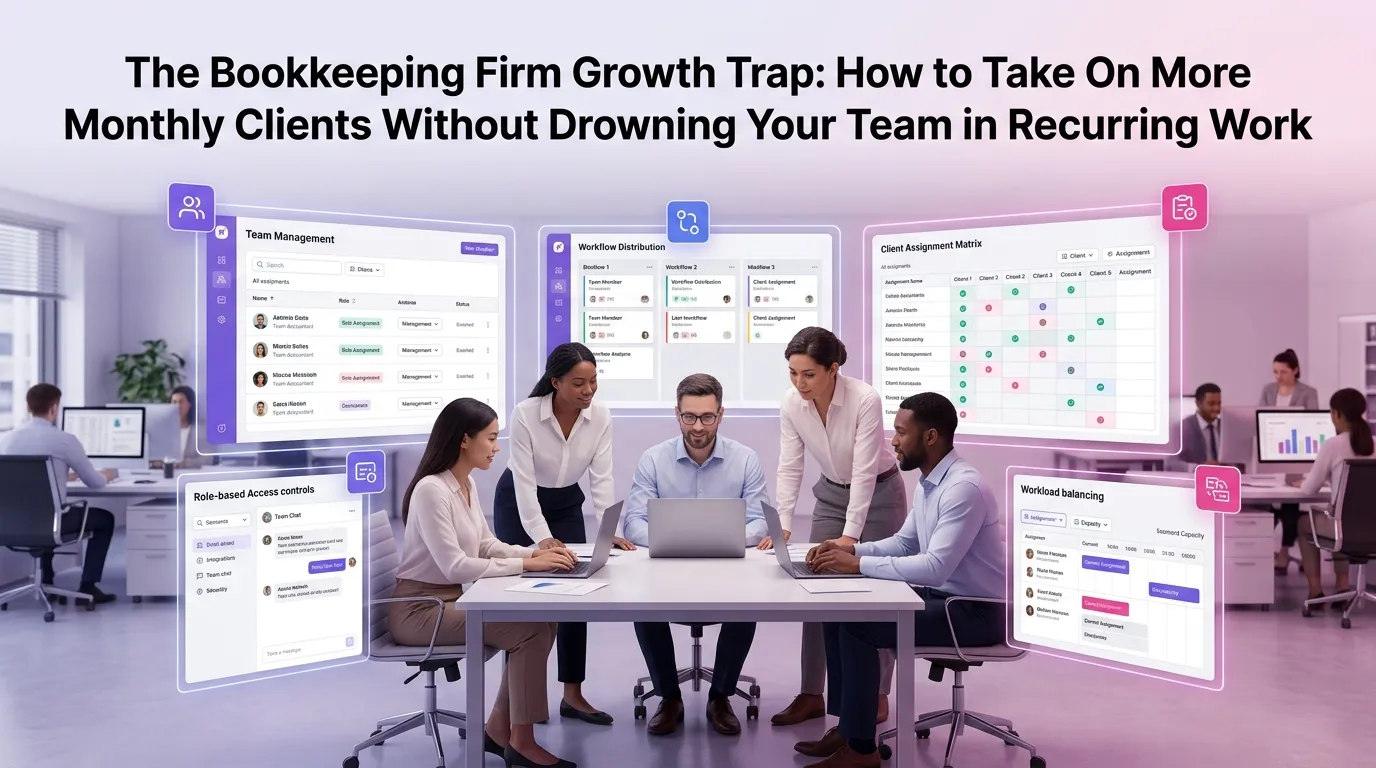
Every bookkeeping firm owner knows the feeling: you land a handful of new monthly clients, celebrate the growth, and then watch your team slowly buckle under the weight of recurring deadlines, repetitive data entry, and never-ending follow-up emails. It's the bookkeeping firm growth trap — and it catches even the most organized practices off guard. The good news is that escaping it doesn't require hiring a dozen new staff members. It requires smarter systems, and specifically, the right bookkeeping firm automation strategy.
Why Growth Feels Like a Punishment in Bookkeeping Firms
Bookkeeping is, by its very nature, a recurring service. Monthly reconciliations, payroll processing, financial statement preparation, tax estimate updates — these tasks don't disappear after you complete them once. They reset every 30 days.
When your client roster is small, this rhythm is manageable. But as you scale, the volume of recurring work compounds faster than your team's capacity grows. A firm that handles 20 monthly clients with two staff members can't simply double its clients without doubling its headaches — unless it changes how the work gets done.
According to the AICPA's Top Technology Initiatives survey, workflow automation consistently ranks among the highest priorities for accounting and bookkeeping professionals — precisely because manual, repetitive work is the single biggest barrier to sustainable growth.
The Real Cost of Manual Recurring Workflows
Most firm owners underestimate how much time their team spends on tasks that aren't billable — or at least, shouldn't require senior-level attention. Think about how many hours per week go toward chasing clients for bank statements, manually entering transaction data, reformatting reports, or sending the same reminder emails month after month.
These micro-tasks individually seem harmless. Collectively, they consume a staggering portion of your team's productive hours. When your staff is buried in administrative repetition, they have less capacity for high-value advisory work, client communication, and the kind of thoughtful analysis that actually justifies your monthly retainer.
The Journal of Accountancy has highlighted that firms embracing automation report up to 40% reductions in time spent on routine tasks — time that gets redirected toward growth, quality control, and client relationships.
The Hidden Bottlenecks Killing Your Capacity
Before you can automate effectively, it helps to identify where your recurring workflows actually break down. The most common bottlenecks in bookkeeping firms include client document collection, transaction categorization review, internal approval chains, and report delivery.
Each of these steps involves human touch points that can be delayed, forgotten, or inconsistently executed. When one step stalls, it creates a cascade effect that pushes deadlines back and forces your team into reactive, last-minute scrambles.
Identifying these friction points is the first step toward building a bookkeeping firm automation strategy that actually sticks.
What Bookkeeping Firm Automation Actually Looks Like in Practice
Automation in a bookkeeping context isn't about replacing your accountants with robots. It's about removing the manual, low-judgment tasks from their plates so they can focus on work that genuinely requires expertise.
Effective bookkeeping firm automation typically covers several key areas: automated client reminders and document requests, workflow triggers that move tasks through your pipeline without manual nudging, templated recurring task creation, and integrated reporting that pulls data without manual reformatting.
Automated Client Communication and Document Collection
One of the most time-consuming recurring tasks in any bookkeeping firm is chasing clients for the documents you need to do your job. Bank statements, receipts, payroll data — clients are busy, and reminders often fall through the cracks.
With automation, you can set up scheduled reminder sequences that go out automatically at the right time each month. If a client hasn't submitted their documents by a certain date, the system follows up without your team lifting a finger. This alone can recover hours of staff time per client, per month.
Workflow Templates and Recurring Task Automation
Every monthly client engagement follows a predictable sequence of steps. With the right platform, you can build workflow templates that automatically generate the full task list for each client at the start of every cycle. Tasks get assigned, deadlines get set, and nothing falls through the cracks.
This is where a purpose-built tax firm automation platform like TaxFlow makes a measurable difference. Rather than relying on spreadsheets, sticky notes, or memory, your team works from a structured, automated pipeline that keeps every client engagement on track without manual setup each month.
Approval Workflows and Internal Review Chains
Internal bottlenecks are just as damaging as client-facing ones. When a junior bookkeeper completes a reconciliation, it often needs to pass through a senior reviewer before it goes to the client. Without a structured workflow, these handoffs get lost in email threads or forgotten entirely.
Automated approval routing ensures that completed work moves to the right reviewer instantly, with notifications and deadlines built in. This reduces the back-and-forth and keeps your quality control process consistent across every client and every team member.
Scaling Monthly Clients Without Scaling Headcount Proportionally
The ultimate goal of bookkeeping firm automation is to change the ratio between clients served and hours required. A well-automated firm can often handle 30–40% more monthly clients with the same team — not by working faster, but by eliminating wasted motion.
Consider the math: if your team currently spends an average of 6 hours per month per client on recurring administrative tasks, and automation cuts that to 3.5 hours, you've effectively freed up capacity for significantly more clients without a single new hire. That's not a marginal improvement — it's a structural shift in your firm's economics.
Building Standardized Processes Before You Automate
One critical mistake firms make is trying to automate chaotic, inconsistent processes. Automation amplifies whatever process it's built on — so if your current workflow is disorganized, you'll just get disorganization at scale.
Before implementing new tools, invest time in documenting your current monthly workflow for a typical client. Map every step, every handoff, every decision point. Identify what's consistent, what varies, and what can be standardized. Only then should you begin building automation around it.
The IRS guidelines on recordkeeping also underscore the importance of consistent, documented processes — particularly for firms managing compliance obligations on behalf of clients. Standardization isn't just an efficiency play; it's a risk management strategy.
Using Data to Identify Your Highest-ROI Automation Opportunities
Not all automation is created equal. Some workflows, when automated, deliver enormous time savings. Others are infrequent enough that the setup investment outweighs the benefit. Smart firms prioritize automation based on frequency and time cost.
Start by tracking where your team's hours actually go. Time-tracking data, even for just two to four weeks, will reveal patterns that point directly to your highest-ROI automation targets. Monthly reconciliation reminders, recurring report generation, and standard client onboarding sequences are almost always near the top of the list.
How TaxFlow Helps Bookkeeping Firms Break the Growth Trap
TaxFlow by MultidexTech was built specifically for tax and bookkeeping firms that want to grow without grinding their teams into the ground. The platform combines workflow automation, client communication tools, recurring task management, and team collaboration features in a single, purpose-built environment.
Rather than stitching together multiple disconnected tools — a project manager here, an email automation tool there, a document portal somewhere else — TaxFlow gives your firm one unified system that handles the full lifecycle of every monthly client engagement.
Firms using TaxFlow report being able to onboard new monthly clients faster, deliver work more consistently, and reduce the administrative overhead that typically comes with growth. If you're ready to see what that looks like in practice, you can start your free trial and explore the platform with your own workflows.
What to Look for in a Bookkeeping Firm Automation Platform
If you're evaluating tools beyond TaxFlow, there are several criteria worth prioritizing. First, look for platforms designed specifically for accounting and bookkeeping firms — generic project management tools often lack the industry-specific features you need. Second, prioritize ease of recurring task configuration, since this is the core of your monthly workflow engine.
Third, evaluate client-facing features carefully. A platform that automates internal workflows but still requires manual client communication is only solving half the problem. You want end-to-end automation that covers both sides of the engagement.
Finally, consider scalability. The tool that works for 20 clients should still work well — and ideally better — when you reach 80 or 100. To explore how TaxFlow fits your firm's growth stage, view our pricing plans and find the tier that matches your current and projected client volume.
Building a Growth-Ready Firm Culture Around Automation
Technology is only part of the equation. For bookkeeping firm automation to truly transform your capacity, your team needs to trust the systems and commit to using them consistently. That means investing in training, creating clear ownership of workflow steps, and building a culture where process improvement is an ongoing conversation.
Involve your team in the automation design process. They're the ones closest to the recurring friction, and they'll surface problems and opportunities that leadership might miss. When staff feel ownership over the systems they use, adoption rates climb and the benefits compound faster.
For more strategies on building efficient, scalable firm operations, explore our blog where we regularly publish guides, case studies, and workflow frameworks for growing bookkeeping and tax firms.
Frequently Asked Questions
What is bookkeeping firm automation?
Bookkeeping firm automation refers to the use of software and workflow tools to handle repetitive, recurring tasks in a bookkeeping practice without manual effort each time. This includes automated client reminders, recurring task generation, internal approval routing, and report delivery — all designed to reduce administrative overhead and increase team capacity.
How many more clients can I take on with automation?
The capacity gain varies by firm, but many bookkeeping practices report handling 30–50% more monthly clients after implementing structured automation — without adding staff. The key driver is eliminating the time spent on low-judgment administrative tasks so your team can focus on higher-value work.
Do I need to change my current processes before automating?
It's strongly recommended to document and standardize your current workflows before automating them. Automation amplifies whatever process it's built on, so disorganized workflows will produce disorganized results at scale. Spend time mapping your monthly client workflow, identifying consistent patterns, and standardizing steps before building automation around them.
Is TaxFlow suitable for small bookkeeping firms or only large practices?
TaxFlow is designed to serve bookkeeping and tax firms at multiple stages of growth. Whether you're managing 15 monthly clients or 150, the platform scales with your needs. Smaller firms benefit from the structure and consistency automation provides, while larger firms gain the capacity to grow without proportional increases in overhead.
How long does it take to set up bookkeeping automation workflows?
With a platform like TaxFlow, most firms can configure their core recurring workflows within a few days. The initial setup investment pays back quickly — typically within the first one to two monthly cycles, as your team begins recovering hours previously spent on manual administrative tasks.
Ready to Break Free from the Growth Trap?
The bookkeeping firm growth trap is real, but it's not inevitable. With the right automation strategy and the right platform, you can take on significantly more monthly clients without burning out your team or sacrificing the quality your clients depend on.
MultidexTech's TaxFlow platform is purpose-built for exactly this challenge. Explore what's possible with a 14-day free trial — no credit card required, no complex setup. Start building the automated, scalable firm you've been working toward.
Related Posts
The Billing Bottleneck: How Mid-Size Tax Firms Are Automating Invoicing, Follow-Ups, and Collections Without Losing Client Relationships
11 min read
The Bookkeeping Firm Growth Trap: How to Serve More Monthly Clients Without Drowning in Recurring Workflows
12 min read

The Hidden Cost of Chasing Documents: How Tax Firms Are Reclaiming Hours Lost to Follow-Ups and Missing Files
12 min read