
The Client Retention Code: How Bookkeeping Firms Are Using Automated Communication and Delivery Workflows to Keep Clients Longer and Reduce Churn
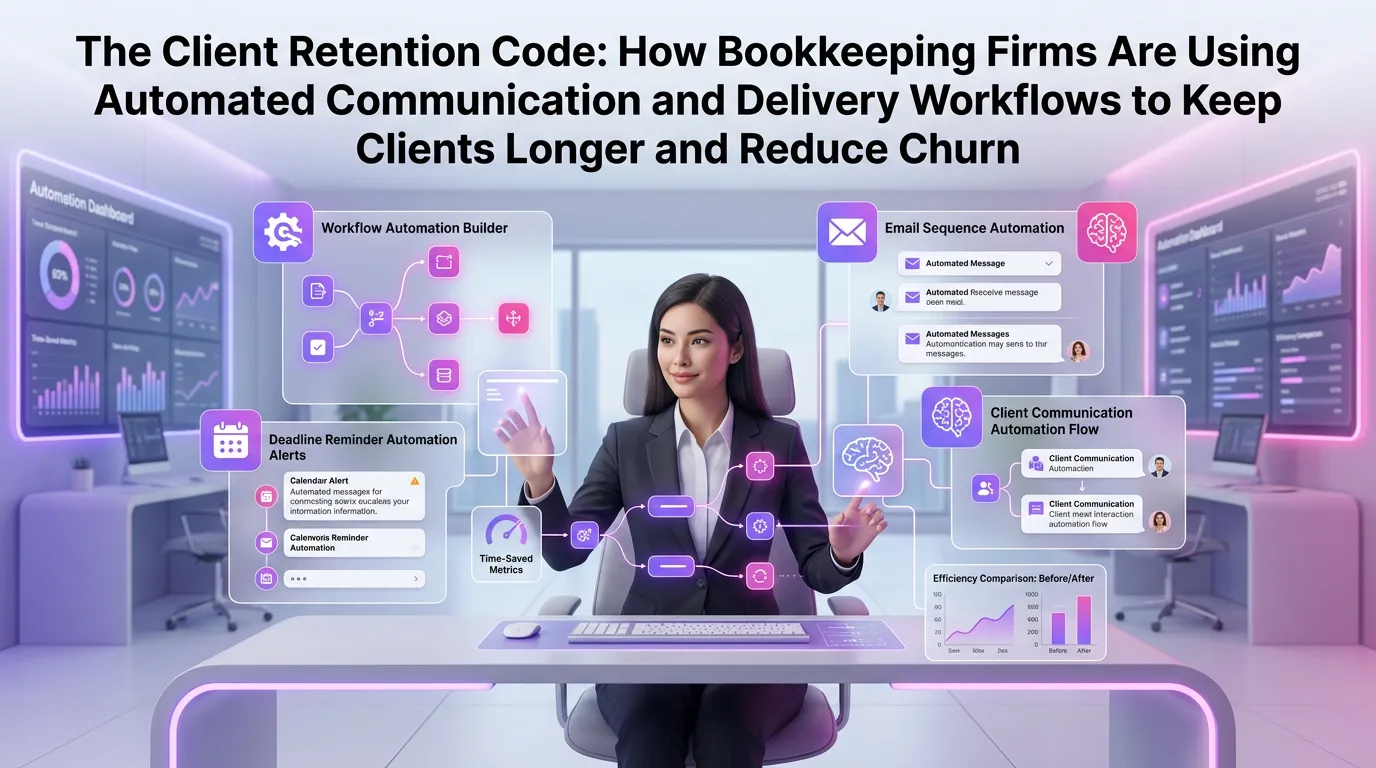
Client churn is one of the most expensive problems a bookkeeping firm can face. Research consistently shows that acquiring a new client costs five to seven times more than retaining an existing one — yet most firms invest the bulk of their energy in business development while leaving client experience largely on autopilot. The result is a slow, silent revenue leak that compounds month after month. The firms breaking this pattern share a common denominator: they have deployed bookkeeping firm client retention automation strategies that keep clients informed, engaged, and confident in the value they are receiving.
Why Bookkeeping Clients Leave (And What It Really Costs)
Before solving a retention problem, you need to understand its root cause. In most cases, clients do not leave because of price — they leave because of perceived indifference. A client who receives no proactive communication, who has to chase down deliverables, or who cannot remember the last time their bookkeeper added visible value is a client quietly evaluating alternatives.
According to the American Institute of CPAs (AICPA), client service quality and responsiveness rank among the top reasons small business owners switch accounting and bookkeeping providers. The technical work may be flawless, but if the client cannot see or feel that quality, it might as well not exist.
Consider the math: if your average bookkeeping client generates $4,800 in annual recurring revenue and you lose just eight clients per year, that is $38,400 in lost revenue — before accounting for the cost of replacing them. For a 50-client firm, even a 15% annual churn rate represents a serious drag on growth and profitability.
The Communication Gap: Where Most Firms Fail
The single biggest driver of preventable churn is inconsistent communication. Clients are not bookkeepers — they do not inherently understand what work is being done on their behalf between billing cycles. Without regular touchpoints, silence reads as inactivity, and inactivity erodes trust.
Most bookkeeping firms operate reactively. They respond to client questions, deliver reports when they are ready, and send reminders when deadlines are imminent. This reactive posture leaves the client feeling like a transaction rather than a valued relationship.
Proactive, structured communication changes the dynamic entirely. When clients receive consistent updates, timely document requests, and completion notifications without having to ask, they perceive their bookkeeper as organized, attentive, and indispensable. That perception is the foundation of long-term retention.
The Hidden Cost of Manual Follow-Up
Beyond client experience, manual communication workflows exact a significant toll on your team. Staff time spent chasing missing bank statements, sending reminder emails, and manually notifying clients of completed reports is time that cannot be spent on higher-value advisory work.
A mid-sized bookkeeping firm handling 60 clients may spend 10–15 hours per week on administrative communication alone. Automating those touchpoints does not just improve the client experience — it reclaims meaningful capacity for your team.
Bookkeeping Firm Client Retention Automation: What It Looks Like in Practice
Retention automation is not a single tool or tactic. It is a systematic approach to ensuring every client interaction — from onboarding through ongoing service delivery — is timely, consistent, and professionally executed. Here is how leading firms are structuring these workflows.
1. Automated Onboarding Sequences
The first 90 days of a client relationship are the most critical for long-term retention. Clients who experience a smooth, organized onboarding process are significantly more likely to remain long-term. Automated onboarding sequences ensure every new client receives a welcome message, a structured document checklist, and a clear timeline — without any manual effort from your team.
These sequences can include automated reminders if documents are not submitted within a set window, reducing the back-and-forth that often characterizes early client relationships. A polished onboarding experience signals professionalism and sets the tone for everything that follows.
2. Recurring Document Request Workflows
One of the most frustrating bottlenecks in bookkeeping is waiting for clients to submit bank statements, receipts, and other supporting documents. Automated recurring request workflows trigger at the same time each month, prompting clients to submit what is needed and following up automatically if no response is received.
This eliminates the awkward manual chase, keeps your team's workflow on schedule, and demonstrates to clients that your firm operates with precision and structure. Over time, clients adapt to the rhythm and submission rates improve markedly.
3. Work Completion and Delivery Notifications
When a deliverable is ready — whether it is a monthly reconciliation, a financial report, or a tax document — clients should know immediately. Automated delivery notifications sent at the moment of completion reinforce the value your firm is providing and give clients a regular reminder that work is being done on their behalf.
These notifications can include a brief summary of what was completed, a secure link to access the deliverable, and a prompt to reach out with questions. This simple touchpoint transforms a passive delivery into an active value demonstration.
4. Milestone and Deadline Reminders
Tax deadlines, estimated payment due dates, and year-end preparation windows are stress points for clients. Firms that proactively remind clients of upcoming deadlines — rather than waiting for clients to ask — position themselves as trusted advisors rather than reactive service providers.
The IRS Business Tax Calendar outlines dozens of recurring deadlines relevant to small business clients. Automated reminders tied to these dates ensure your clients are never caught off guard, and they associate that preparedness with your firm's expertise.
5. Periodic Check-In and Satisfaction Touchpoints
Retention is not just about operational communication — it is about relationship maintenance. Automated quarterly check-in messages, brief satisfaction surveys, or service anniversary acknowledgments remind clients that your firm values the relationship beyond the monthly invoice.
These touchpoints do not need to be elaborate. A short, personalized-feeling message asking whether the client has any questions or new business goals they would like to discuss can open conversations that lead to expanded service agreements — and dramatically reduce the risk of silent churn.
The Technology Stack Behind High-Retention Bookkeeping Firms
Implementing these workflows requires a platform capable of orchestrating communication, document management, and task automation in a coordinated way. Piecemeal solutions — a separate email tool here, a shared folder there — create inconsistency and gaps that undermine the client experience you are trying to build.
Purpose-built platforms designed for accounting and bookkeeping firms integrate these functions into a single, coherent workflow engine. When your document requests, delivery notifications, and client reminders all flow from the same system, the experience feels seamless to clients and manageable for your team.
The Journal of Accountancy has highlighted workflow automation as one of the defining competitive differentiators for accounting firms in the current decade. Firms that embrace these tools now are building structural advantages that will be difficult for less-automated competitors to close.
TaxFlow by MultidexTech is a tax firm automation platform built specifically for these use cases — combining automated client communication, document collection, and delivery workflows into a unified system designed to help bookkeeping and tax firms retain clients and scale efficiently.
Measuring Retention: Metrics That Matter
You cannot improve what you do not measure. Bookkeeping firms serious about reducing churn should track a small set of retention-specific metrics on a monthly basis.
Key Retention KPIs for Bookkeeping Firms
Monthly Churn Rate: The percentage of clients who cancel or do not renew in a given month. Even a 1% reduction in monthly churn compounds significantly over a 12-month period.
Average Client Tenure: How long the average client has been with your firm. Tracking this over time reveals whether your retention efforts are producing measurable results.
Net Revenue Retention (NRR): Total revenue retained from existing clients, including expansions and upsells, minus revenue lost to churn. NRR above 100% means your existing client base is growing — the hallmark of a healthy recurring revenue business.
Response and Delivery Time: How quickly your firm responds to client inquiries and delivers completed work. Automation directly improves these metrics by removing manual bottlenecks.
Building a Retention-First Culture in Your Firm
Automation is a powerful enabler, but it works best when it reinforces a culture that genuinely prioritizes client experience. That means training staff to view every client interaction as a retention opportunity, reviewing churn data in team meetings, and celebrating retention milestones alongside new business wins.
Firms that combine the right technology with a client-centric mindset consistently outperform peers on retention metrics. The automation handles the consistency and scale; the human element handles the judgment and relationship depth that no workflow can fully replicate.
If you are ready to explore what a structured approach to bookkeeping firm client retention automation could look like for your practice, explore our blog for additional guides on workflow design, client communication strategy, and firm growth.
Frequently Asked Questions
What is bookkeeping firm client retention automation?
Bookkeeping firm client retention automation refers to the use of software workflows to systematically manage client communication, document requests, deliverable notifications, and relationship touchpoints. These automated systems ensure clients receive consistent, timely engagement without requiring manual effort from your team at every step.
How much does client churn actually cost a bookkeeping firm?
The cost of churn depends on your average client value, but the impact is typically significant. Beyond lost recurring revenue, you must account for the cost of acquiring replacement clients — which is generally five to seven times more expensive than retaining existing ones. For a firm with 50 clients at $400/month average, losing just 10% annually represents $24,000 in lost revenue plus acquisition costs.
What types of communication should be automated for better retention?
The highest-impact areas to automate include new client onboarding sequences, recurring document collection requests, work completion and delivery notifications, tax deadline reminders, and periodic client check-in messages. Together, these touchpoints create a consistent client experience that reinforces your firm's value throughout the year.
Do clients respond well to automated messages, or does it feel impersonal?
When done well, automation feels professional and attentive rather than impersonal. The key is to use personalization tokens (client name, specific deliverable names, relevant dates), keep messages concise and clear, and ensure the tone matches your firm's voice. Clients generally appreciate timely, relevant communication — regardless of whether it was triggered manually or by a workflow.
How do I get started with retention automation for my bookkeeping firm?
Start by mapping your current client communication touchpoints and identifying the gaps — places where clients go without updates for weeks at a time, or where your team spends significant time on manual follow-up. Then evaluate purpose-built platforms like TaxFlow that offer pre-built workflow templates for bookkeeping and tax firms. You can start your free trial and pilot automation on a small client segment before rolling out firm-wide.
Ready to reduce churn and build a more predictable bookkeeping business? MultidexTech's TaxFlow platform gives you the automated communication and delivery workflows you need to deliver a consistently excellent client experience — without adding to your team's workload. Start your free 14-day trial today and see why growing bookkeeping firms trust TaxFlow to power their client retention strategy. Prefer to explore options first? View our pricing plans to find the right fit for your firm.
``` ```htmlRelated Posts
The Monthly Close Bottleneck: How Bookkeeping Firms Are Automating Recurring Client Work to Deliver Faster, More Consistent Results
11 min read
The Reconciliation Rut: How Bookkeeping Firms Are Using Automation to Deliver Faster Month-End Closes Without the Manual Grind
10 min read

The Bookkeeping Bottleneck: How Automation Turns Repetitive Data Entry Into a Hands-Off Workflow
11 min read