
The Monthly Close Bottleneck: How Bookkeeping Firms Are Automating Recurring Client Work to Deliver Faster, More Consistent Results
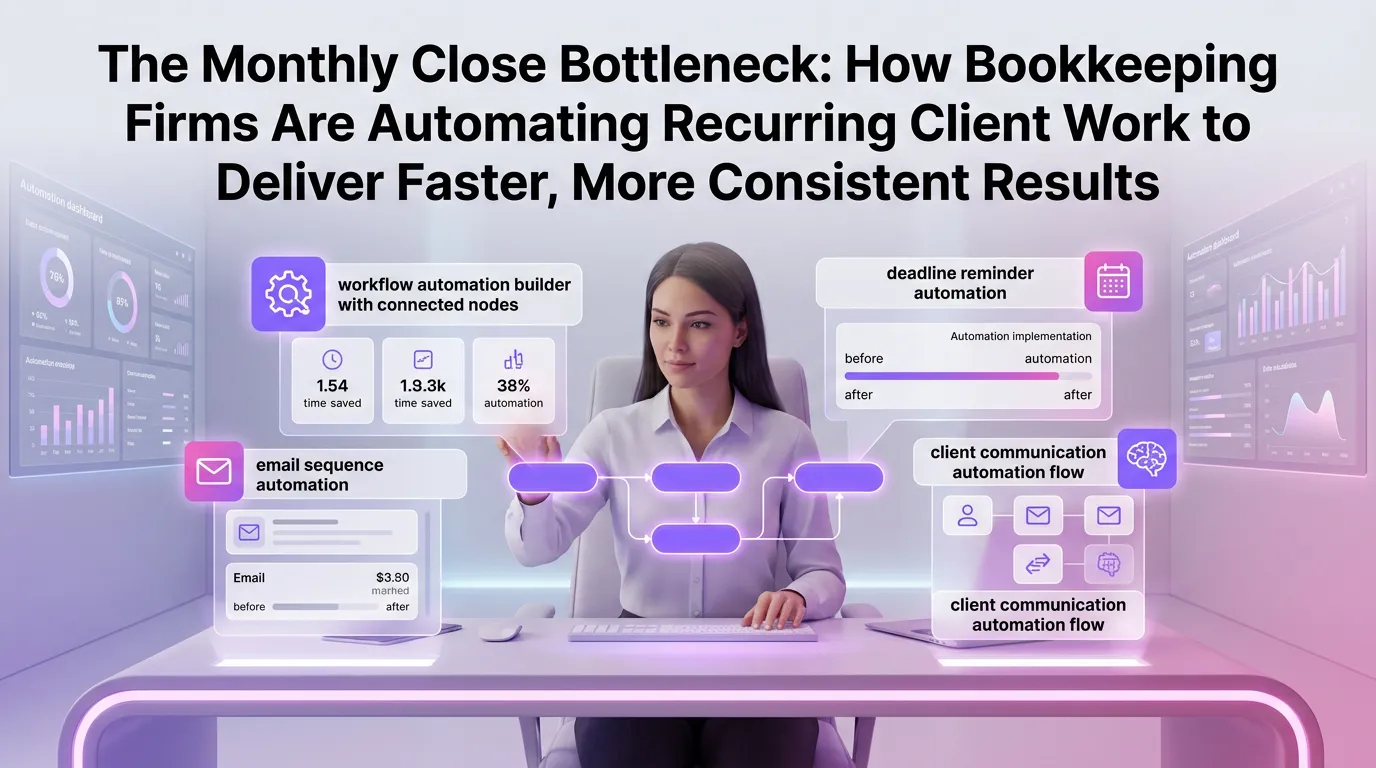
Every month, bookkeeping firms across the country face the same grueling sprint: reconcile accounts, generate reports, chase down client documents, and somehow deliver everything on time — for dozens of clients simultaneously. The monthly close process is one of the most time-intensive, error-prone workflows in the accounting profession, and for many firms, it remains almost entirely manual. But that's changing fast. Bookkeeping firm automation is no longer a luxury reserved for large enterprises — it's the competitive edge that modern firms are using to scale their client base without burning out their teams.
Why the Monthly Close Is Still a Major Bottleneck
Despite advances in cloud accounting software, the monthly close cycle still involves an enormous amount of repetitive, human-driven work. Staff accountants spend hours copying data between systems, sending follow-up emails to clients, and manually generating the same report templates month after month.
According to research highlighted by the Journal of Accountancy, accounting professionals report that a significant portion of their working hours are consumed by tasks that could be partially or fully automated. These aren't complex judgment calls — they're routine, rules-based processes that technology can handle reliably.
The real cost isn't just time. Manual processes introduce inconsistency. When different staff members handle the same client differently — using slightly different templates, different follow-up cadences, different file naming conventions — quality becomes unpredictable. Clients notice, and firms lose trust.
What Bookkeeping Firm Automation Actually Looks Like in Practice
Automation in bookkeeping firms isn't about replacing accountants. It's about eliminating the friction between high-value work and the administrative overhead that surrounds it. Here's what that looks like in real workflows.
Automated Client Document Collection
One of the most time-consuming pre-close tasks is gathering source documents from clients — bank statements, receipts, payroll summaries, and more. Without automation, this means sending individual emails, waiting, following up, waiting again, and sometimes still closing the month with missing information.
With a tax firm automation platform like TaxFlow, firms can configure automated document request sequences that trigger at the start of each month. Clients receive branded, professional requests with clear deadlines. Reminders go out automatically if documents aren't submitted. Staff only step in when there's a genuine exception — not to manage routine follow-up.
Workflow Triggers and Recurring Task Assignment
Every bookkeeping engagement has predictable milestones: bank feeds need to be reviewed, credit card statements need to be reconciled, depreciation schedules need to be updated. These tasks are the same every month, yet most firms recreate them manually or rely on staff memory and spreadsheet checklists.
Automation platforms allow firms to build recurring workflow templates that auto-assign tasks to the right team members on a set schedule. When Month X begins, the system already knows who owns what, what the deadline is, and what the previous month's status was. Nothing falls through the cracks because the system doesn't forget.
Standardized Report Generation and Delivery
Once the books are closed, clients need their reports — P&L statements, balance sheets, cash flow summaries, and custom KPI dashboards depending on the engagement. Formatting these manually, firm by firm, month by month, is both tedious and inconsistent.
Automated report generation pulls finalized data and populates pre-approved templates, ensuring every client receives a polished, on-brand deliverable with zero manual formatting. Delivery can be scheduled automatically or triggered by a staff approval step, depending on the firm's preferred workflow.
The Hidden Costs of Not Automating
Firms that resist automation often underestimate what it's actually costing them. The most obvious cost is staff time — hours spent on low-value tasks that could be redirected toward advisory services, client relationship management, or business development.
But there are less visible costs too. Staff turnover is a growing problem in accounting firms, and burnout from repetitive, high-pressure monthly close cycles is a contributing factor. The AICPA has consistently flagged talent retention as one of the top challenges facing accounting firms today. Automation reduces the drudgery that drives talented staff out the door.
There's also the opportunity cost of being stuck in execution mode. Firms that are perpetually firefighting the close cycle have no bandwidth to offer the higher-margin advisory and consulting services that clients increasingly want — and that competitors are already providing.
Bookkeeping Firm Automation: Building a Scalable Client Model
One of the most powerful outcomes of automation is what it does to your firm's capacity model. Without automation, growth is roughly linear: more clients means more staff, more hours, more overhead. With automation, that relationship changes fundamentally.
Serving More Clients Without Adding Headcount
When routine tasks are handled by automated workflows, your existing team can support a larger client portfolio. Firms that implement structured automation consistently report being able to take on 20–40% more clients without proportional increases in staffing costs. That's not a marginal efficiency gain — it's a structural change in how the business operates.
This scalability is particularly important for small and mid-sized bookkeeping firms competing against larger players. Automation levels the playing field, allowing a boutique firm to deliver the consistency and speed of a much larger operation.
Creating Consistent Client Experiences at Scale
Consistency is one of the most underrated drivers of client retention. When clients know exactly what to expect — when they'll receive their reports, what the document request process looks like, how questions will be handled — they develop confidence in the firm. That confidence translates directly into long-term relationships and referrals.
Automated workflows enforce consistency by design. Every client moves through the same structured process, every month, regardless of which staff member is managing the engagement. The firm's standards are baked into the system, not dependent on individual habits.
Key Features to Look for in a Bookkeeping Automation Platform
Not all automation tools are built with bookkeeping workflows in mind. When evaluating platforms, firms should look for capabilities that address the specific demands of recurring monthly close work.
Recurring Workflow Templates
The platform should allow firms to build reusable workflow templates for standard engagement types — monthly bookkeeping, quarterly reviews, annual compilations — and apply them to new clients instantly. Templates should be customizable at the client level without requiring a rebuild from scratch.
Automated Client Communication
Document requests, deadline reminders, status updates, and report delivery should all be configurable within the platform. Firms should be able to set communication sequences once and trust that clients are being contacted appropriately throughout the month.
Task Tracking and Visibility
Managers need real-time visibility into where every client engagement stands. Which clients are waiting on documents? Which reconciliations are complete? Which reports are pending review? A strong automation platform provides a centralized dashboard that answers these questions at a glance, without requiring status meetings or manual check-ins.
Integration with Accounting Software
Automation platforms need to connect seamlessly with the tools firms already use — QuickBooks, Xero, and other cloud accounting systems. The IRS continues to expand its digital infrastructure, and firms need platforms that can adapt to evolving compliance requirements without creating new manual touchpoints.
How TaxFlow by MultidexTech Addresses the Monthly Close Challenge
TaxFlow was built specifically for tax and bookkeeping firms that need to manage high volumes of recurring client work without sacrificing quality or speed. The platform combines workflow automation, client communication tools, document management, and reporting capabilities into a single, unified system.
Firms using TaxFlow can configure recurring monthly workflows for each client engagement, automate document collection sequences, track task completion across the team, and deliver finalized reports — all from one platform. There's no need to stitch together multiple tools or manage complex integrations between disconnected systems.
Whether you're a solo practitioner managing 30 bookkeeping clients or a growing firm with a team of 10 and a portfolio of 200 engagements, TaxFlow scales with your business. You can view our pricing plans to find the tier that fits your current size and growth trajectory.
Getting Started: What the Transition to Automation Looks Like
Many firm owners hesitate to adopt automation because they assume the implementation will be disruptive. In practice, the transition is more manageable than expected — especially with a platform designed for firm workflows from the ground up.
The most effective approach is to start with your highest-volume, most standardized engagement type. Build a workflow template for that service, automate the client communication sequence, and run one or two clients through the new process before rolling it out broadly. This allows your team to identify gaps and refine the workflow without risking your entire client base.
Within a few months, most firms find that the automated workflows have become second nature and that the time savings are immediately measurable. Staff report less stress around the monthly close, and clients notice the improved consistency and communication. Want to see more insights on firm efficiency strategies? Explore our blog for practical guides and industry analysis.
Frequently Asked Questions
What is bookkeeping firm automation?
Bookkeeping firm automation refers to the use of software platforms to handle repetitive, rules-based tasks in a bookkeeping practice — such as client document requests, task assignment, workflow tracking, and report delivery — without requiring manual intervention at each step. The goal is to reduce administrative overhead, improve consistency, and free staff to focus on higher-value work.
Will automation replace my bookkeeping staff?
No. Automation is designed to eliminate low-value, repetitive tasks — not to replace the judgment, communication, and expertise that trained bookkeeping professionals provide. In practice, automation allows your existing team to handle more clients and deliver better service, rather than reducing headcount.
How long does it take to implement a bookkeeping automation platform?
Implementation timelines vary depending on firm size and complexity, but many firms can configure their first automated workflows within a few days of onboarding. Platforms like TaxFlow are designed with firm workflows in mind, which reduces the learning curve significantly compared to general-purpose automation tools.
Is my client data secure in an automation platform?
Reputable firm automation platforms use enterprise-grade encryption, role-based access controls, and regular security audits to protect client data. When evaluating any platform, firms should confirm compliance with relevant data security standards and review the provider's data handling policies before onboarding clients.
Can I automate workflows for different types of bookkeeping engagements?
Yes. Most firm automation platforms allow you to build separate workflow templates for different engagement types — monthly bookkeeping, quarterly reviews, payroll processing, annual compilations, and more. Each template can be customized for the specific tasks, deadlines, and communication sequences relevant to that service type.
Ready to Close the Books Faster — Every Month?
The monthly close bottleneck is a solvable problem. Firms that embrace bookkeeping firm automation are already delivering faster turnarounds, more consistent client experiences, and stronger margins — without working longer hours or adding staff. The technology is mature, the ROI is proven, and the competitive pressure to adopt it is only growing.
TaxFlow by MultidexTech is built specifically for bookkeeping and tax firms that are ready to move beyond manual workflows. With recurring workflow automation, client communication tools, and real-time task tracking, TaxFlow gives your team everything it needs to run a tighter, more scalable monthly close process.
Try it free for 14 days — no credit card required. Start your free trial today and see what your monthly close process looks like when the busywork is handled for you.
Related Posts
The Client Retention Code: How Bookkeeping Firms Are Using Automated Communication and Delivery Workflows to Keep Clients Longer and Reduce Churn
11 min read
The Reconciliation Rut: How Bookkeeping Firms Are Using Automation to Deliver Faster Month-End Closes Without the Manual Grind
10 min read

The Bookkeeping Bottleneck: How Automation Turns Repetitive Data Entry Into a Hands-Off Workflow
11 min read