
The Reconciliation Rut: How Bookkeeping Firms Are Using Automation to Deliver Faster Month-End Closes Without the Manual Grind
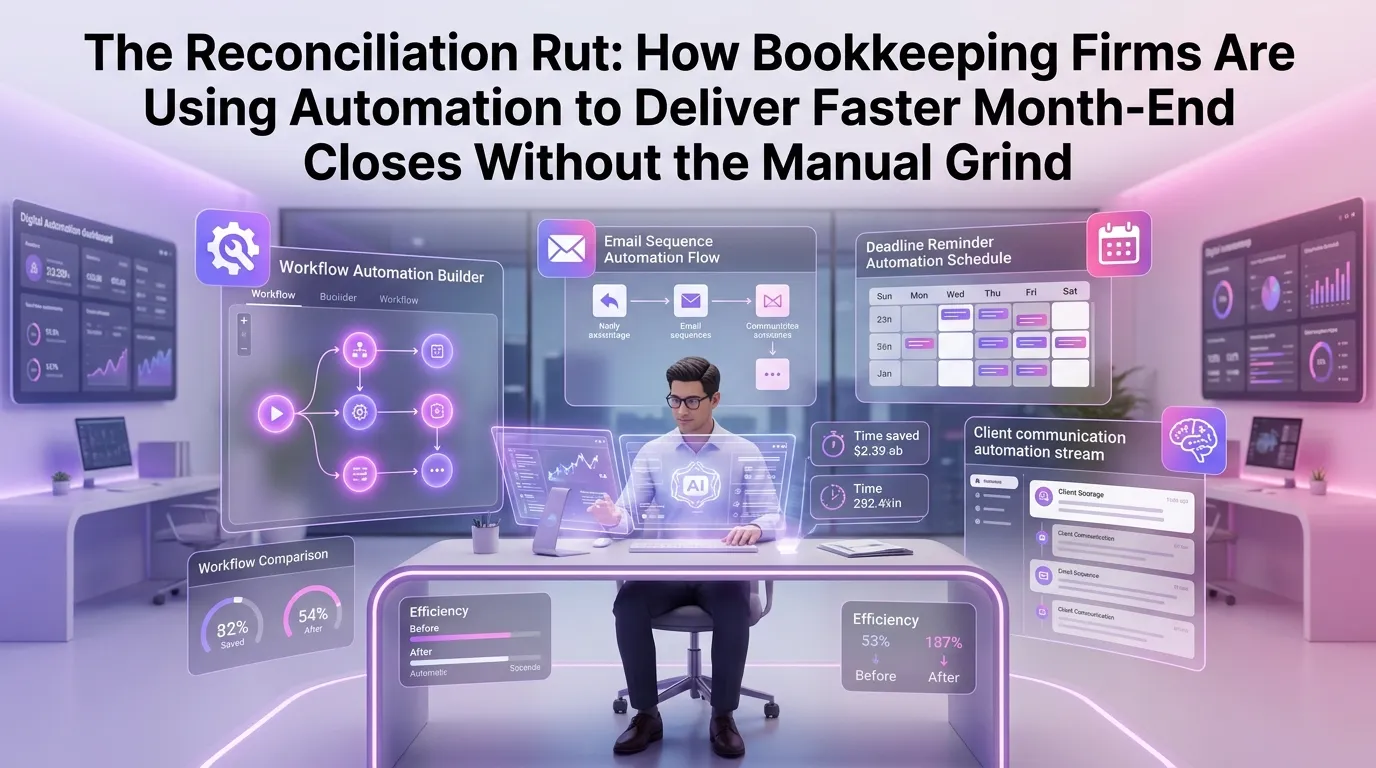
Month-end close used to be a predictable ritual — a few late nights, a stack of bank statements, and a pot of strong coffee. But as bookkeeping firms scale their client rosters and regulatory complexity deepens, that familiar grind has become something far more punishing. Today, the firms that are pulling ahead aren't working harder — they're working smarter through bookkeeping firm automation. And the results are reshaping what clients expect from their accounting partners.
Why Month-End Close Is Breaking Bookkeeping Teams
The average month-end close for a mid-sized bookkeeping firm can take anywhere from five to ten business days — and that's when everything goes smoothly. When it doesn't, staff are buried in reconciliation errors, missing transaction data, and client follow-ups that drag the timeline even further.
According to the American Institute of CPAs (AICPA), accounting professionals spend a disproportionate amount of their time on repetitive, low-value tasks rather than advisory work. This imbalance leads to burnout, staff attrition, and — perhaps most critically — slower deliverables for clients who are making real-time business decisions based on stale numbers.
The problem isn't a lack of effort. It's a lack of the right infrastructure. Manual reconciliation processes are inherently error-prone, and when your firm handles dozens of clients simultaneously, even small inefficiencies compound into significant bottlenecks.
What Bookkeeping Firm Automation Actually Looks Like in Practice
There's a lot of noise in the market about "automation," but what does it actually mean for a bookkeeping firm trying to close the books faster? It's not about replacing accountants — it's about removing the friction between them and the work that matters.
Modern bookkeeping firm automation tools handle tasks like bank feed categorization, transaction matching, intercompany reconciliations, and variance flagging — all without a human needing to touch each line item. Staff are alerted only when an exception requires judgment, which is exactly how skilled professionals should be spending their time.
Platforms like TaxFlow's tax firm automation platform are purpose-built to streamline these workflows, giving bookkeeping teams a centralized command center where client data flows in, gets processed, and surfaces actionable insights — rather than raw chaos.
Automated Bank Reconciliation: The First Domino
Bank reconciliation is the cornerstone of month-end close, and it's traditionally one of the most time-consuming steps. Automated reconciliation tools connect directly to bank feeds, match transactions against the general ledger in real time, and flag discrepancies instantly.
This alone can cut reconciliation time by 60–70% for most firms. Instead of a staff accountant spending two hours per client per month matching transactions manually, the system does it continuously — and the accountant steps in only when something doesn't add up.
The downstream effect is significant: when reconciliation is faster and more accurate, everything else in the close process accelerates too. Journal entries, financial statement preparation, and client review calls can all happen sooner.
Rule-Based Transaction Categorization
One of the most tedious parts of bookkeeping is categorizing transactions — especially for clients with high transaction volumes or multiple revenue streams. Automation platforms allow firms to build intelligent rule sets that automatically assign categories based on vendor name, amount, account type, or historical patterns.
Over time, machine learning capabilities refine these rules based on corrections, making the system smarter with every close cycle. New transactions from familiar vendors are categorized instantly, while truly ambiguous items are queued for human review.
This approach dramatically reduces the cognitive load on staff and virtually eliminates the "what do I do with this?" paralysis that slows down inexperienced bookkeepers working through complex client accounts.
Automated Client Data Requests and Follow-Ups
One of the most underappreciated time sinks in month-end close isn't the bookkeeping itself — it's chasing clients for missing documents. Receipts, invoices, payroll records, and loan statements all need to arrive before the books can close, and clients rarely deliver them on schedule.
Automation tools can send templated data request emails, track document submissions, and issue automated reminders without any manual effort from your team. Some platforms even allow clients to upload documents directly into a secure portal that feeds straight into the workflow.
The result? Your team spends less time playing email tag and more time actually closing the books. Client relationships also improve because communications are timely and professional, even when your staff is managing a heavy workload.
The ROI of Faster Month-End Closes
Speed isn't just a quality-of-life improvement for your team — it's a direct revenue driver. When your firm can close the books faster, you can serve more clients with the same headcount, deliver higher-value advisory services, and differentiate yourself in a competitive market.
Consider the math: if automation reduces your average close time from eight days to three days per client, and you manage 40 active clients, that's 200 staff-days recovered every month. That's capacity you can redirect toward new client acquisition, tax planning services, or financial analysis that commands a premium fee.
The Journal of Accountancy has consistently reported that firms embracing technology-driven workflows see measurable improvements in both profitability and client retention. Clients notice when they receive their financials faster — and they remember it when it's time to renew their engagement.
Reducing Errors and the Cost of Corrections
Manual processes don't just take time — they introduce risk. A miskeyed transaction, a missed reconciling item, or a miscategorized expense can cascade into material errors that require hours of rework to trace and correct.
Automated workflows enforce consistency. Every transaction goes through the same logic, every time. Exception reports are generated automatically, so nothing slips through the cracks. When errors do occur, they're caught earlier in the process — before they've had a chance to compound.
This is especially important given the IRS's recordkeeping requirements, which demand that businesses maintain accurate, organized financial records. Automation helps your clients stay compliant without placing the entire burden on your team.
How to Transition Your Firm to an Automated Month-End Workflow
The idea of overhauling your firm's workflows can feel daunting, especially if you've built your processes around specific tools or staff habits. But the transition doesn't have to be disruptive. The most successful implementations take an incremental approach.
Start by identifying your biggest bottlenecks — the three or four steps in your close process that consistently cause delays or require the most manual effort. Automate those first. Once your team sees the time savings and gains confidence in the system, expanding automation to other areas becomes much easier.
Training is also critical. Automation tools are only as effective as the people using them. Invest time upfront in onboarding your team properly, setting up rule libraries, and configuring client-specific workflows. The payoff comes quickly — most firms report significant time savings within the first full close cycle after implementation.
Choosing the Right Bookkeeping Firm Automation Platform
Not all automation platforms are created equal. When evaluating options, look for solutions that offer deep integration with your existing accounting software, flexible workflow customization, and robust exception management capabilities.
You'll also want a platform that scales with your firm. A tool that works well for 10 clients should work just as well — or better — for 100. Look for vendors who understand the specific needs of bookkeeping and tax firms, not generic business automation tools that were never designed with accounting workflows in mind.
If you're ready to explore what's possible, you can start your free trial with TaxFlow and see firsthand how purpose-built automation can transform your month-end close process. There's no commitment required, and the platform is designed to get you up and running quickly.
Building a Scalable, Automation-First Firm Culture
The firms that benefit most from automation aren't just using new tools — they're building a culture where process efficiency is a core value. That means documenting workflows, continuously reviewing where time is being spent, and staying open to evolving how work gets done.
It also means redefining what your team's roles look like. When automation handles the mechanical work, your staff can focus on interpretation, communication, and strategy. That shift is good for morale, good for client outcomes, and good for your bottom line.
Firms that make this cultural shift early will have a significant competitive advantage as client expectations continue to rise. Clients increasingly expect real-time financial visibility, proactive insights, and fast turnaround times. Automation is what makes delivering all three simultaneously possible.
To explore more strategies for growing and modernizing your practice, explore our blog for insights on workflow optimization, tax firm technology, and client management best practices.
Frequently Asked Questions
What is bookkeeping firm automation?
Bookkeeping firm automation refers to the use of software tools and workflows that automatically handle repetitive accounting tasks — such as bank reconciliation, transaction categorization, and client document requests — reducing the need for manual data entry and freeing staff to focus on higher-value work.
How much time can automation save on month-end close?
Most firms that implement automation report reducing their month-end close time by 40–70%. The exact savings depend on your current workflow, client volume, and which processes you automate first. Bank reconciliation and transaction categorization typically yield the fastest time savings.
Will automation replace bookkeeping staff?
No. Automation is designed to eliminate repetitive, low-value tasks — not replace skilled professionals. In practice, automation allows bookkeepers to handle more clients with the same headcount, take on more advisory work, and deliver better service. It enhances the role of your team rather than diminishing it.
Is bookkeeping firm automation suitable for small firms?
Absolutely. In fact, smaller firms often see the most dramatic impact from automation because they have fewer resources to throw at manual work. Even a solo practitioner or a team of two or three can benefit significantly from automated reconciliation, document collection, and workflow management tools.
How do I get started with automation for my bookkeeping firm?
The best starting point is to map out your current month-end close workflow and identify your top three bottlenecks. Then evaluate automation platforms that address those specific pain points. TaxFlow offers a 14-day free trial so you can test the platform with real client workflows before making any commitment — you can start your free trial here or view our pricing plans to find the right fit for your firm.
Ready to escape the reconciliation rut? MultidexTech's TaxFlow platform is built specifically for bookkeeping and tax firms that want to close faster, serve more clients, and stop losing hours to manual grind. Try it free for 14 days — no credit card required — and discover what your team can accomplish when automation handles the heavy lifting.
Related Posts
The Client Retention Code: How Bookkeeping Firms Are Using Automated Communication and Delivery Workflows to Keep Clients Longer and Reduce Churn
11 min read
The Monthly Close Bottleneck: How Bookkeeping Firms Are Automating Recurring Client Work to Deliver Faster, More Consistent Results
11 min read

The Bookkeeping Bottleneck: How Automation Turns Repetitive Data Entry Into a Hands-Off Workflow
11 min read