
The Compliance Calendar Advantage: How Tax Firms Are Using Automated Deadline Tracking to Serve More Clients Without Missing a Beat
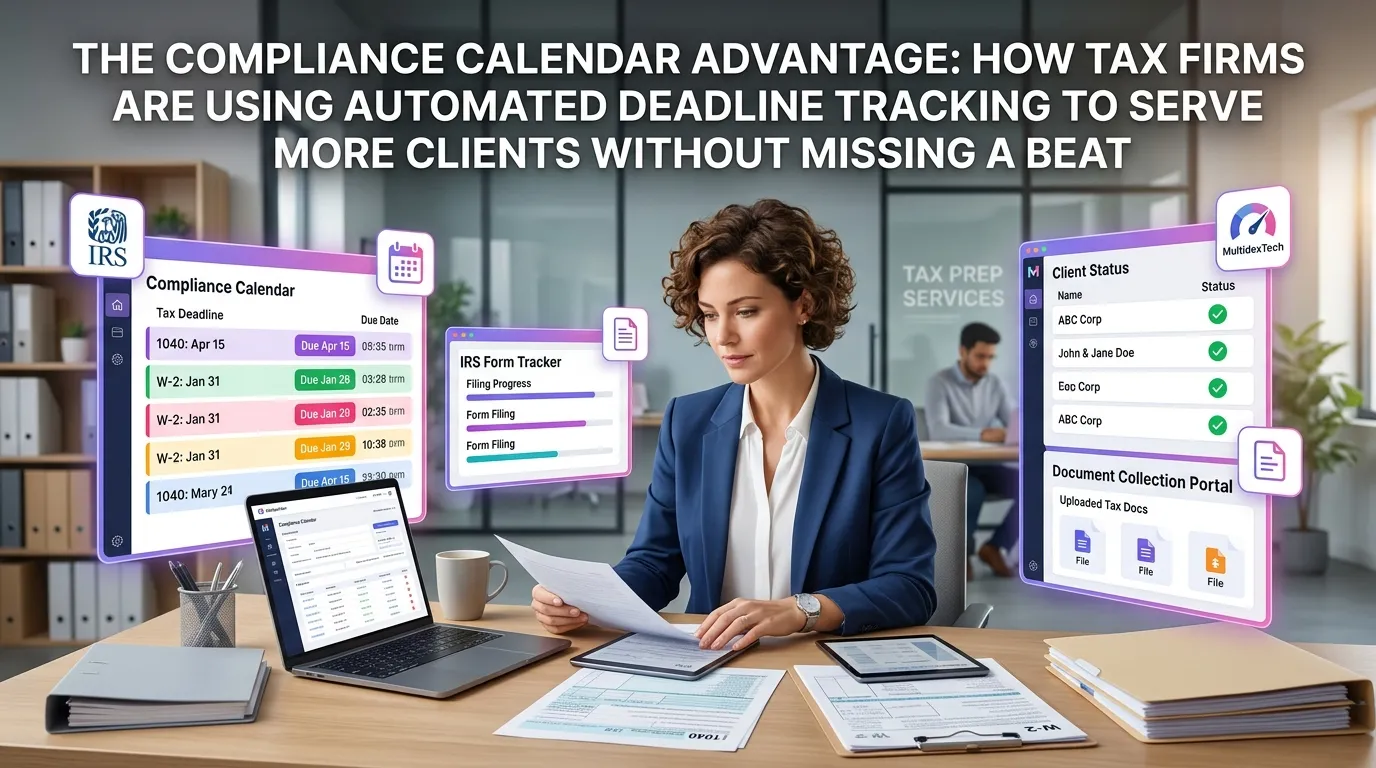
Tax season never truly ends. Between quarterly estimated payments, extension deadlines, payroll filings, and year-end returns, tax professionals are juggling dozens — sometimes hundreds — of critical dates simultaneously. One missed deadline can mean penalties for a client, a damaged relationship, and a serious blow to your firm's reputation. That's why automated deadline tracking for tax firms has moved from a "nice-to-have" to an operational necessity. Forward-thinking firms are now leveraging compliance calendars powered by automation to scale their client base, reduce errors, and reclaim the mental bandwidth that manual tracking consumes.
The Hidden Cost of Manual Deadline Management
Most tax professionals underestimate how much time and energy goes into manually tracking filing deadlines. Spreadsheets, sticky notes, shared calendars, and email reminders create a fragmented system that's only as reliable as the person maintaining it.
According to the AICPA's Tax Practice Management resources, workflow inefficiencies are among the top challenges facing accounting firms today. When deadline management relies on manual processes, the risk of human error scales directly with your client volume.
Consider a mid-sized firm managing 300 clients. Across those clients, there may be thousands of individual filing obligations per year — federal, state, local, quarterly, and annual. Tracking all of that manually isn't just tedious; it's genuinely dangerous to your firm's compliance posture.
The Real Consequences of a Missed Filing Deadline
The IRS imposes significant penalties for late filings and payments, and in many cases those penalties compound over time. A single missed extension deadline can cost a client hundreds or even thousands of dollars.
Beyond the financial impact, there's a trust dimension. Clients hire tax professionals precisely because they want to avoid these situations. When a firm drops the ball on a deadline, it raises a fundamental question: what else might have been missed?
The reputational damage from a compliance failure can far outweigh any short-term operational savings from avoiding better systems. That's the core argument for investing in automated deadline tracking for tax firms.
What Is a Compliance Calendar — and Why Does Automation Change Everything?
A compliance calendar is a structured, comprehensive schedule of all filing obligations, payment due dates, and regulatory requirements relevant to your clients. In its simplest form, it's a list of dates. In its most powerful form, it's a dynamic, intelligent system that adapts to each client's unique situation.
Manual compliance calendars are static. They don't account for weekends, holidays, jurisdiction-specific rules, or last-minute IRS announcements. Automated compliance calendars, by contrast, are living documents that update in real time and push alerts to the right people at the right time.
Key Features of an Automated Compliance Calendar
Not all deadline management tools are created equal. The most effective platforms offer a combination of features that work together to eliminate gaps in your oversight.
- Client-specific deadline mapping: Each client's filing obligations are tracked individually based on their entity type, jurisdiction, and tax elections.
- Automated reminders and escalations: Alerts are sent to staff and clients at configurable intervals — 30 days out, 14 days out, 7 days out — with escalation protocols if no action is taken.
- Holiday and weekend adjustments: The system automatically shifts deadlines that fall on non-business days, reflecting IRS and state agency rules.
- Extension tracking: When extensions are filed, the calendar updates automatically to reflect the new due date.
- Audit trail and reporting: Every action taken on a deadline is logged, giving you documentation for quality control and client communication.
These capabilities transform deadline management from a reactive scramble into a proactive, systematic process. That shift is where the real operational value lies.
How Automated Deadline Tracking for Tax Firms Enables Growth
Here's a question that gets to the heart of the matter: what's the real bottleneck to growing a tax firm? For many practitioners, it's not a lack of clients — it's a lack of capacity to serve more clients without increasing risk.
When your team is spending hours each week manually checking calendars, sending reminder emails, and chasing down missing documents before deadlines, that time isn't being spent on client advisory work, business development, or higher-value services. Automation removes that bottleneck.
Scaling Client Volume Without Scaling Chaos
A firm that manually manages 100 clients may feel stretched at 150. But a firm running on automated deadline tracking can often double its client base without proportionally increasing administrative overhead. The system handles the repetitive monitoring work while your team focuses on judgment-intensive tasks.
This is precisely the kind of leverage that distinguishes high-growth firms from those that plateau. By building automation into your workflow infrastructure, you create a scalable foundation that grows with you rather than against you.
Platforms like TaxFlow — a purpose-built tax firm automation platform — are designed specifically to give firms this kind of operational leverage. Rather than adapting generic project management tools to tax workflows, TaxFlow is built around the way tax professionals actually work.
Improving Client Experience Through Proactive Communication
Clients don't just want their taxes filed accurately — they want peace of mind. Proactive deadline reminders, status updates, and clear communication about upcoming obligations are all part of delivering a premium client experience.
Automated systems make it easy to send personalized, timely communications without requiring staff to manually draft and send each message. A client who receives a reminder two weeks before a quarterly estimated payment is due feels taken care of — and is far less likely to be caught off guard by a tax bill.
This kind of proactive service is a powerful differentiator in a competitive market. It's the difference between a firm that reacts to problems and one that prevents them.
Integrating Deadline Tracking Into Your Broader Workflow
Deadline tracking doesn't exist in isolation. It's one component of a larger workflow ecosystem that includes client onboarding, document collection, preparation, review, and filing. The most effective automation strategies connect these components so that information flows seamlessly between them.
For example, when a new client is onboarded and their entity type and filing history are entered into the system, the compliance calendar should automatically populate with all relevant deadlines. When a return is completed and filed, the system should mark that deadline as resolved and archive the relevant documentation.
The Role of Task Assignment and Accountability
One of the most underappreciated aspects of automated deadline management is its ability to enforce accountability within your team. When every deadline is assigned to a specific staff member, with documented reminders and escalation paths, there's no ambiguity about who is responsible for what.
This clarity is especially important in firms with multiple preparers, reviewers, and client managers. Without clear ownership, deadlines fall into the gaps between roles. Automation closes those gaps by making responsibility explicit and visible.
The Journal of Accountancy has noted that workflow automation is increasingly central to how top-performing accounting firms manage quality control and staff productivity. Deadline tracking is one of the most impactful places to start.
Common Objections — and Why They Don't Hold Up
Despite the clear benefits, some firms hesitate to adopt automated deadline tracking. Here are the most common objections, and why they deserve a second look.
"Our current system works fine."
This is the most dangerous objection, because it's often true — until it isn't. Manual systems work fine until a staff member goes on leave, a client adds a new entity, or a state changes its filing deadlines mid-year. The question isn't whether your system works today; it's whether it's resilient enough to handle the unexpected.
"It's too expensive."
The cost of a single IRS penalty — let alone the reputational cost of a client relationship damaged by a missed deadline — typically exceeds the annual cost of a modern automation platform. When you frame it as risk management rather than software spend, the economics become very clear.
"Our team won't adopt it."
Change management is a real concern, but modern platforms are designed with usability in mind. Intuitive interfaces, role-based dashboards, and mobile access make adoption far easier than legacy tools. The key is choosing a platform that fits your team's workflow rather than forcing your team to adapt to the platform.
Choosing the Right Automated Deadline Tracking Solution for Your Firm
When evaluating tools, there are several criteria that should guide your decision. First, consider how well the platform handles multi-jurisdiction compliance. If you serve clients in multiple states, you need a system that tracks state-specific deadlines alongside federal ones.
Second, look at integration capabilities. A deadline tracking system that doesn't connect to your tax preparation software, document management system, or client portal creates data silos that undermine the value of automation.
Third, evaluate the quality of the alert and notification system. Reminders that go to the wrong person, or that arrive too late to act on, are nearly as bad as no reminders at all. Configurable, role-based notification logic is essential.
Finally, consider scalability. Choose a platform that can grow with your firm — one that performs as well at 500 clients as it does at 50. If you're ready to see what that looks like in practice, you can start your free trial and explore TaxFlow's compliance calendar features firsthand.
Frequently Asked Questions
What is automated deadline tracking for tax firms?
Automated deadline tracking for tax firms refers to software-driven systems that automatically monitor, manage, and send alerts for all tax filing deadlines relevant to a firm's client base. These systems replace manual calendar management with dynamic, real-time compliance calendars that adapt to each client's specific obligations, entity type, and jurisdiction.
How does automated deadline tracking help prevent IRS penalties?
By sending timely reminders to both staff and clients well in advance of due dates, automated systems ensure that filings are prepared and submitted on time. They also automatically adjust for weekends, federal holidays, and IRS-announced extensions, reducing the risk of missing a deadline due to calendar errors or oversight.
Can automated compliance calendars handle multi-state filing requirements?
Yes. Advanced tax firm automation platforms are designed to track not just federal deadlines, but also state and local filing obligations across multiple jurisdictions. Each client's compliance calendar can be customized to reflect their specific filing requirements, regardless of how many states are involved.
Is automated deadline tracking suitable for small tax firms?
Absolutely. In fact, small firms often benefit the most from automation because they have fewer administrative resources to dedicate to manual tracking. Automation allows a solo practitioner or small team to manage a larger client book with greater confidence and less operational risk. Many platforms offer tiered pricing plans designed to be accessible for firms of all sizes.
How long does it take to implement a compliance calendar automation system?
Implementation timelines vary by platform and firm size, but most modern solutions are designed for rapid onboarding. Cloud-based platforms like TaxFlow can typically be set up and configured within a few days, with client data imported and deadlines populated quickly. Many firms are fully operational on the new system within one to two weeks.
Ready to Never Miss a Deadline Again?
The firms that will thrive in the next decade aren't necessarily the ones with the most experienced staff or the lowest fees — they're the ones that build the most reliable, scalable operational systems. Automated deadline tracking is one of the highest-leverage investments you can make in that direction.
TaxFlow by MultidexTech is built specifically for tax professionals who want to grow their practice without growing their stress. With intelligent compliance calendars, automated client reminders, and seamless workflow integration, TaxFlow gives your team the infrastructure to serve more clients with greater confidence.
MultidexTech offers a 14-day free trial — no credit card required — so you can experience the compliance calendar advantage for yourself. Start your free trial today and see how much easier deadline management can be. You can also explore our blog for more insights on building a modern, efficient tax practice.
Related Posts
The Extension Season Playbook: How Tax Firms Are Using Deadline Tracking to Turn October Into an Opportunity Instead of an Emergency
11 min read
The Deadline Intelligence Gap: How Tax Firms Are Using Automated Tracking to Manage Hundreds of Due Dates Without a Single Spreadsheet
12 min read

The Deadline Intelligence Gap: How Tax Firms Are Using Automated Tracking to Manage More Returns With Less Mental Load
12 min read