
The Extension Season Playbook: How Tax Firms Are Using Deadline Tracking to Turn October Into an Opportunity Instead of an Emergency
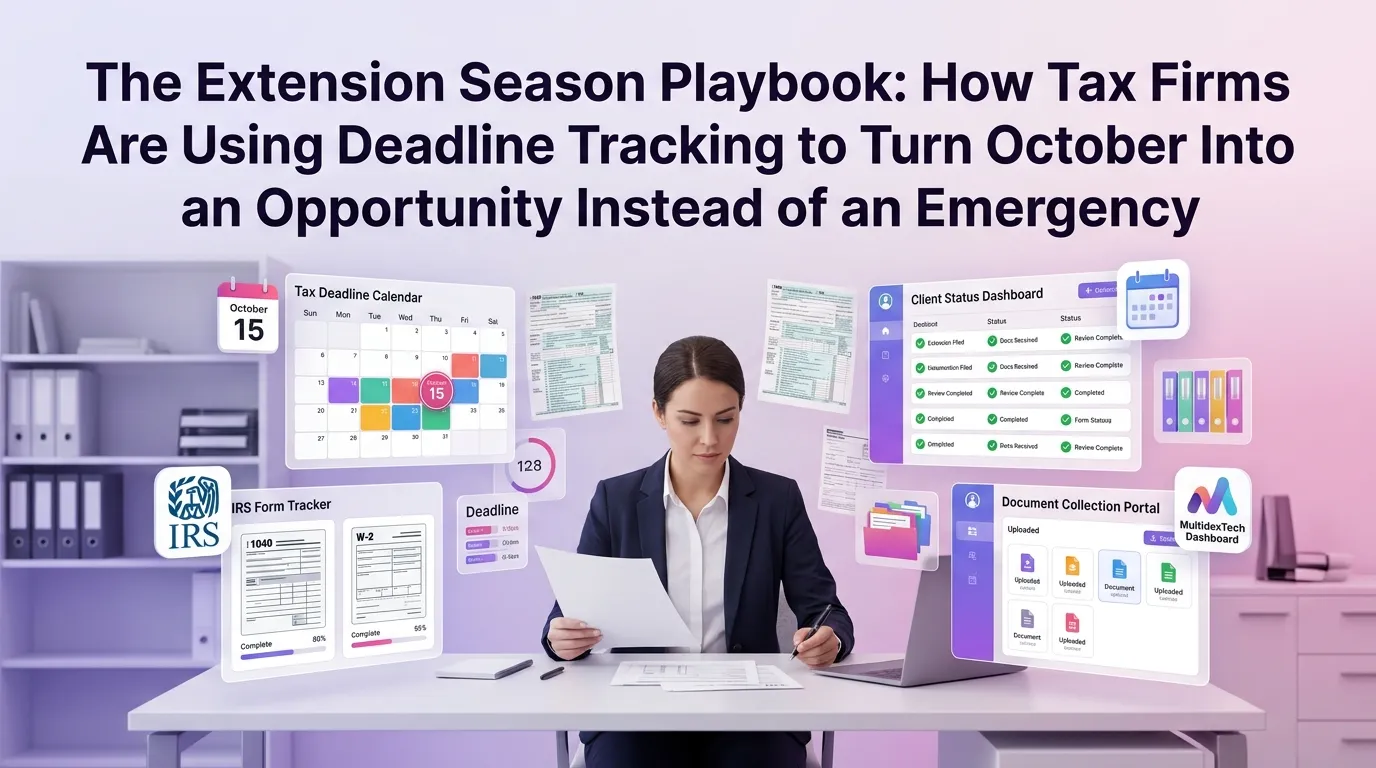
For most tax professionals, October feels less like a month and more like a gauntlet. Extension deadlines converge, client files that sat dormant since April suddenly demand immediate attention, and the margin for error shrinks with every passing day. But a growing number of forward-thinking firms are rewriting this narrative entirely — transforming what was once a chaotic sprint into a well-orchestrated, revenue-generating season. The secret? Disciplined, technology-driven tax extension deadline tracking that gives teams visibility, accountability, and control long before the calendar flips to fall.
Why October Became the Most Stressful Month in Tax
The October 15th individual extension deadline is one of the most concentrated pressure points in the entire tax calendar. Firms that filed extensions in April essentially deferred the work — but not the deadline. When those files come due simultaneously, the resulting workload can overwhelm even well-staffed practices.
According to data from the IRS filing season statistics, tens of millions of individual returns are filed on extension each year. That's a massive volume of work that doesn't disappear — it simply gets delayed. For firms without a structured tracking system, that delay becomes a liability.
The problem isn't the volume alone. It's the invisibility. Without clear visibility into which extended returns are in what stage, partners and managers are essentially flying blind — reacting to crises rather than preventing them.
The Hidden Cost of Poor Deadline Management
Most firms are aware of the obvious costs of missed deadlines: penalties, client dissatisfaction, and potential malpractice exposure. But the hidden costs are often even more damaging to a firm's long-term health.
Staff Burnout and Turnover
When deadlines aren't tracked proactively, staff are constantly working in reactive mode. Last-minute fire drills, late nights in October, and the anxiety of not knowing what's coming next all contribute to burnout. The AICPA has consistently highlighted talent retention as one of the top challenges facing accounting firms — and chaotic deadline management is a direct accelerant.
High turnover is expensive. Recruiting, onboarding, and training a new staff accountant can cost a firm tens of thousands of dollars. Fixing the operational dysfunction that drove them away costs far less.
Revenue Leakage
Poor deadline tracking also creates revenue leakage. When teams are scrambling, billable time goes unrecorded, scope creep goes unbilled, and rush jobs eat into margins. Firms that have systematized their extension season routinely report improved realization rates simply because they have more time to do the work right — and bill it properly.
Client Relationship Erosion
Clients notice when their firm is disorganized. Missed communications, last-minute document requests, and surprise penalty notices erode trust in ways that are difficult to repair. In a relationship-driven industry, that trust is your most valuable asset.
What Effective Tax Extension Deadline Tracking Actually Looks Like
Effective deadline tracking is not simply a spreadsheet with due dates. It's a dynamic, real-time system that connects deadlines to workflows, staff assignments, client communications, and document status — all in one place.
Centralized Deadline Dashboards
The foundation of any solid system is a centralized dashboard that shows every open extension, its due date, its current status, and the staff member responsible for it. This single source of truth eliminates the "I thought you were handling it" conversations that plague disorganized firms.
Dashboards should be filterable by deadline date, client type, staff member, and completion status. This allows partners to get a firm-wide view in seconds, while managers can drill down to their team's specific workload.
Automated Alerts and Escalations
Static tracking is better than nothing, but automated alerts are what truly transform a firm's responsiveness. A well-configured system should send alerts when a deadline is approaching, when a file has been stagnant for too long, and when a task is overdue.
Escalation protocols matter too. If a staff accountant hasn't moved a file forward in three days and the deadline is in a week, the system should automatically notify their manager. This removes the burden of manual oversight and ensures nothing falls through the cracks.
Client Document Tracking Integration
One of the biggest bottlenecks in extension season is waiting on client documents. An integrated tracking system should connect deadline visibility with document receipt status, so teams know at a glance which returns are blocked by missing information — and can prioritize client outreach accordingly.
This integration also enables proactive client communication. Instead of scrambling to collect documents in September, firms can begin automated document request campaigns in July and August, smoothing out the workload curve significantly.
How Top Firms Are Using Technology to Flip the Script
The firms that are thriving during extension season aren't working harder — they're working smarter. They've invested in a tax firm automation platform that handles the administrative and tracking overhead so their professionals can focus on high-value work.
Workload Balancing Before the Crunch
With full visibility into the extension pipeline, managers can see capacity issues forming weeks in advance. If one team is overloaded and another has bandwidth, assignments can be redistributed before the bottleneck becomes a crisis.
This kind of proactive workload balancing is only possible when you have real-time data. Firms relying on email threads and spreadsheets simply don't have the visibility to make these adjustments in time.
Turning Extensions Into Upsell Opportunities
Here's the strategic insight that separates high-performing firms from the rest: the extension season is not just a deadline management challenge — it's a client engagement opportunity. When a firm reaches out proactively with organized, professional communication, clients notice.
Firms that use automated client portals and deadline tracking workflows report higher rates of advisory service upsells during extension season. Why? Because the outreach is timely, professional, and positions the firm as a proactive partner rather than a reactive vendor. As the Journal of Accountancy has noted, the shift toward advisory services is the defining growth strategy for modern accounting firms — and extension season is an underutilized touchpoint for that conversation.
Post-Season Analytics for Continuous Improvement
Firms that track deadlines systematically also accumulate valuable data. After October 15th, they can run reports on average completion times, bottleneck stages, client responsiveness, and staff efficiency. This data becomes the foundation for next year's planning — turning every extension season into a learning opportunity.
Building Your Extension Season Playbook
If you're ready to stop dreading October and start leveraging it, here's a practical framework for building your firm's extension season playbook.
Step 1: Audit Your Current Tax Extension Deadline Tracking Process
Start by honestly assessing what you're doing now. Where do deadlines live? Who owns them? How are staff alerted when something is due? What happens when a deadline is at risk? If the answers involve spreadsheets, email, or "it depends on the partner," you have room to improve.
Document the current process, identify the failure points, and use that as your baseline for measuring improvement after you implement a better system.
Step 2: Implement a Centralized Tracking System Before Summer Ends
Don't wait until September to set up your tracking infrastructure. By the time extensions start coming due, your system should already be populated with every open extension, assigned to the appropriate staff, and configured with automated alerts.
The best time to implement is June or July — early enough to work out configuration issues before the crunch, and late enough that you have a clear picture of your extension volume.
Step 3: Establish Client Communication Cadences
Map out exactly when and how you'll communicate with extension clients throughout the summer and fall. Automated reminders for document submission, status updates, and deadline notifications should all be templated and scheduled in advance.
Consistency in communication reduces inbound client calls, which frees up staff time for actual work. It also demonstrates professionalism and builds the trust that drives referrals and retention.
Step 4: Review and Optimize After Every Season
After October 15th, schedule a post-mortem. Review your analytics, gather staff feedback, and identify the two or three biggest friction points. Then commit to fixing them before next year. Continuous improvement compounds — each year's extension season should be measurably better than the last.
The ROI of Getting This Right
The return on investment from systematic deadline management is real and measurable. Firms that implement automated tracking consistently report reduced overtime costs, improved client satisfaction scores, higher staff retention, and stronger realization rates.
More importantly, they report something harder to quantify but equally valuable: confidence. When partners know that every extension is being tracked, every client is being communicated with, and every deadline is covered, they can focus on growing the firm instead of managing the chaos.
If you're ready to experience that confidence for yourself, start your free trial of TaxFlow and see how purpose-built deadline tracking changes the way your firm operates.
Frequently Asked Questions
What is tax extension deadline tracking and why does it matter?
Tax extension deadline tracking is the systematic process of monitoring all extended tax return due dates, their current completion status, and the staff responsible for each file. It matters because untracked deadlines lead to missed filings, client penalties, staff burnout, and revenue leakage — all of which are preventable with the right system in place.
When should tax firms start preparing for the October extension deadline?
Ideally, firms should begin populating their extension tracking systems and initiating client document requests by June or July. This gives teams three to four months to collect documents, complete returns, and address any complex issues before the October 15th deadline. Starting early dramatically reduces the crunch in September and October.
What features should I look for in a tax deadline tracking tool?
Look for a centralized dashboard with real-time status updates, automated alerts for approaching and overdue deadlines, workload visibility across staff members, client document tracking integration, and post-season analytics reporting. The best tools connect deadline management to your broader workflow so nothing exists in isolation.
How can deadline tracking help with client retention?
Proactive, consistent communication — enabled by automated deadline tracking — signals to clients that your firm is organized and attentive. Clients who receive timely reminders, clear status updates, and professional outreach are significantly more likely to remain loyal and refer others than those who feel like an afterthought during busy season.
Is TaxFlow suitable for small and mid-sized tax firms?
Yes. TaxFlow by MultidexTech is designed to scale with firms of all sizes. Small firms benefit from the structure and automation that replaces manual tracking, while mid-sized firms gain the workload visibility and reporting capabilities needed to manage larger teams and higher client volumes. You can view our pricing plans to find the right fit for your firm, or explore our blog for more resources on firm efficiency and deadline management.
Ready to make this your best extension season yet? TaxFlow by MultidexTech gives tax firms the deadline tracking, workflow automation, and client communication tools they need to turn October from a crisis into a competitive advantage. Try it free for 14 days — no credit card required. Start your free trial today and see the difference that real visibility makes.
Related Posts

The Deadline Intelligence Gap: How Tax Firms Are Using Automated Tracking to Manage Hundreds of Due Dates Without a Single Spreadsheet
12 min read
The Compliance Calendar Advantage: How Tax Firms Are Using Automated Deadline Tracking to Serve More Clients Without Missing a Beat
12 min read

The Deadline Intelligence Gap: How Tax Firms Are Using Automated Tracking to Manage More Returns With Less Mental Load
12 min read