
The Deadline Intelligence Gap: How Tax Firms Are Using Automated Tracking to Manage Hundreds of Due Dates Without a Single Spreadsheet
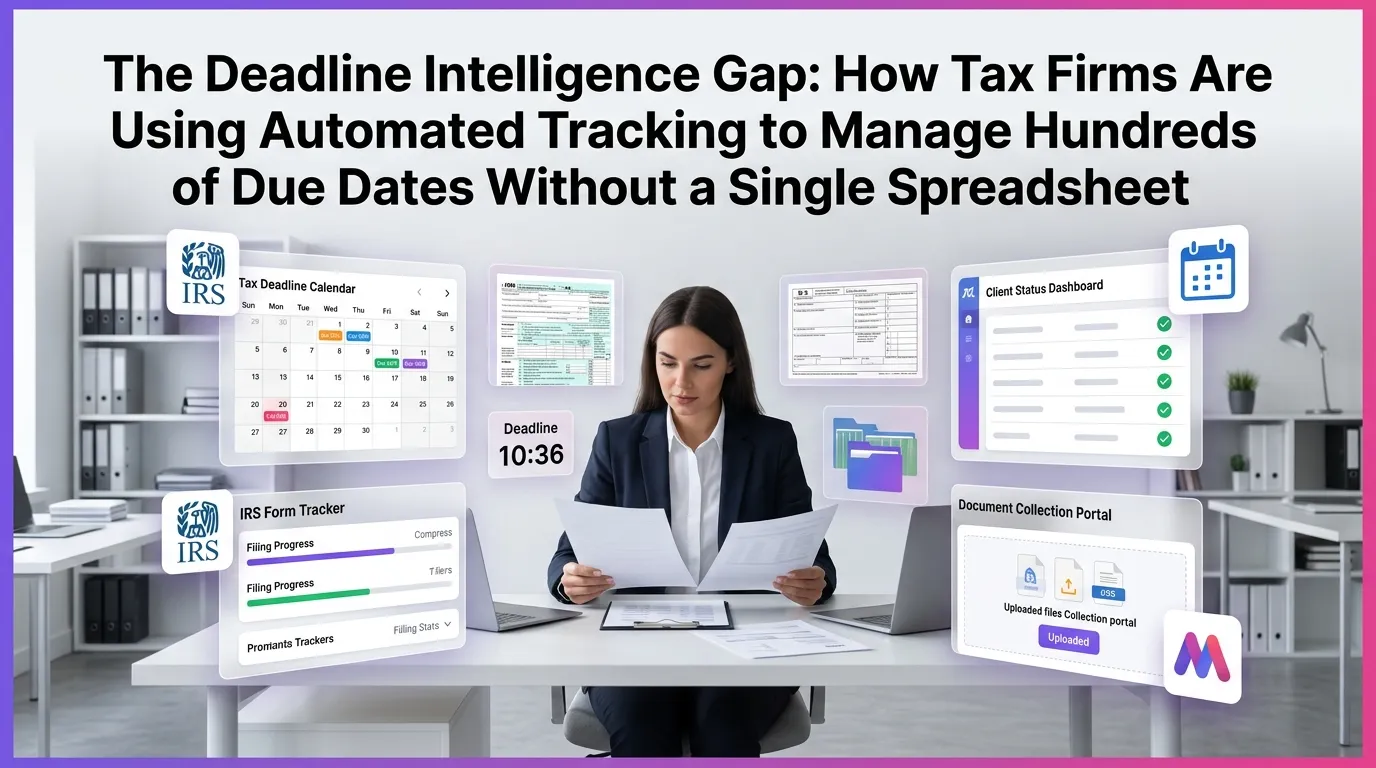
Tax firms today are managing more clients, more filing types, and more regulatory complexity than ever before. With hundreds of due dates scattered across federal, state, and local jurisdictions — each with its own rules, extensions, and penalties — the margin for error is razor-thin. Firms that still rely on spreadsheets, sticky notes, or calendar reminders are not just working inefficiently; they're operating with a dangerous blind spot that puts client relationships and revenue at risk.
The Hidden Cost of Manual Deadline Management
Most tax professionals understand that missing a deadline is bad. What they underestimate is how often near-misses occur and how much mental energy goes into preventing them. A single partner at a mid-sized firm might be personally tracking dozens of extension deadlines, estimated tax payments, payroll filings, and state-specific due dates simultaneously.
The cognitive load is enormous. And when that load is distributed across a team without a centralized system, the risk multiplies. One staff member updates a spreadsheet; another doesn't see the change. A client calls to change their filing status, and the deadline implications don't get flagged. These aren't hypothetical scenarios — they're the daily reality for thousands of tax practices.
According to the American Institute of CPAs (AICPA), missed deadlines and compliance errors are among the top causes of professional liability claims against accounting firms. The financial and reputational damage from a single missed filing can far exceed the cost of any software investment.
Why Spreadsheets Are the Wrong Tool for Deadline Intelligence
Spreadsheets were never designed for dynamic, multi-variable deadline management. They're static by nature — they don't alert you, they don't update automatically when the IRS changes a due date, and they don't integrate with your client management workflow.
The problem isn't discipline or effort. Even the most meticulous tax professional can't manually track every interaction between a client's situation and the applicable filing calendar. What if a client files for an extension? What if they're in a state that follows different rules? What if a federal holiday shifts a due date by one day? A spreadsheet requires a human to catch every one of these variables. Automated deadline tracking for tax firms solves this at the system level.
The IRS Tax Calendar alone lists dozens of recurring deadlines that shift based on weekends, holidays, and filing status. Layering state requirements on top of that creates a complexity that no static document can reliably handle.
The Compounding Problem of Scale
A solo practitioner with 50 clients might manage deadline tracking manually — barely. But when a firm grows to 200, 500, or 1,000 clients, the same approach becomes structurally impossible. Each new client doesn't just add one deadline; they add a cascade of them across their entity types, jurisdictions, and tax elections.
Firms that don't solve the deadline intelligence problem early find themselves hitting a growth ceiling. They can't take on more clients because they can't safely manage more deadlines. The irony is that the tool limiting their growth is often a free spreadsheet — and the solution costs a fraction of what one missed deadline would.
What Automated Deadline Tracking for Tax Firms Actually Looks Like
Automated deadline tracking isn't just a fancier calendar. It's a system that understands the relationships between client data, filing requirements, and time — and acts on those relationships proactively. Here's what a modern solution actually delivers:
Dynamic, Client-Specific Deadline Calendars
Every client has a unique filing profile — their entity type, fiscal year, state registrations, and elected forms all determine which deadlines apply to them. A proper automated system builds a personalized deadline calendar for each client automatically, based on the data you've already entered.
When a client's situation changes — say, they add a state registration or elect S-corp status — the system updates their deadline profile without requiring manual intervention. This is the core of what makes automation genuinely powerful rather than just convenient.
Intelligent Alerts and Escalation Workflows
Automated alerts are only useful if they reach the right person at the right time with the right context. A well-designed system sends tiered reminders — perhaps 30 days out, 14 days out, and 3 days out — and escalates if no action has been logged. It also distinguishes between a deadline that's been addressed and one that's still open.
This kind of intelligent escalation means that nothing slips through because a staff member was out sick or a reminder email got buried. The system holds accountability at the workflow level, not the individual level.
Jurisdiction-Aware Rule Engines
Federal deadlines are just the beginning. State filing requirements vary dramatically — some states conform to federal extensions, others don't. Some have their own estimated tax payment schedules. A jurisdiction-aware rule engine keeps track of these differences so your team doesn't have to.
This is especially critical for firms serving clients across multiple states. The alternative — manually researching state rules for every client — is both time-consuming and error-prone. Automation handles this as a background function, surfacing only the exceptions that require human judgment.
The Operational Shift: From Reactive to Proactive
One of the most profound changes that automated deadline tracking brings to a tax firm isn't technical — it's cultural. When deadlines are managed reactively (scrambling as they approach), the entire firm operates in a state of low-grade urgency. Staff feel stressed, partners are constantly context-switching, and client communication becomes crisis-driven.
When deadlines are managed proactively through automation, the firm operates from a position of control. Work gets scheduled weeks in advance. Client conversations happen on your timeline, not theirs. And the partners can focus on advisory work — the high-value activity that actually differentiates a firm — instead of administrative firefighting.
This shift also has direct implications for staff retention. Burnout in tax practices is frequently tied to the chaotic pace of deadline season. Firms that systematize deadline management report that their teams feel more confident, less stressed, and better able to deliver quality work. That's not a soft benefit — it's a competitive advantage in a tight talent market.
How Client Communication Improves with Automation
Automated systems don't just help your internal team — they improve the client experience too. When your platform can automatically send clients a heads-up that their quarterly estimated payment is due in two weeks, or that you'll need their documents by a certain date to meet their filing deadline, clients feel informed and valued.
This proactive communication reduces the volume of inbound "where are we on my taxes?" calls and emails. It also sets clear expectations, which reduces the friction that often accompanies deadline crunches. Clients who feel well-managed are clients who refer others and renew their engagements year after year.
Choosing the Right Platform: What to Look For
Not all deadline tracking tools are created equal. Some are glorified to-do lists. Others are calendar overlays that still require manual entry. When evaluating a tax firm automation platform, look for these specific capabilities:
- Client-level deadline mapping: Deadlines should be tied to individual client profiles, not generic firm-wide calendars.
- Automatic rule updates: The system should update when IRS or state deadlines shift due to holidays or regulatory changes.
- Workflow integration: Deadline alerts should trigger actual tasks, not just notifications that get ignored.
- Audit trail: Every deadline action — who acknowledged it, when, and what was done — should be logged for compliance purposes.
- Multi-user visibility: Partners, managers, and staff should all have role-appropriate views of the deadline landscape.
According to the Journal of Accountancy, technology adoption is now a primary differentiator among high-growth accounting firms. Practices that invest in purpose-built tools consistently outperform those relying on generic productivity software.
Real-World Impact: What Firms Are Experiencing
Firms that have implemented automated deadline tracking consistently report several measurable outcomes. First, they see a dramatic reduction in missed or late filings — often dropping to near zero after the first full tax season on the platform. Second, they recover significant billable hours that were previously spent on deadline administration.
Third — and perhaps most importantly — they gain the confidence to grow. When you know your deadline management system will scale with you, adding 50 or 100 new clients doesn't feel like a risk. It feels like an opportunity. That confidence is what separates firms that plateau from firms that grow intentionally and sustainably.
The firms seeing the greatest results are those that treat deadline automation not as a feature to try, but as a foundational operational decision. They integrate it into onboarding, build workflows around it, and train their entire team to rely on it as the single source of truth for all filing obligations.
Getting Started Without Disrupting Your Practice
One concern firms often raise is the transition cost — the time and effort required to move from their current system to an automated one. This concern is understandable but frequently overestimated. Modern platforms are designed for rapid onboarding, with import tools that pull client data from common practice management systems and pre-built deadline templates for the most common filing types.
The best approach is to implement during a lower-volume period and run the new system in parallel with your existing process for one season. By the time the next busy season arrives, your team will have full confidence in the platform. You can start your free trial to experience the setup process firsthand before committing to a full rollout.
Frequently Asked Questions
What is automated deadline tracking for tax firms?
Automated deadline tracking for tax firms is a software-driven system that monitors, organizes, and alerts tax professionals to upcoming filing deadlines based on each client's unique tax profile. Unlike manual spreadsheets, automated systems update dynamically when client data changes or regulatory deadlines shift, ensuring nothing is missed.
How does automated deadline tracking handle state-specific filing rules?
Purpose-built tax firm platforms include jurisdiction-aware rule engines that account for each state's unique filing requirements, extension policies, and payment schedules. These rules are maintained and updated by the software provider, so your team doesn't need to manually research state-by-state variations.
Can automated deadline tracking integrate with existing practice management software?
Most modern automated deadline tracking platforms are designed to integrate with or import data from common practice management systems. This minimizes duplicate data entry and ensures that your deadline calendar stays in sync with your client database. Always verify specific integration capabilities with the platform provider before purchasing.
How many deadlines can an automated system realistically manage?
There is no practical upper limit. A well-designed system can manage thousands of individual deadlines across hundreds of clients simultaneously. The system's capacity scales with your firm's growth, which is precisely why it outperforms manual methods that hit a ceiling as client volume increases.
Is automated deadline tracking worth the investment for small tax firms?
Yes — arguably more so for small firms than large ones. Small firms often lack the administrative staff to manage deadline oversight manually, making them more vulnerable to errors. The cost of one missed deadline (in penalties, client loss, or liability exposure) typically exceeds the annual cost of a dedicated platform. Many providers, including MultidexTech, offer tiered pricing that makes the investment accessible at any firm size. You can view our pricing plans to find the right fit for your practice.
Ready to eliminate deadline anxiety from your practice? TaxFlow by MultidexTech gives tax firms a purpose-built automated deadline tracking system designed to scale with your client base — without the spreadsheets, without the scrambling, and without the risk. Start your 14-day free trial today and see how much clearer your firm's future looks when every deadline is accounted for. No credit card required.
Want to explore more strategies for building a more efficient, scalable tax practice? Explore our blog for expert insights on workflow automation, client management, and firm growth — all written specifically for tax professionals navigating the modern practice landscape.
Related Posts
The Extension Season Playbook: How Tax Firms Are Using Deadline Tracking to Turn October Into an Opportunity Instead of an Emergency
11 min read
The Compliance Calendar Advantage: How Tax Firms Are Using Automated Deadline Tracking to Serve More Clients Without Missing a Beat
12 min read

The Deadline Intelligence Gap: How Tax Firms Are Using Automated Tracking to Manage More Returns With Less Mental Load
12 min read