
The Accountant's Operating System: How to Build Firm-Wide Standards That Eliminate Guesswork and Drive Consistent Results
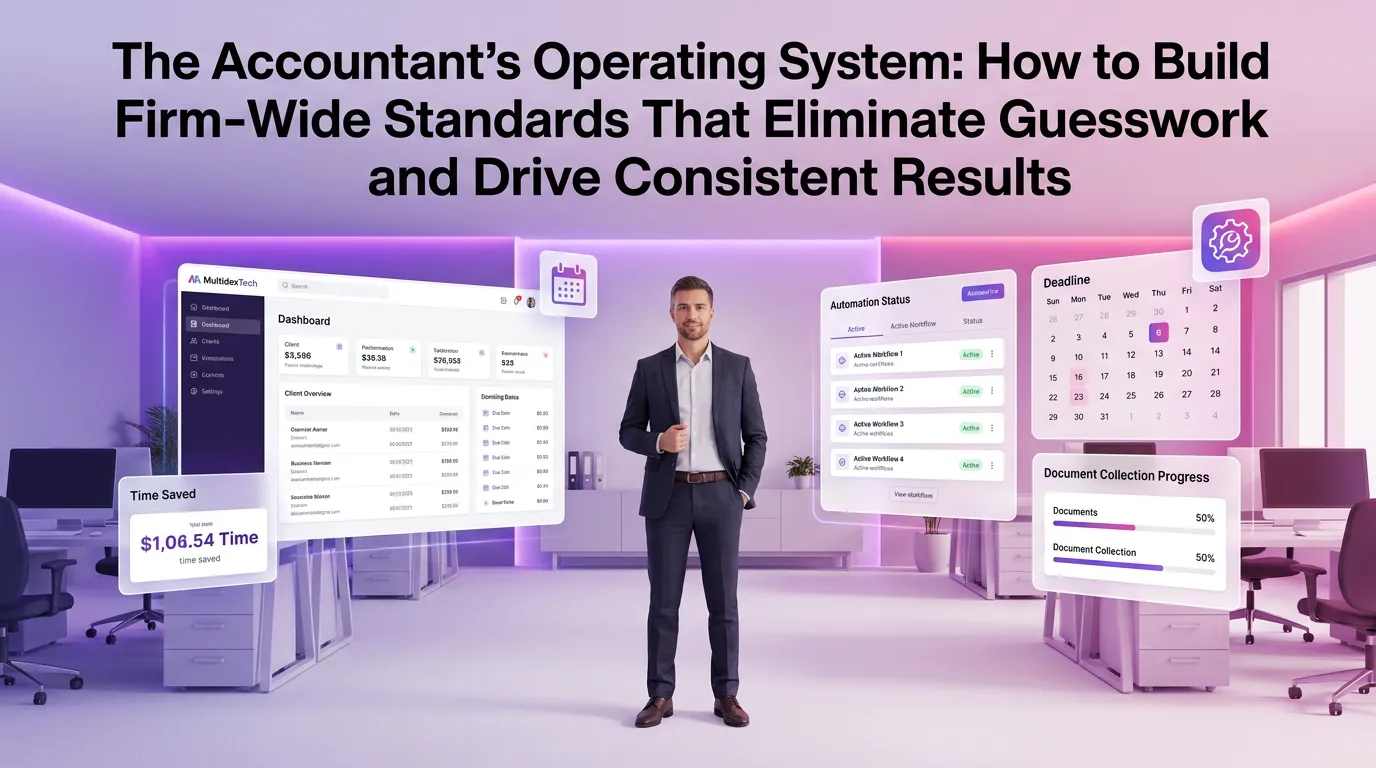
Every accounting firm reaches a point where informal processes start to crack under pressure. A team member handles a client differently than a colleague would. A deadline slips because nobody owned it clearly. A new hire takes months to become productive because the "way we do things" exists only in the founder's head. These are not talent problems — they are systems problems. The firms that scale successfully, retain top staff, and deliver consistently exceptional client experiences are the ones that have built what we call an Accountant's Operating System: a firm-wide framework of standards, workflows, and accountability structures that eliminate guesswork at every level.
What Is a Firm Operating System and Why Does It Matter?
A firm operating system is not a single piece of software or a binder of policies collecting dust on a shelf. It is the interconnected set of standards, processes, roles, and tools that define how your firm operates — from how you onboard a new client to how you close out a tax season.
Think of it as the difference between a franchise and an independent restaurant. The franchise has documented recipes, training protocols, and quality checks that produce a consistent burger whether you are in Dallas or Denver. The independent restaurant relies on the head chef showing up every day. Most accounting firms are built more like the latter — and that fragility has real consequences for growth.
According to the AICPA's research on top issues facing the accounting profession, workflow inefficiency and staff retention are consistently ranked among the most pressing challenges for firms of all sizes. A well-designed operating system directly addresses both.
The Core Pillars of Practice Management Best Practices for Accountants
Building a firm operating system starts with understanding its foundational components. Each pillar reinforces the others, creating a self-sustaining structure that keeps your firm running smoothly even as it grows.
1. Standardized Client Onboarding
The onboarding process is your firm's first opportunity to demonstrate competence and set expectations. A chaotic onboarding experience — missed emails, unclear timelines, redundant document requests — signals to clients that the rest of the engagement will feel the same way.
A standardized onboarding workflow should include a defined welcome sequence, a structured intake form, a clear document checklist, and an assigned point of contact. Every client should experience the same high-quality entry point regardless of which team member handles them.
Using a tax firm automation platform like TaxFlow allows you to automate key onboarding steps — sending welcome emails, triggering document requests, and assigning tasks to staff — so nothing falls through the cracks during your busiest periods.
2. Documented Workflow Templates
Every recurring service your firm offers — individual tax returns, business returns, bookkeeping, payroll, advisory — should have a documented workflow template. This template breaks the service down into discrete, assignable tasks with expected timelines and responsible parties.
Workflow templates serve multiple purposes. They make it easy to train new staff, they provide a basis for quality review, and they give managers visibility into where work stands at any given moment.
The Journal of Accountancy has highlighted that firms with formal workflow documentation report significantly faster turnaround times and higher staff satisfaction — both of which translate directly to profitability.
3. Clear Role Definitions and Accountability Structures
In many small and mid-sized firms, roles are loosely defined and responsibilities overlap in confusing ways. When something goes wrong — or right — it is unclear who owns it. This ambiguity breeds frustration and inconsistency.
Your operating system should clearly define who is responsible for each type of task, who reviews completed work, and who communicates directly with clients at each stage. This is not about bureaucracy — it is about clarity. Clear accountability actually frees people to do their best work.
4. Consistent Communication Standards
How your firm communicates with clients is just as important as the quality of the work product itself. Are client-facing emails professional and on-brand? Do clients receive proactive status updates, or do they have to chase your team for information?
Establishing communication standards — including response time expectations, approved language for common scenarios, and escalation protocols — ensures that every client interaction reinforces the same professional impression.
Practice Management Best Practices for Accountants: Building the System Step by Step
Knowing the pillars is one thing; building them is another. Here is a practical framework for implementing your firm operating system without disrupting active work.
Step 1: Audit Your Current State
Before you build anything new, you need an honest picture of how your firm actually operates today. Shadow your team members, review recent client files, and identify where delays, errors, or client complaints tend to cluster.
Look for the moments where a team member says, "I wasn't sure what to do, so I..." — those moments reveal the gaps your operating system needs to fill.
Step 2: Identify Your High-Value, High-Frequency Services
You do not need to document everything at once. Start with the services you deliver most frequently and that generate the most revenue. For most tax firms, this means individual returns, business returns, and quarterly bookkeeping clients.
Build your first workflow templates around these services. Even a rough first draft is infinitely more useful than nothing — and it gives your team something concrete to react to and improve.
Step 3: Assign a Process Owner for Each Service Line
Every workflow template needs a human champion — someone who owns it, updates it when processes change, and monitors whether the team is actually following it. Without a process owner, documentation becomes stale and ignored within months.
This role does not need to be a senior partner. In fact, assigning process ownership to experienced staff members is a powerful way to develop leadership and increase engagement.
Step 4: Build Your Tech Stack Around Your Processes
Too many firms make the mistake of adopting software and then trying to fit their processes around it. The better approach is to define your ideal process first, then select tools that support it.
Your technology stack should cover client communication, document management, task and workflow management, billing, and reporting. Ideally, these tools are integrated so that data flows between them without manual re-entry — a principle that a purpose-built platform like TaxFlow is designed to fulfill.
Step 5: Train, Reinforce, and Iterate
A documented process that nobody follows is worse than no process at all — it creates false confidence. Once your workflows are defined, invest real time in training your team. Walk through each step together. Answer questions. Explain the "why" behind each requirement.
Then build in regular review cycles. Tax law changes. Client expectations evolve. Your processes should be living documents that improve over time, not artifacts frozen in the past.
How Automation Amplifies Your Operating System
Manual processes have a ceiling. Even the most disciplined team will eventually miss a step when they are juggling 200 returns during tax season. Automation removes the human error from routine, repeatable tasks — freeing your team to focus on judgment-intensive work that genuinely requires their expertise.
Consider how automation can support each pillar of your operating system: automated onboarding sequences that trigger when a new client record is created; workflow task assignments that fire automatically when a prior step is marked complete; automated reminders to clients who have not yet submitted required documents; and real-time dashboards that give managers a live view of firm-wide progress.
The IRS's ongoing modernization efforts are also pushing more interactions into digital channels, making it increasingly important for firms to have digital-first workflows that can interface seamlessly with electronic filing systems and e-signature tools.
If you are ready to see what a fully automated operating system looks like in practice, you can start your free trial of TaxFlow and explore how it supports each layer of firm-wide process standardization.
Measuring the Impact of Your Operating System
You cannot manage what you cannot measure. Once your operating system is in place, you need a small set of key performance indicators (KPIs) to track whether it is working.
Useful metrics include average turnaround time per service type, error and revision rates, client satisfaction scores, staff utilization rates, and revenue per staff member. Tracking these over time will reveal which parts of your operating system are performing and which need refinement.
Monthly team reviews — even brief ones — where you walk through these metrics together create a culture of continuous improvement and shared ownership of firm performance.
The Cultural Dimension: Getting Buy-In From Your Team
Process documentation can feel threatening to experienced team members who have built their value around being the person who "knows how things work." It is important to frame your operating system as a tool that makes everyone's job easier — not a surveillance mechanism or a threat to job security.
Involve your team in building the workflows. Their frontline knowledge is invaluable, and their participation creates ownership. People support systems they helped design.
Celebrate early wins publicly. When a new team member onboards a client flawlessly on their second week because the process was clear, point that out. When a workflow template prevents a missed deadline, acknowledge it. Culture is built through repeated stories, and your operating system should become the hero of many of them.
For more practical guidance on building efficient, high-performing accounting practices, explore our blog where we regularly publish actionable insights for firm leaders.
Frequently Asked Questions
What are the most important practice management best practices for accountants just starting to formalize their processes?
Start with your highest-frequency services and document those workflows first. Assign a process owner for each service line, invest in training your team on the new standards, and choose technology that supports — rather than dictates — your ideal processes. Small, consistent improvements compound significantly over time.
How long does it take to build a firm operating system?
A basic operating system covering your core service lines can be built in four to eight weeks with focused effort. Full implementation — including technology integration, team training, and initial iteration cycles — typically takes three to six months. The key is to start with something imperfect and improve it, rather than waiting until everything is perfect before launching.
Can a small firm with just two or three staff members benefit from process standardization?
Absolutely. In fact, small firms often benefit the most because a single missed step or inconsistent client experience has an outsized impact at that scale. Documented processes also make it dramatically easier to bring on your next hire and get them productive quickly — which is often the bottleneck to growth for small firms.
What role does technology play in a firm operating system?
Technology should support and enforce your defined processes — not replace the thinking that goes into designing them. The right tools automate routine steps, provide visibility into work status, and reduce the cognitive load on your team. Platforms like TaxFlow are purpose-built to integrate these functions in a single environment designed specifically for tax and accounting firms.
How do I get my team to actually follow the documented processes?
Involve them in creating the processes so they have ownership. Explain the reasoning behind each step. Build the processes into your technology so following them is the path of least resistance. And hold regular reviews where adherence to process is part of the conversation — not to punish, but to identify where the process itself may need to improve.
Ready to put your firm's operating system on autopilot? MultidexTech's TaxFlow platform is built specifically for tax and accounting firms that are serious about scaling without sacrificing quality. From automated onboarding to real-time workflow dashboards, TaxFlow gives you the infrastructure to run a consistent, professional firm at any size. Try it free for 14 days — no credit card required — and see the difference a purpose-built system makes. Start your free trial today, or view our pricing plans to find the right fit for your firm.
Related Posts
The Delegation Blueprint: How Tax Firm Owners Are Using Team Management Tools to Assign Work, Track Progress, and Stop Being the Bottleneck
11 min read
The Team Visibility Problem: How Tax Firms Are Using Role-Based Management to Assign Work, Track Progress, and Scale Without the Chaos
13 min read
The Org Chart That Runs Itself: How Tax Firms Are Using Role-Based Team Management to Scale Without Supervision Bottlenecks
11 min read