
The Team Visibility Problem: How Tax Firms Are Using Role-Based Management to Assign Work, Track Progress, and Scale Without the Chaos
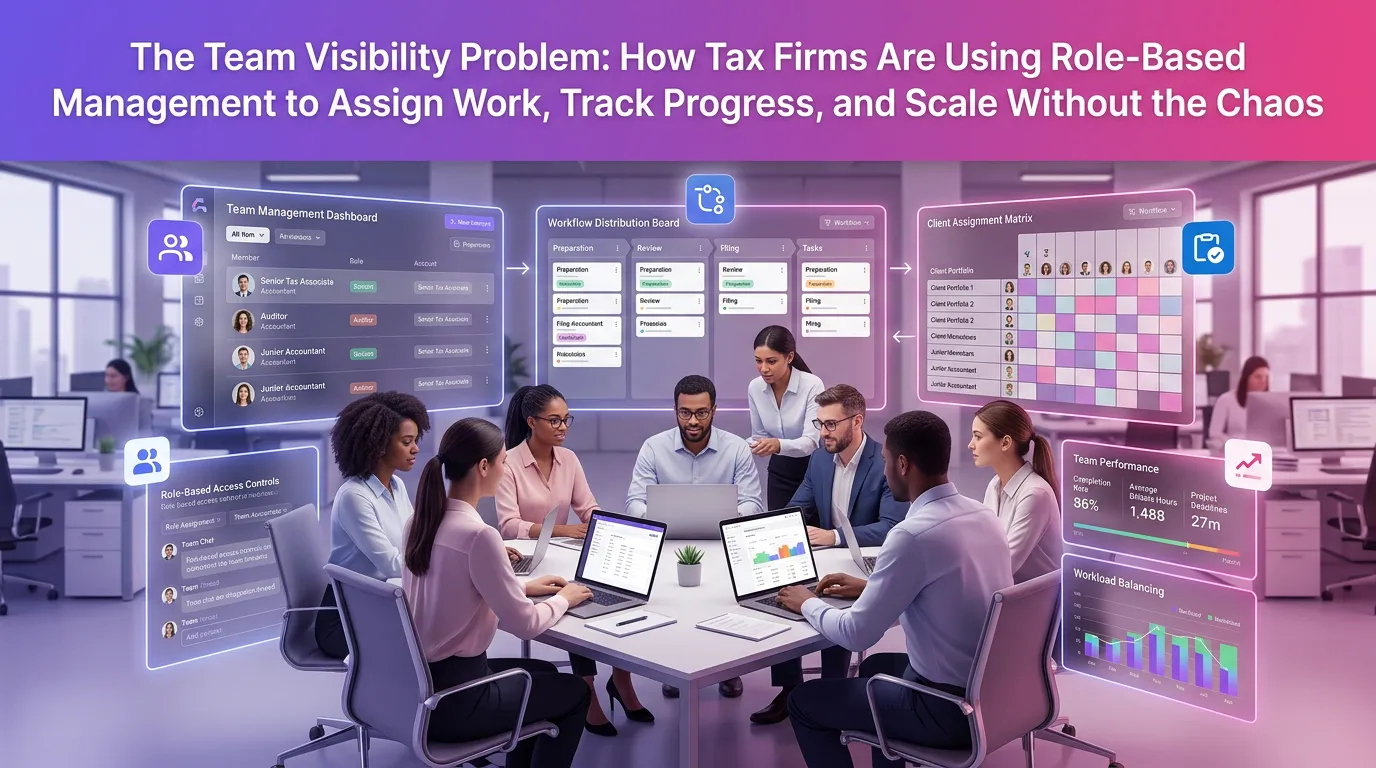
Running a growing tax firm often feels like conducting an orchestra where no one can see the conductor. Senior preparers are buried in returns, reviewers don't know what's ready for their attention, and managers spend half their day sending status-check emails instead of doing billable work. The result is missed deadlines, duplicated effort, and a team that's perpetually reactive rather than strategic. This is the team visibility problem — and it's one of the most common reasons tax firms plateau instead of scale.
Fortunately, modern tax firm automation platforms are solving this with role-based management systems that give every team member a clear view of their responsibilities, their workload, and the overall health of the practice. In this post, we'll break down exactly how role-based management works, why it matters for tax firms specifically, and how to implement it without disrupting your existing workflows.
What Is the Team Visibility Problem in Tax Firms?
The team visibility problem isn't just about not knowing who's doing what. It's a systemic breakdown in communication that compounds under seasonal pressure. During peak filing periods, even small coordination failures cascade into significant operational disruptions.
Consider a typical scenario: a preparer finishes a complex business return, marks it done in their personal spreadsheet, and moves on. The reviewer doesn't know it's ready. The client calls asking for an update. The manager has to track down the preparer, confirm the status, and relay the information — a chain of interruptions that could have been avoided entirely with proper workflow visibility.
According to the AICPA's guidance on managing accounting firms, one of the top operational challenges for growing practices is the lack of standardized processes for tracking work in progress. Without that standardization, firms rely on tribal knowledge — and tribal knowledge doesn't scale.
Why Traditional Methods Break Down as Tax Firms Grow
Small firms often manage team coordination through informal systems: shared spreadsheets, group chats, sticky notes, or simply shouting across the office. These methods work when everyone is in the same room and handling a manageable volume of returns. They collapse the moment you add a second location, a remote employee, or a significant uptick in client volume.
Spreadsheets, in particular, are a common culprit. They require manual updating, offer no real-time visibility, and provide zero accountability. When two people edit the same row simultaneously, or when someone forgets to update a status, the entire team is working from bad data.
Email-based task management is similarly fragile. Important assignments get buried in inboxes, deadlines aren't tracked in a centralized location, and there's no easy way to see the aggregate workload across your team at a glance. As firms grow, these friction points don't just persist — they multiply.
How Role-Based Team Management for Tax Firms Solves the Core Problem
Role-based management systems address the visibility problem at its root by structuring work around defined roles, permissions, and workflows. Instead of relying on individuals to self-report their progress, the system captures and surfaces status updates automatically as work moves through predefined stages.
Here's what a well-designed role-based system typically enables:
Granular Role Assignment and Permissions
Not every team member needs access to every piece of information. A staff preparer doesn't need to see firm-wide billing data; a reviewer doesn't need to modify client intake settings. Role-based systems allow practice managers to define exactly what each role can see, edit, and approve.
This granularity does more than protect sensitive data — it reduces cognitive overload. When team members only see what's relevant to their role, they can focus on their actual work rather than filtering through noise. It also creates natural accountability checkpoints, because each role has a defined scope of responsibility.
Task Assignment and Workload Balancing
One of the most powerful features of role-based management is the ability to assign tasks with full context attached. Rather than saying "handle the Johnson return," a manager can assign the task with the client file, the relevant deadline, the engagement type, and any prior-year notes — all in one place.
Equally important is the ability to see workload distribution across the team. If three preparers each have 40 returns in queue and a fourth has 15, a manager can rebalance before the bottleneck becomes a crisis. This kind of proactive resource management is simply not possible with spreadsheets or email.
Progress Tracking Across Workflow Stages
A well-structured tax workflow has distinct stages: intake, data gathering, preparation, review, client approval, e-file, and completion. Role-based systems map each task to these stages, giving managers a real-time pipeline view of every engagement in the firm.
This visibility is transformative. Instead of asking "where are we on the Martinez return?", a manager can open a dashboard and see that it's in review, assigned to a specific reviewer, with a due date three days out. No interruptions. No status meetings. No guesswork.
The Compliance Dimension: Why Role Clarity Matters for Tax Professionals
Role-based management isn't just an operational convenience — it has meaningful implications for compliance and professional liability. The IRS Circular 230 establishes standards of practice for tax professionals, including requirements around supervision of staff and oversight of work product.
When a firm has clear role definitions and documented workflow stages, it creates an audit trail that demonstrates proper supervisory controls. If a return is ever questioned, the firm can show exactly who prepared it, who reviewed it, what changes were made, and when each step was completed. That documentation is invaluable in a regulatory context.
Beyond compliance, role clarity reduces errors. When everyone knows their specific responsibility in a workflow — and when the system enforces that responsibility — things are less likely to fall through the cracks. Preparers don't skip steps because they assume a reviewer will catch it. Reviewers don't assume the preparer handled something they didn't. The system makes the handoffs explicit and trackable.
Scaling Without Chaos: Team Management for Tax Firms at Every Stage
One of the most compelling arguments for role-based management is its scalability. The same system that works for a five-person firm can accommodate a fifty-person firm — because the underlying logic is the same. You're defining roles, assigning work, and tracking progress. The volume scales; the framework doesn't need to change.
This is critical for firms with growth ambitions. Many practices hit a ceiling not because of a lack of clients or talent, but because their operational infrastructure can't support more complexity. Adding a new preparer to a spreadsheet-based system creates more confusion. Adding a new preparer to a role-based system simply means assigning them a role, setting their permissions, and adding them to the queue.
Onboarding New Team Members Faster
Role-based systems dramatically reduce the onboarding time for new staff. When a new preparer joins, they don't need a two-hour walkthrough of "how we do things here." They log in, see their assigned tasks, understand their role permissions, and know exactly what they're responsible for from day one.
This structured onboarding also reduces the burden on senior staff, who often spend disproportionate time hand-holding new hires through informal processes. With a defined system, the process itself does much of the teaching.
Supporting Remote and Hybrid Teams
The shift toward remote and hybrid work has made team visibility even more critical. When your team isn't in the same physical space, you can't rely on ambient awareness — overhearing conversations, seeing someone at their desk, noticing who's in the conference room. Role-based systems replicate that organizational awareness digitally.
Remote preparers can see their queue, update task statuses, and communicate within the context of specific engagements. Managers can monitor progress without micromanaging. The entire team operates from a shared, real-time view of the firm's work — regardless of where anyone is physically located.
What to Look for in a Role-Based Management System for Your Tax Firm
Not all practice management tools are created equal. When evaluating a role-based system for your firm, there are several capabilities worth prioritizing.
First, look for customizable role definitions. Your firm's org chart is unique, and a system that only offers generic roles (admin, staff, manager) may not map cleanly to how you actually operate. The ability to define custom roles with specific permissions gives you flexibility as your team evolves.
Second, prioritize real-time dashboard visibility. A system that requires manual reporting or generates static snapshots isn't giving you the live view you need to manage effectively. Look for dashboards that update automatically as work progresses.
Third, consider workflow integration. Role-based management is most powerful when it's embedded in your broader workflow — connected to client records, document management, e-file status, and billing. Siloed tools create the same fragmentation you're trying to solve.
The Journal of Accountancy's coverage of technology tools for accounting firms consistently highlights integrated platforms as delivering higher ROI than point solutions, precisely because they eliminate the data silos that create friction.
If you're ready to see how a purpose-built system can transform your firm's operations, explore our blog for more in-depth guides on practice management, workflow automation, and client communication strategies.
Practical Steps to Implement Role-Based Management in Your Tax Firm
Transitioning to a role-based system doesn't have to be disruptive. In fact, the most successful implementations follow a phased approach that allows teams to adapt gradually rather than overhauling everything at once.
Step 1: Map your existing workflow. Before you can define roles, you need to understand how work actually moves through your firm. Document each stage of your engagement lifecycle, identify who is responsible at each stage, and note where handoffs currently break down.
Step 2: Define your role structure. Based on your workflow map, define the roles that reflect your team's actual responsibilities. Be specific — "senior reviewer" and "staff preparer" are more useful than generic labels.
Step 3: Configure permissions thoughtfully. Resist the temptation to give everyone maximum access "just in case." Start with the minimum permissions each role needs and expand based on real needs. This keeps the system clean and reduces confusion.
Step 4: Pilot with one workflow type. Rather than migrating all engagements at once, start with a single engagement type — say, individual 1040 returns. Work out the kinks before rolling out to business returns or other service lines.
Step 5: Review and iterate. After the first season with the new system, gather feedback from your team. What's working? Where are the friction points? Role-based systems should evolve with your firm, not remain static.
Frequently Asked Questions
What is role-based management in a tax firm context?
Role-based management is a system for organizing team work by assigning specific responsibilities, permissions, and task queues to defined roles within the firm. Instead of managing work through ad-hoc communication, each team member operates within a structured framework that defines what they can see, do, and approve. This creates accountability, reduces miscommunication, and gives managers real-time visibility into firm-wide progress.
How does team management for tax firms differ from general project management tools?
General project management tools like Trello or Asana are designed for broad use cases and lack the tax-specific features that accounting practices need. Tax-focused team management systems include features like engagement tracking tied to IRS deadlines, e-file status integration, client document management, and compliance-aware audit trails. These purpose-built capabilities make them far more effective for tax firm workflows than generic alternatives.
Can role-based systems support remote tax teams?
Yes — in fact, role-based management is especially valuable for remote and hybrid teams. Because work assignments, statuses, and communications are centralized in the platform, team members don't need to be physically co-located to stay coordinated. Managers can monitor progress, balance workloads, and identify bottlenecks from anywhere, and preparers always have a clear view of their responsibilities without needing to check in via email or chat.
How long does it take to implement a role-based management system?
Implementation timelines vary depending on firm size and the complexity of your existing workflows, but most firms can complete an initial setup within a few days to two weeks. Platforms like TaxFlow are designed for rapid onboarding, with guided setup processes that walk you through role configuration, workflow mapping, and team setup. Starting with a pilot for one engagement type can further reduce the time to value.
Is role-based management only useful for large tax firms?
Not at all. While the benefits become more pronounced as firms grow, even small practices with three to five team members benefit from role clarity and workflow visibility. The key advantage for smaller firms is that implementing a structured system early makes scaling significantly easier — you're building the operational foundation now rather than scrambling to retrofit it later when the firm is larger and the stakes are higher.
Ready to eliminate the chaos and give your team the clarity they need to perform at their best? TaxFlow by MultidexTech is built specifically for tax firms that want to grow without sacrificing control. With role-based management, real-time workflow dashboards, and seamless team coordination, TaxFlow gives you the infrastructure to scale confidently. Start your free trial today and experience 14 days of full access — no credit card required. Or view our pricing plans to find the right fit for your firm size and workflow needs.
Related Posts
The Delegation Blueprint: How Tax Firm Owners Are Using Team Management Tools to Assign Work, Track Progress, and Stop Being the Bottleneck
11 min read

The Org Chart That Runs Itself: How Tax Firms Are Using Role-Based Team Management to Scale Without Supervision Bottlenecks
11 min read
The Staff Utilization Problem: How Tax Firms Are Using Team Management Tools to Assign Work Smarter, Reduce Bottlenecks, and Scale Without the Guesswork
12 min read