
The Org Chart That Runs Itself: How Tax Firms Are Using Role-Based Team Management to Scale Without Supervision Bottlenecks

Most tax firms don't fail because of bad accountants — they fail because of bad structure. When every decision flows through a single partner, when staff can't act without approval, and when no one is quite sure who owns what, the firm doesn't scale. It stagnates. The firms that grow consistently aren't necessarily the ones with the most talent — they're the ones that have built an operational structure that works even when the managing partner steps away from their desk. That structure starts with role-based team management.
Why Traditional Tax Firm Hierarchies Break Under Growth
The classic tax firm org chart looks something like this: a managing partner at the top, a few senior accountants in the middle, and a rotating staff of preparers and admins at the bottom. On paper, it makes sense. In practice, it creates a supervision bottleneck that tightens every tax season.
When one or two people hold all decision-making authority, growth becomes self-limiting. Every new client, every new hire, every edge case gets funneled upward. The partner becomes a single point of failure — overworked, under-informed, and constantly reactive instead of strategic.
According to the AICPA's Practice Management resources, succession planning and workflow delegation are among the top challenges facing CPA firms today. The issue isn't unique to small firms — it scales poorly at every size.
What Role-Based Team Management Actually Means for Tax Firms
Role-based team management is the practice of assigning specific permissions, responsibilities, and access levels to each member of your team based on their role — not their individual identity. Instead of saying "John can approve returns," you define what a Senior Reviewer can do, and then assign John that role.
This distinction matters enormously. When roles are defined systematically, onboarding new staff becomes faster, accountability becomes clearer, and the firm can grow without the managing partner manually managing every permission.
In the context of a tax firm, roles might include Client Intake Specialist, Tax Preparer, Senior Reviewer, Compliance Manager, and Partner. Each role carries defined access to client records, task assignments, document approvals, and communication logs.
The Core Components of a Well-Defined Role Structure
A functional role-based system has three layers: access control, task ownership, and escalation paths. Access control determines who can see or edit what. Task ownership ensures every deliverable has a clear responsible party. Escalation paths define when and how issues move up the chain.
Without all three, firms end up with what might be called "role theater" — titles that exist but don't actually govern how work flows. The result is the same bottleneck, just with better-looking business cards.
Platforms built specifically for tax firm automation handle these three layers natively, embedding them into the workflow rather than bolting them on as an afterthought.
How Role-Based Team Management for Tax Firms Eliminates Supervision Bottlenecks
The bottleneck problem in tax firms is fundamentally a trust-and-visibility problem. Partners don't delegate because they can't see what's happening without being directly involved. Role-based systems solve this by making the work visible without requiring the partner to be present in every conversation.
When a tax preparer submits a return for review, the system automatically routes it to the assigned Senior Reviewer based on role — not based on who happens to be available or who the preparer personally messages. The partner can see the queue, the status, and the history without intervening.
This is the fundamental shift: from supervision as a bottleneck to oversight as a dashboard. Partners move from being in the critical path of every task to being informed observers who only step in when genuinely needed.
Real-World Workflow: From Intake to Filed Return
Consider a mid-size tax firm handling 800 returns per season. Without a structured role system, the flow is chaotic: documents arrive in a shared inbox, preparers grab whatever's on top, reviews happen via email threads, and the partner signs off on everything at the last minute.
With role-based management, the same 800 returns move through a defined pipeline. The Client Intake Specialist logs documents and creates the client record. The system assigns the return to an available Tax Preparer based on workload rules. The completed return routes automatically to a Senior Reviewer. Only flagged exceptions reach the Partner level.
The result isn't just faster — it's measurably less stressful and significantly more scalable. The Journal of Accountancy has documented similar workflow transformations at firms that moved from reactive to process-driven operations.
Building Your Tax Firm's Role Architecture: A Practical Framework
Getting role-based management right doesn't require a complete organizational overhaul. It requires clarity about what each person actually does — and what they should be empowered to do without asking for permission.
Step 1: Audit Your Current Workflow
Before assigning roles, map how work actually flows today — not how it's supposed to flow. Walk through a return from client inquiry to e-file confirmation and note every touchpoint, every approval, and every place where work sits waiting for someone's attention.
You'll almost certainly find that a handful of people are approval gates for decisions they don't need to own. That's your bottleneck map — and it's exactly what your role structure needs to dissolve.
Step 2: Define Roles by Capability, Not Title
Resist the temptation to map your existing job titles directly to system roles. A "Senior Associate" at your firm might do what a "Tax Preparer" does at another. What matters is what the role is authorized to do: prepare, review, approve, communicate with clients, access billing records, and so on.
Define no more than five to seven roles to start. Too many roles creates its own complexity and often replicates the bottleneck problem in a different form.
Step 3: Set Escalation Rules Explicitly
Every role structure needs defined escalation triggers. What conditions automatically elevate a task to the next level? A return over a certain dollar threshold? A client with prior IRS notices? A document discrepancy that exceeds a defined tolerance?
Explicit escalation rules mean staff can act confidently within their authority and know precisely when to pass the baton — without needing to ask the partner every time.
Team Management for Tax Firms in the Age of Remote and Hybrid Work
The shift toward distributed teams has made role-based management not just useful but essential. When your team is split across locations — or working asynchronously across time zones — you can't rely on hallway conversations or visual cues to know what's happening.
Role-based systems create a shared operational context. Every team member, regardless of location, sees the same task queue, the same client status, and the same escalation flags. The work becomes the communication.
The IRS's guidance on practice management increasingly acknowledges the operational realities of distributed tax practices, including the importance of documented workflows and clear authority structures for compliance purposes.
Permissions as a Compliance Tool
Beyond efficiency, role-based access control has significant compliance implications. Data privacy regulations, IRS Circular 230, and state-level CPA licensing rules all carry requirements around who can access client information and what they can do with it.
A role-based system that enforces access at the platform level provides a built-in audit trail. When a client's return was accessed, by whom, and what action was taken — all of this is logged automatically, not reconstructed after the fact.
This kind of documentation is increasingly expected during peer reviews and malpractice proceedings. It's also simply good practice for any firm that takes client confidentiality seriously.
Measuring the Impact: What to Track After Implementing Role-Based Management
Implementing a role structure isn't a set-it-and-forget-it exercise. The first 90 days should include active monitoring of a few key metrics to confirm the structure is working as intended.
Track average return cycle time — from document receipt to e-file submission. Track the number of tasks that escalate to partner level versus those resolved at lower tiers. Track staff utilization across roles to identify imbalances in workload distribution.
If partner-level escalations are still high after 60 days, the escalation rules need refinement. If certain roles are consistently overloaded while others have capacity, the role definitions may need rebalancing. This is normal — role architecture is iterative, not static.
Why Purpose-Built Tools Outperform General Project Management Software
Many firms attempt to implement role-based management using general-purpose tools like Asana, Monday.com, or even shared spreadsheets. These tools can be configured to approximate the workflow — but they lack the tax-specific logic that makes the approach truly effective.
A purpose-built tax firm automation platform like TaxFlow by MultidexTech embeds tax-specific role definitions, compliance-aware access controls, and return-lifecycle workflows out of the box. The configuration time is dramatically lower, and the margin for error is reduced because the system understands the domain it's managing.
General tools require you to build the tax firm logic yourself — and maintain it every time your team structure or regulatory environment changes. That's overhead most firms can't afford.
Frequently Asked Questions
What is role-based team management for tax firms?
Role-based team management for tax firms is the practice of defining specific permissions, responsibilities, and access levels tied to job roles rather than individuals. This ensures that every team member operates within a clear authority structure, reducing the need for constant supervisory approval and enabling the firm to scale more efficiently.
How does role-based management reduce supervision bottlenecks?
By clearly defining what each role can do — and automating task routing based on those definitions — role-based systems remove the need for partners or senior staff to manually direct every workflow step. Work moves through the pipeline automatically, and supervision shifts from active gatekeeping to passive oversight via dashboards and alerts.
Is role-based management only relevant for large tax firms?
No. Even a firm with three to five staff members benefits from clearly defined roles. The habits established early — clear task ownership, defined escalation paths, access controls — are far easier to maintain as the firm grows than they are to retrofit onto a chaotic existing structure later.
How does role-based access control help with compliance?
Role-based access control restricts who can view or modify sensitive client data, creating an automatic audit trail. This supports compliance with IRS Circular 230, data privacy regulations, and peer review requirements by documenting who accessed what, when, and what action was taken — without requiring manual logging.
Can TaxFlow by MultidexTech support role-based team management?
Yes. TaxFlow is designed specifically for tax firms and includes native role-based access controls, automated task routing, escalation rules, and staff workload management. Firms can configure role structures that match their specific workflows and scale them as the team grows. You can start your free trial to explore the full feature set, or view our pricing plans to find the right fit for your firm.
Ready to Build a Firm That Runs Without You in the Room?
The firms that thrive through tax season — and beyond — aren't the ones working the hardest. They're the ones that have built systems capable of carrying the load without requiring a partner to touch every task. Role-based team management is the foundation of that kind of firm.
MultidexTech's TaxFlow platform was built specifically to help tax firms implement this structure without months of configuration or a dedicated IT team. From role definitions to automated task routing to compliance-ready audit trails, TaxFlow handles the operational architecture so your team can focus on the work that actually requires their expertise.
Start your 14-day free trial today at taxflow.multidextech.com/register — no credit card required. And if you want to explore more strategies for scaling your practice, explore our blog for in-depth guides on workflow automation, client management, and firm growth.
Related Posts
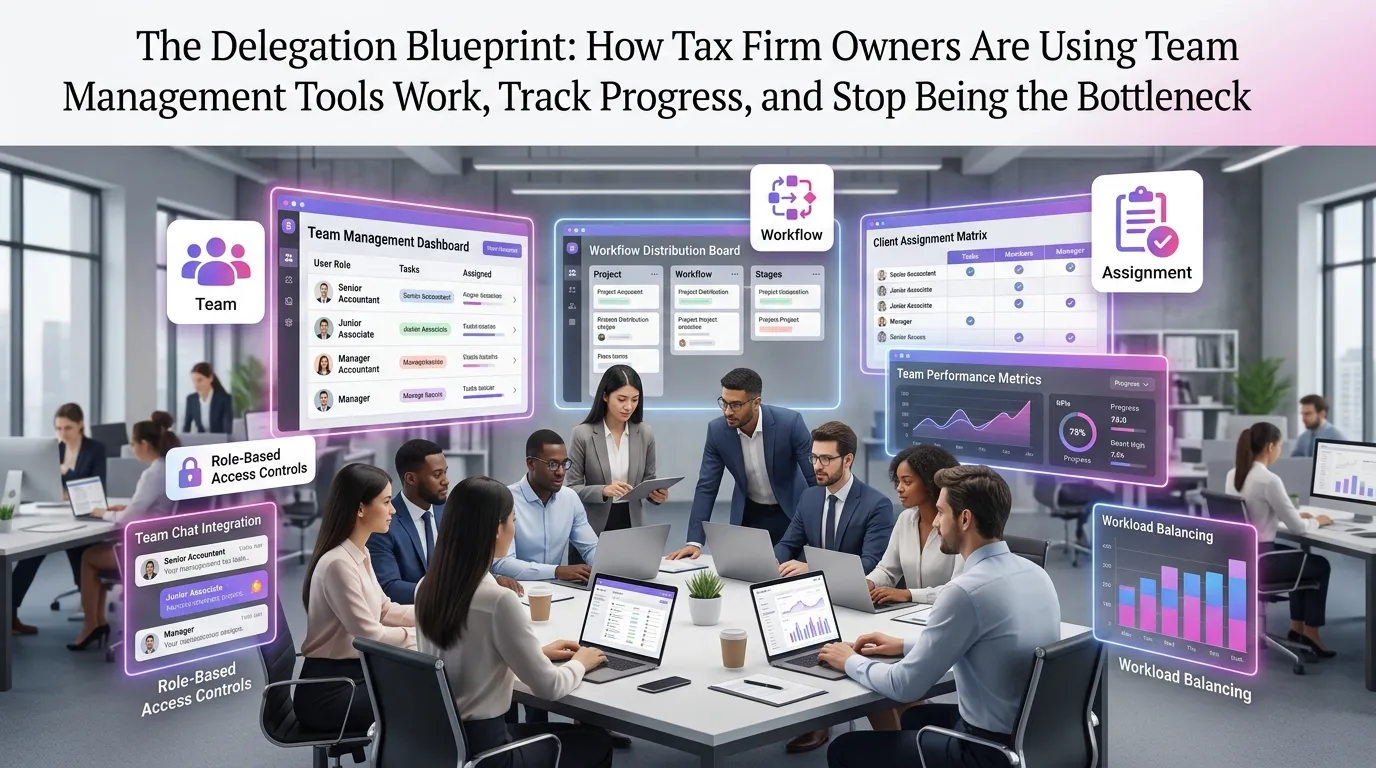
The Delegation Blueprint: How Tax Firm Owners Are Using Team Management Tools to Assign Work, Track Progress, and Stop Being the Bottleneck
11 min read
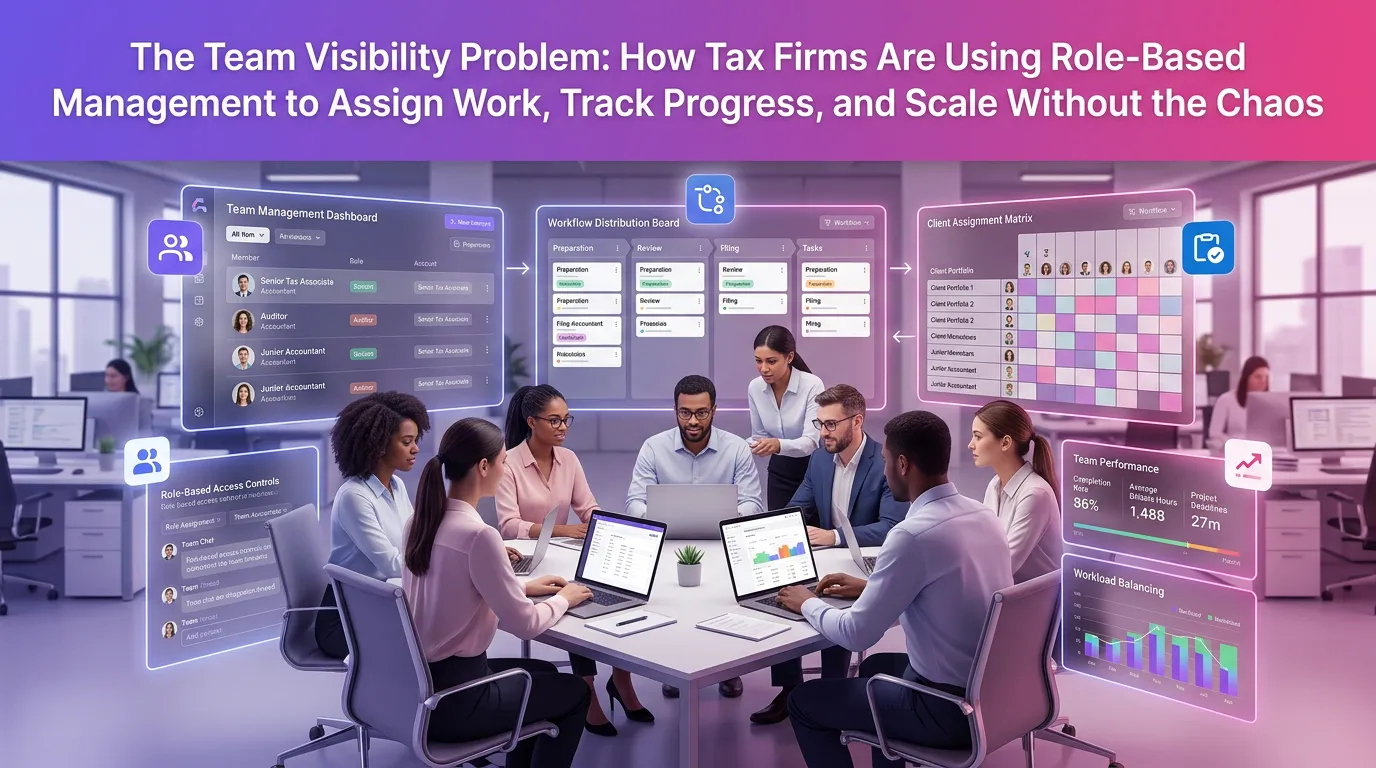
The Team Visibility Problem: How Tax Firms Are Using Role-Based Management to Assign Work, Track Progress, and Scale Without the Chaos
13 min read
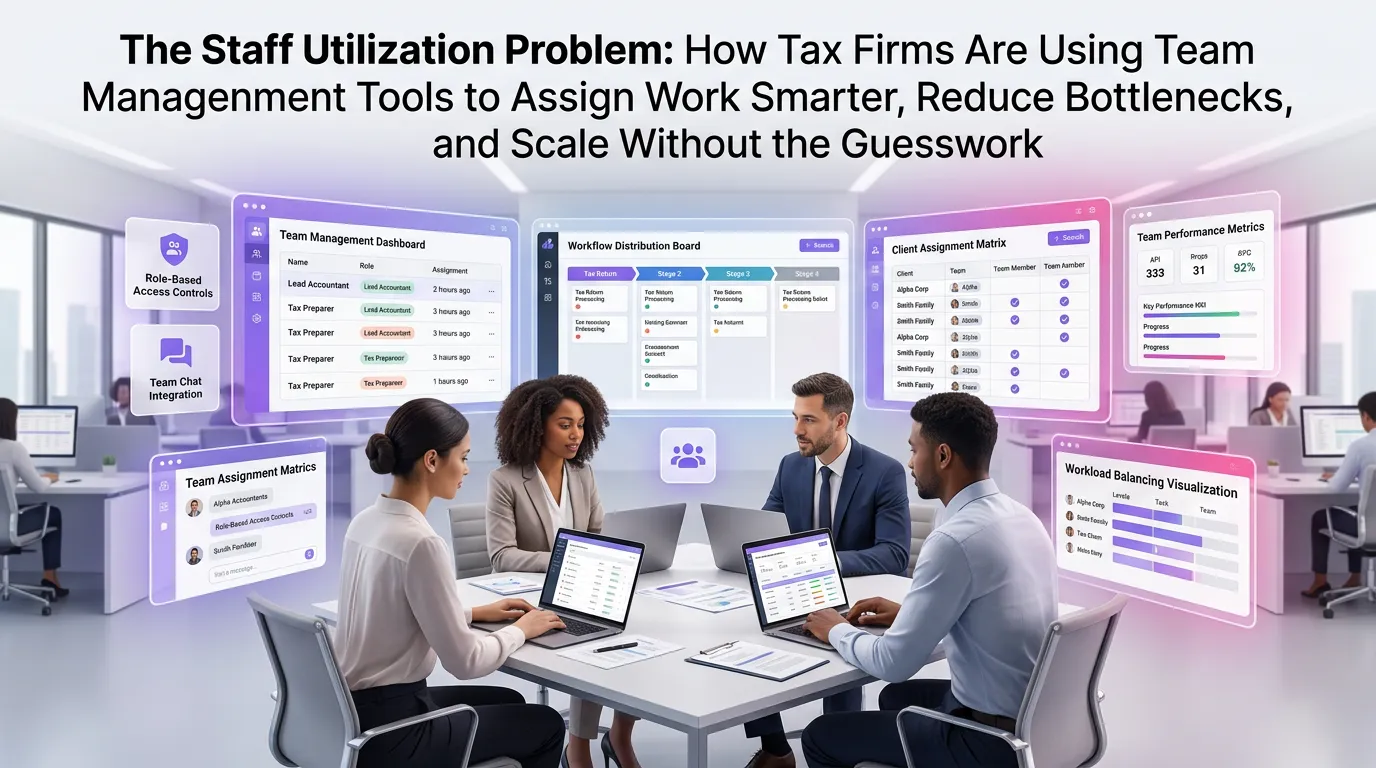
The Staff Utilization Problem: How Tax Firms Are Using Team Management Tools to Assign Work Smarter, Reduce Bottlenecks, and Scale Without the Guesswork
12 min read