
The Delegation Blueprint: How Tax Firm Owners Are Using Team Management Tools to Assign Work, Track Progress, and Stop Being the Bottleneck

If you're a tax firm owner who starts every morning by answering questions your team should already know the answers to, you're not running a firm — you're running a help desk. The painful truth is that most tax practice owners become the single point of failure in their own businesses. Every assignment, every deadline, every client update flows through them, and the firm's capacity is capped at whatever one person can personally manage.
The good news? This is a solvable problem. The firms scaling past the chaos aren't hiring more people — they're building better systems. Specifically, they're implementing structured team management for tax firms that allows work to be assigned, tracked, and completed without the owner touching every task. This post is your blueprint for making that shift.
Why Tax Firm Owners Become Bottlenecks in the First Place
The bottleneck problem usually starts with good intentions. Early on, handling everything yourself makes sense — you know the clients, you know the standards, and it's faster to just do it than to explain it. But as the firm grows, those habits calcify into systems (or the dangerous absence of them).
When there's no clear framework for assigning tasks, staff default to asking the owner before taking action. When there's no visibility into who's working on what, owners feel compelled to check in constantly. According to the AICPA's firm management resources, one of the most common complaints from accounting firm partners is that they spend more time managing workflow than delivering client value.
The solution isn't to work harder. It's to build a delegation infrastructure that runs independently of your availability.
The Four Pillars of Effective Team Management for Tax Firms
True delegation in a tax firm isn't just handing off tasks. It requires four interconnected pillars working together: clear assignment, contextual information, visibility into progress, and accountability checkpoints. Miss any one of these, and the system breaks down.
1. Structured Task Assignment
Every task in your firm should have a single owner. Not "the team," not "whoever has time" — one named person responsible for completion. This sounds obvious, but most firms still rely on verbal instructions, email threads, or sticky notes that create ambiguity and excuses.
When you assign work through a structured system, each task should carry: the assignee's name, the due date, the priority level, and links to the relevant client file or document. This eliminates the back-and-forth that eats up 30 minutes of every morning. A proper tax firm automation platform makes this kind of structured assignment the default, not the exception.
2. Contextual Information Attached to Every Task
One of the biggest reasons staff come back to owners with questions is because the task arrived without context. "Prepare the 1040 for Johnson" tells a preparer almost nothing about what's unusual, what the client expects, or what documents are still missing.
Effective delegation means attaching the right information to the work itself. This includes prior-year notes, client communication history, checklists, and any flags raised during intake. When your team has everything they need at the point of assignment, the number of interruptions drops dramatically.
3. Real-Time Progress Visibility
Owners become micromanagers not because they want to, but because they have no other way to know what's happening. If the only way to check on a return is to ask the preparer, you'll ask constantly — and so will your clients.
A workflow system with real-time status updates solves this. When you can see at a glance which returns are in preparation, which are in review, and which are waiting on client documents, you stop needing to interrupt your team. You also stop getting caught off guard when a deadline is approaching and a return is still sitting untouched.
4. Accountability Without Micromanagement
The final pillar is automated accountability — deadline reminders, escalation triggers, and completion confirmations that don't require the owner to chase anyone down. When a task is overdue, the system flags it. When a preparer completes their work, the reviewer is automatically notified. The owner only steps in when something genuinely requires their attention.
This is what separates a well-managed firm from a chaotic one. The Journal of Accountancy has noted that firms with documented workflow processes report significantly higher staff satisfaction and lower error rates than those relying on informal communication.
What a Delegation-First Workflow Actually Looks Like
Let's walk through a concrete example. It's February 15th. Your firm has 200 individual returns to process before April 15th. Without a system, here's what typically happens: returns are assigned verbally or via email, staff work at different paces with no visibility across the team, bottlenecks form at the review stage, and the owner spends the last two weeks of March personally pushing returns through the pipeline.
With a delegation-first workflow, the same scenario plays out very differently.
Step 1: Batch Assignment at Intake
As client documents arrive and intake is completed, returns are automatically queued and assigned based on preparer capacity. Each preparer sees their full workload, prioritized by due date and complexity. No one needs to ask "what should I work on next?"
Step 2: Automated Checklists and Document Requests
If documents are missing, the system triggers a client request automatically — without the owner or a staff member manually following up. The IRS's recordkeeping guidance makes clear that complete documentation is the preparer's responsibility, and your workflow system should enforce that standard consistently.
Step 3: Status-Based Review Routing
When a preparer marks a return as complete, it moves automatically into the review queue for the assigned reviewer. The reviewer doesn't need to be told — the system handles the handoff. This eliminates the "I thought you were going to send it to me" conversations that cost firms hours every week.
Step 4: Owner-Level Oversight Without Owner-Level Involvement
The firm owner can see the entire pipeline at a glance — how many returns are in each stage, which ones are at risk of missing their deadline, and where the team's capacity is strained. They intervene only where their expertise is actually needed, not because information is being withheld by an inefficient process.
Common Delegation Mistakes Tax Firms Make
Even firms that try to implement delegation often stumble on the same predictable mistakes. Recognizing these in advance can save months of frustration.
Delegating Tasks Without Authority
If you assign a task to a staff member but they still need your approval for every minor decision, you haven't delegated — you've just added a step. Effective delegation means defining the decision-making authority that comes with the task. Your senior preparer should be able to determine how to handle a straightforward depreciation question without escalating it.
Using Email as a Workflow Tool
Email is where delegation goes to die. Assignments buried in inboxes get missed, context gets lost in threads, and there's no single source of truth for what's been completed. If your firm still relies on email to manage internal work distribution, that's the first thing to change.
Failing to Define "Done"
Every task needs a clear completion criteria. "Review the return" is not a task — it's a vague directive. "Review the return, confirm all schedules are attached, verify the e-file authorization is signed, and mark as ready to transmit" is a task. The more specific your definition of done, the fewer errors make it through to the client.
How Team Management for Tax Firms Scales Your Capacity
Here's the math that most firm owners don't do explicitly: if you spend two hours per day answering questions, checking on status, and redistributing work — that's 500 hours per year. At a billing rate of $200/hour, that's $100,000 in capacity you're consuming with administrative overhead.
Structured team management for tax firms recaptures that capacity. When your team operates independently, you can take on more clients with the same headcount, or serve the same clients with significantly less stress. The firms that grow past the $1M revenue mark aren't doing it by working more hours — they're doing it by systematizing delegation so the firm runs as a machine, not as an extension of the owner's memory.
If you're ready to see what this looks like in practice, you can start your free trial of TaxFlow and explore how workflow automation changes the daily experience of running a tax practice.
Building Your Delegation Blueprint: A Practical Starting Point
You don't need to overhaul your entire firm overnight. Start with these three steps this week.
Audit your interruptions. For three days, write down every time a team member comes to you with a question. Categorize each question: Was it because they lacked information? Because they weren't sure who owned the task? Because they didn't know the status of something else? This audit will reveal exactly where your delegation system is failing.
Document your most common task types. Pick the five most frequent tasks in your firm — preparing a 1040, onboarding a new client, sending an engagement letter — and write out every step. These become your workflow templates. Once documented, anyone on your team can execute them without asking you how.
Implement one workflow at a time. Don't try to automate everything simultaneously. Pick the task type that causes the most friction and build a proper workflow for it first. Measure the impact over four weeks, then move to the next one. You can view our pricing plans to find the tier that matches your firm's current size and workflow needs.
For more strategies on building efficient tax firm operations, explore our blog where we cover everything from client communication automation to deadline management systems.
Frequently Asked Questions
What is team management for tax firms, and why does it matter?
Team management for tax firms refers to the systems, tools, and processes used to assign work, track progress, and hold staff accountable without requiring constant owner involvement. It matters because without it, firm owners become bottlenecks that limit growth and create burnout.
How do I start delegating more effectively as a tax firm owner?
Start by auditing where your time is being consumed by questions and status checks. Then document your core workflows as step-by-step processes and assign clear ownership to each task. Use a dedicated workflow platform rather than email or spreadsheets to manage assignments and track completion.
What features should I look for in a tax firm workflow tool?
Look for task assignment with due dates and priority levels, real-time status tracking across the pipeline, automated reminders and escalations, document attachment capabilities, and reporting that shows bottlenecks across your team. Integration with your tax preparation software is also a significant advantage.
How long does it take to see results from implementing workflow automation?
Most firms see a measurable reduction in owner interruptions within the first two to four weeks of consistent use. Full productivity gains — including faster turnaround times and higher capacity — typically become clear after one full tax season operating with the new system in place.
Can small tax firms with just a few employees benefit from team management tools?
Absolutely. In fact, small firms often benefit most because the owner is frequently doing double duty as both practitioner and manager. Even with two or three staff members, structured task management eliminates the informal communication that creates confusion and errors at scale.
Ready to stop being the bottleneck in your own firm? TaxFlow by MultidexTech gives tax firm owners the delegation infrastructure they need to assign work confidently, track progress in real time, and scale without chaos. Try it free for 14 days — no credit card required. Start your free trial today.
Related Posts

The Team Visibility Problem: How Tax Firms Are Using Role-Based Management to Assign Work, Track Progress, and Scale Without the Chaos
13 min read

The Org Chart That Runs Itself: How Tax Firms Are Using Role-Based Team Management to Scale Without Supervision Bottlenecks
11 min read
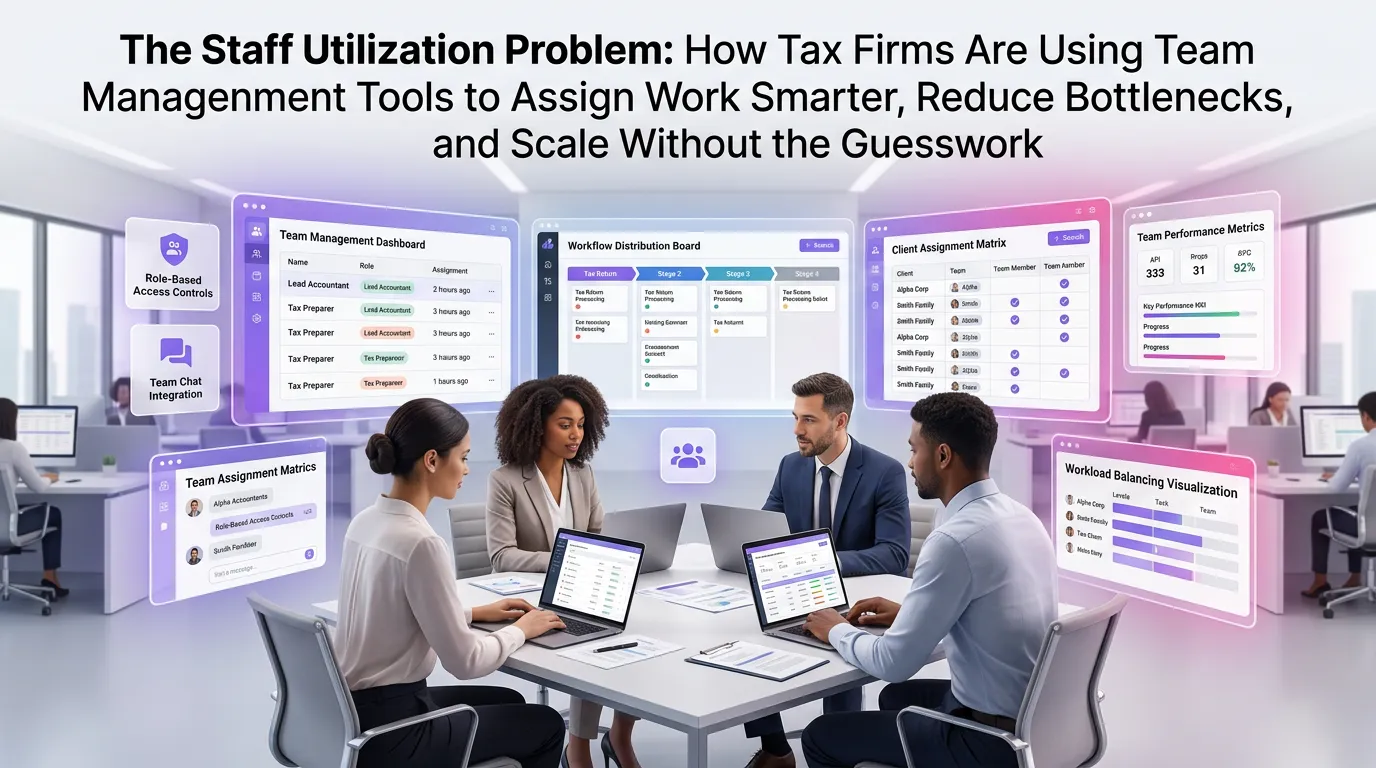
The Staff Utilization Problem: How Tax Firms Are Using Team Management Tools to Assign Work Smarter, Reduce Bottlenecks, and Scale Without the Guesswork
12 min read