
The Staff Utilization Problem: How Tax Firms Are Using Team Management Tools to Assign Work Smarter, Reduce Bottlenecks, and Scale Without the Guesswork
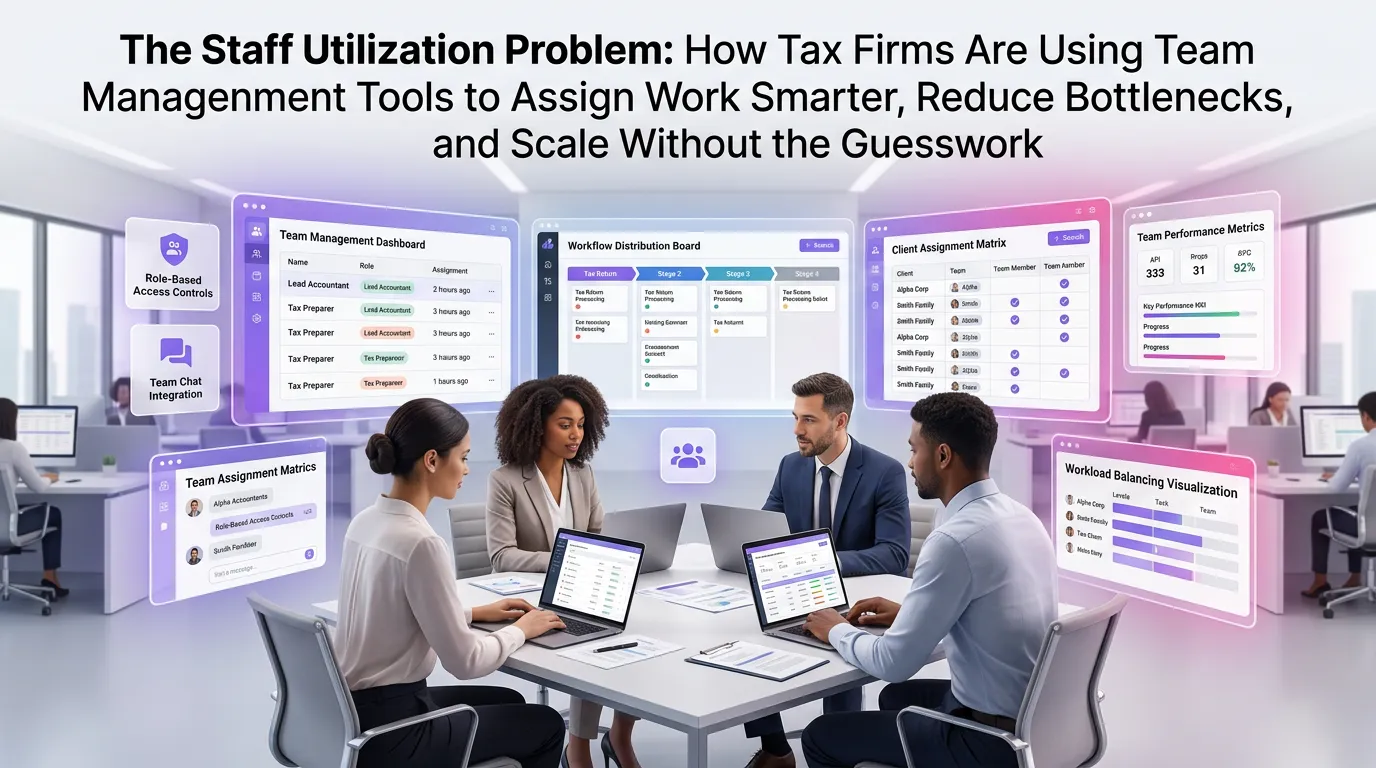
Tax season doesn't break firms because of a lack of talent — it breaks them because of a lack of visibility. Partners watch deadlines slip, managers scramble to reassign work at the last minute, and staff members oscillate between being overwhelmed and underutilized. The root cause is almost always the same: poor work distribution. Effective team management for tax firms isn't just a nice-to-have operational perk — it's the structural backbone that determines whether your firm scales gracefully or collapses under its own complexity.
Why Staff Utilization Is the Silent Profit Killer in Tax Firms
Most tax firm leaders think their biggest problem is capacity. In reality, it's allocation. A firm with 12 staff members might have three people buried under 80% of the billable work while four others are waiting for assignments that never arrive.
This imbalance doesn't just hurt morale — it directly erodes profitability. According to the AICPA's PCPS Top Issues Survey, staff capacity and workload management consistently rank among the top operational challenges for CPA firms of all sizes. The firms that outperform their peers aren't necessarily the ones with more headcount — they're the ones who deploy their existing headcount more intelligently.
When work isn't distributed evenly, you pay a compounding tax. Senior staff burn out. Junior staff stagnate. Clients feel the friction. And partners spend their time firefighting instead of growing the business.
The Hidden Bottlenecks That Derail Tax Workflows
Bottlenecks in tax firms rarely announce themselves. They disguise themselves as "the way things are done around here." Understanding where they actually live is the first step toward eliminating them.
The Single-Point-of-Approval Problem
Many firms route every client deliverable through one or two senior reviewers. When those individuals are unavailable — or simply overloaded — the entire pipeline stalls. Work queues up invisibly in someone's inbox, and deadlines approach without anyone realizing the exposure.
This is especially dangerous during peak filing seasons when the IRS filing deadlines are immovable. A bottleneck at the review stage in March can cascade into a client crisis by April 15th.
Informal Assignment Systems That Don't Scale
In smaller firms, work assignments often happen through hallway conversations, email threads, or gut instinct. A manager remembers that Sarah is "pretty free right now" and assigns her a complex partnership return — without knowing she's already 90% utilized on three other engagements.
These informal systems work until they don't. The moment your firm adds two or three more clients, or hires two new staff members, the system breaks. You need structure before you need scale — not after.
Lack of Real-Time Workload Visibility
Without a centralized dashboard showing who has what, managers are making assignment decisions in the dark. They rely on status update meetings that are already outdated by the time they happen, or they interrupt staff mid-task to ask for verbal progress reports.
This friction isn't just inefficient — it signals to your team that the firm lacks the operational maturity they expect from a professional employer.
What Smart Team Management for Tax Firms Actually Looks Like
Modern team management for tax firms goes far beyond a shared spreadsheet or a project management tool borrowed from a software company. It requires workflows built specifically around how tax work actually moves — from client intake through preparation, review, approval, and delivery.
Role-Based Task Assignment
The most effective firms assign work based on a combination of role, skill level, and current utilization — not just availability. A staff accountant shouldn't be handed a complex multi-state corporate return simply because they have open hours this week. Smart assignment logic accounts for complexity, client tier, and staff competency simultaneously.
Platforms built for tax operations allow managers to set role parameters so that tasks are automatically routed to the right staff level. This eliminates the guesswork and removes the cognitive load from managers who would otherwise be making these judgment calls manually, dozens of times per week.
Workload Dashboards That Surface Imbalances Before They Become Problems
A real-time utilization dashboard gives practice managers a bird's-eye view of every team member's current load. When one preparer is at 95% capacity and another is at 40%, that imbalance becomes immediately visible — and correctable — before it manifests as a missed deadline.
This kind of visibility also changes the conversation during team check-ins. Instead of asking "how is everyone doing?" managers can ask "I see Alex has three returns in review and two in prep — do we need to reassign anything?" That's a fundamentally more productive management posture.
Automated Status Tracking Across the Return Lifecycle
Tax returns move through predictable stages: data collection, preparation, internal review, partner approval, client review, and filing. When each stage transition is tracked automatically — rather than relying on manual updates — managers always know exactly where every engagement stands.
This eliminates the "black hole" effect where a return disappears into a reviewer's queue and no one knows its status until a client calls to ask. Automated tracking creates accountability without micromanagement.
How Bottleneck Reduction Drives Firm Scalability
Removing bottlenecks isn't just about efficiency — it's about creating the structural conditions that allow your firm to take on more clients without proportionally increasing headcount. That's the definition of scalable growth.
Consider a firm that processes 400 returns per season with 8 staff members. If their current process involves a 48-hour average review turnaround due to a two-person review bottleneck, redistributing review responsibilities and adding structured handoff protocols could cut that to 24 hours. The result: the same team can handle 20-30% more volume without a single new hire.
According to the Journal of Accountancy, firms that invest in workflow automation and structured task management report measurable improvements in both staff satisfaction and client retention — two metrics that directly impact long-term revenue.
The Compounding Effect of Better Utilization
When utilization improves across the team, the benefits compound quickly. Preparers finish work faster because they aren't context-switching between too many clients. Reviewers have predictable queues instead of chaotic inboxes. Partners spend less time on operational triage and more time on advisory work that commands higher billing rates.
Over the course of a single tax season, these efficiency gains can translate into tens of thousands of dollars in recovered billable hours — hours that were always there, just buried under poor process design.
Choosing the Right Tools for Tax Firm Team Management
Not every project management tool is built for the specific demands of a tax firm. Generic platforms like Trello or Asana can be useful, but they require significant customization to mirror tax workflows — and that customization burden often falls on already-stretched staff.
The more effective approach is to use a tax firm automation platform designed specifically for accounting and tax operations. These platforms understand concepts like return status stages, client document requests, e-file acknowledgments, and IRS deadline calendars — without requiring your team to build those structures from scratch.
Key Features to Look For
When evaluating team management tools for your tax firm, prioritize platforms that offer real-time workload visibility, automated task routing based on role and capacity, deadline tracking tied to actual tax filing calendars, and client-facing portals that reduce the back-and-forth on document collection.
Integration matters too. Your team management tool should connect cleanly with your tax preparation software, your document management system, and your billing platform — so data flows without manual re-entry and your staff isn't toggling between five different applications to complete a single task.
Implementation: Start Small, Scale Fast
The biggest mistake firms make when adopting new team management tools is trying to boil the ocean on day one. Start with one service line — individual returns, for example — and build your assignment and tracking workflow there first. Once your team has confidence in the system, expand it to business returns, bookkeeping clients, and advisory engagements.
This incremental approach reduces change resistance, surfaces edge cases early, and gives your staff time to develop genuine proficiency rather than surface-level familiarity.
Building a Culture of Accountability Without Micromanagement
One of the most underappreciated benefits of structured team management is what it does to your firm's culture. When roles are clear, assignments are visible, and progress is tracked automatically, accountability becomes systemic rather than personal.
Managers no longer have to chase status updates — the system surfaces them. Staff members no longer wonder whether their contributions are visible — the dashboard shows their completed work. Partners no longer have to rely on gut instinct to assess team performance — utilization data tells the story objectively.
This shift from informal accountability to systemic accountability is what separates firms that retain great staff from firms that constantly struggle with turnover. People want to work in environments where expectations are clear and effort is recognized. Good team management infrastructure creates exactly that environment.
Frequently Asked Questions
What is team management for tax firms, and why does it matter?
Team management for tax firms refers to the structured processes, tools, and systems used to assign work, track progress, balance workloads, and ensure that every staff member is utilized effectively. It matters because poor work distribution is one of the leading causes of missed deadlines, staff burnout, and stalled firm growth — even when a firm has adequate headcount.
How do I know if my tax firm has a staff utilization problem?
Common warning signs include consistent deadline misses despite adequate staffing, a few team members who are always overwhelmed while others have light workloads, frequent last-minute reassignments during peak season, and managers who spend significant time on status-chasing rather than actual work. If any of these sound familiar, your utilization process likely needs restructuring.
Can team management tools integrate with existing tax software?
Yes — the best tax firm automation platforms are designed to integrate with common tax preparation software, document management systems, and billing tools. When evaluating options, always confirm what integrations are available out of the box versus what requires custom development, as this significantly affects implementation timelines and ongoing maintenance burden.
How long does it typically take to see results from improved team management practices?
Most firms begin seeing measurable improvements within the first full filing season after implementing structured team management tools — particularly in review turnaround times and deadline adherence rates. Cultural shifts, such as improved staff satisfaction and reduced manager time spent on operational triage, typically become noticeable within two to three months of consistent use.
Is team management software worth the investment for smaller tax firms?
Absolutely. In fact, smaller firms often see the most dramatic impact because they have less redundancy to absorb the cost of poor utilization. A 5-person firm where one preparer is chronically overloaded and another is underutilized is losing a significant percentage of its potential capacity — and that loss compounds every season. Structured team management tools pay for themselves quickly in recovered billable hours alone.
Ready to stop guessing and start managing your team with precision? TaxFlow by MultidexTech gives tax firms a purpose-built platform to assign work intelligently, track every return in real time, and eliminate the bottlenecks that are quietly costing you capacity every season. You can start your free trial today and experience 14 days of full platform access — no credit card required. If you'd like to explore how TaxFlow fits your firm's size and service mix, view our pricing plans or explore our blog for more practice management insights from the MultidexTech team.
``` ```htmlRelated Posts
The Delegation Blueprint: How Tax Firm Owners Are Using Team Management Tools to Assign Work, Track Progress, and Stop Being the Bottleneck
11 min read
The Team Visibility Problem: How Tax Firms Are Using Role-Based Management to Assign Work, Track Progress, and Scale Without the Chaos
13 min read

The Org Chart That Runs Itself: How Tax Firms Are Using Role-Based Team Management to Scale Without Supervision Bottlenecks
11 min read