
The Renewal Trap: How Tax Firms Are Using Automated Deadline Tracking to Manage Licenses, Extensions, and Recurring Obligations Without Dropping the Ball
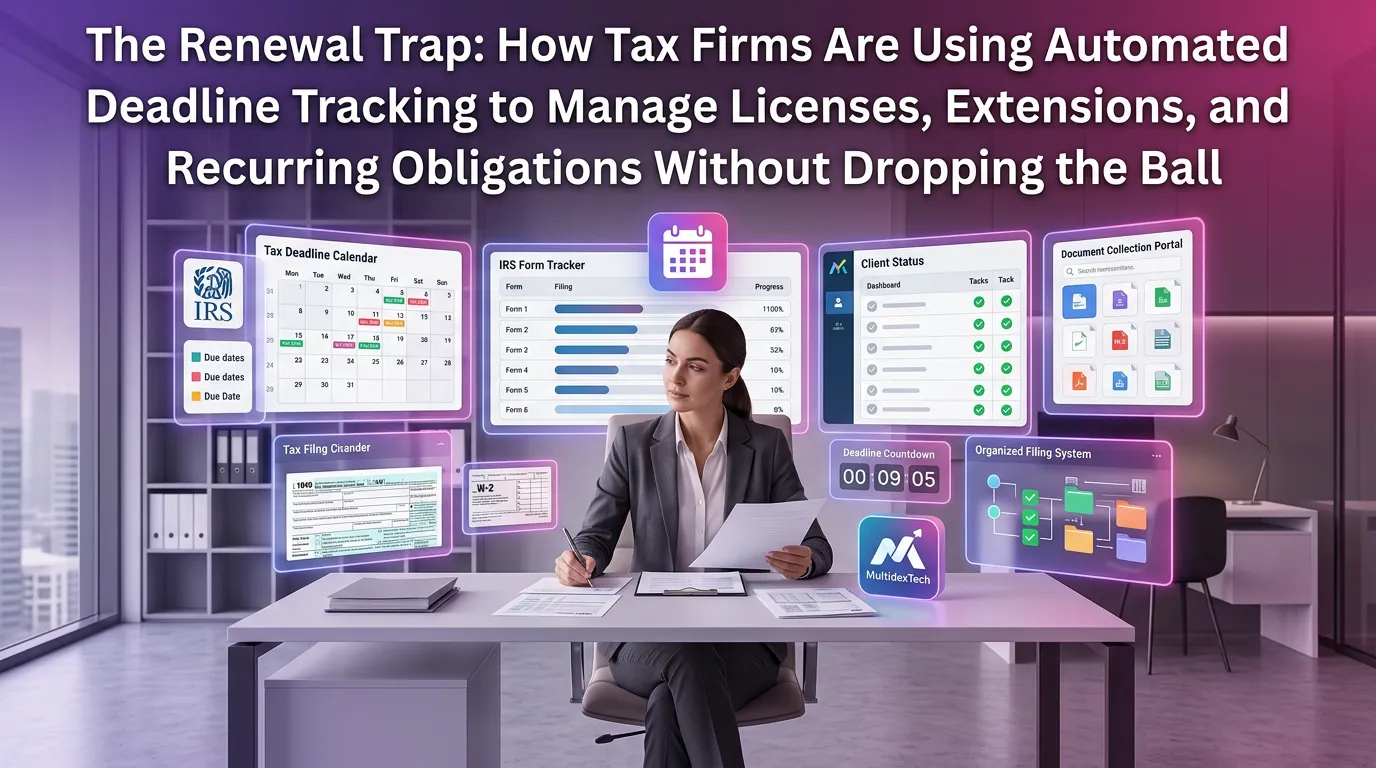
Every tax professional knows the feeling: a renewal notice buried in an inbox, a license expiration missed by two days, or a client extension deadline that slipped through the cracks during the chaos of filing season. These aren't signs of incompetence — they're symptoms of a systemic problem that affects even the most organized firms. The sheer volume of recurring obligations, staggered deadlines, and jurisdiction-specific requirements has made manual tracking not just inefficient, but genuinely dangerous to a firm's reputation and compliance standing. That's why forward-thinking practices are turning to tax firm deadline tracking software to replace spreadsheets, sticky notes, and memory with automated, reliable systems that never sleep.
The Hidden Cost of Manual Deadline Management
Most tax firm owners underestimate the true cost of managing deadlines manually. It's not just the occasional missed renewal — it's the cognitive overhead that comes with maintaining dozens of parallel timelines across clients, staff, and regulatory bodies.
Consider a mid-sized CPA firm handling 400 business clients. Each client may have federal and state filing deadlines, estimated tax payment dates, sales tax obligations, business license renewals, and professional license requirements for the firm's own staff. Multiply that across multiple states and entity types, and you're looking at thousands of individual dates that need to be tracked, communicated, and acted upon every year.
According to the American Institute of CPAs (AICPA), practice management failures — including missed deadlines — are among the leading causes of malpractice claims against accounting firms. The financial and reputational damage from a single missed obligation can far exceed the cost of an entire year's subscription to an automated tracking platform.
What "The Renewal Trap" Actually Looks Like in Practice
The renewal trap isn't a single catastrophic failure. It's a slow accumulation of near-misses, last-minute scrambles, and reactive firefighting that quietly erodes a firm's operational efficiency.
License Renewals: The Forgotten Compliance Layer
Professional license renewals for CPAs, EAs, and tax preparers are often managed separately from client work — and that separation is where things fall apart. A firm partner might track their own PTIN renewal but forget that two staff members are due for state CPA license renewals in different months.
The IRS requires all paid tax preparers to renew their PTIN annually, and failure to do so can result in penalties and the inability to legally prepare returns. When this is managed through a shared calendar or personal reminder, the risk of a gap is significant — especially during staff transitions.
Extension Deadlines: A False Sense of Security
Filing an extension gives clients more time, but it doesn't eliminate the deadline — it moves it. Firms that successfully navigate April 15th often face a second wave of pressure in September and October as extension deadlines converge.
Without systematic tracking, extended returns can fall into a gray zone where no one is actively monitoring them. Staff assume someone else is watching the calendar. Clients assume their accountant has it covered. The result is a deadline that everyone thought was managed and no one actually tracked.
Recurring Client Obligations: The Compounding Problem
Quarterly estimated tax payments, annual report filings, sales tax remittances, and payroll tax deposits each follow their own cadence. For a firm managing hundreds of clients across multiple states, these obligations create a constant drumbeat of deadlines that requires a structured system — not a best-effort approach.
Why Spreadsheets and Shared Calendars Fall Short
Spreadsheets have served tax firms for decades, and they're not without merit. They're flexible, familiar, and free. But they have fundamental limitations that become critical at scale.
First, spreadsheets are static. They don't send alerts, adapt to regulatory changes, or flag upcoming deadlines proactively. Someone has to look at the spreadsheet for it to be useful — and in a busy firm, that doesn't always happen. Second, shared calendars lack the context that deadline management requires. A calendar event that says "Q3 Estimated Tax — Client XYZ" tells you what, but not why, how, or who is responsible for taking action.
Third, and most critically, neither spreadsheets nor calendars scale gracefully. Adding a new client, a new state jurisdiction, or a new service line means manually updating every tracking document. The maintenance burden grows faster than the firm itself, and data integrity suffers as a result.
How Tax Firm Deadline Tracking Software Changes the Equation
Automated deadline tracking isn't just about replacing a spreadsheet with software. It's about building a system that actively manages obligations on behalf of the firm — surfacing risks before they become problems and keeping every team member aligned without requiring constant manual coordination.
Centralized Visibility Across All Obligation Types
The best tax firm deadline tracking software consolidates every type of deadline into a single, searchable dashboard. Whether it's a PTIN renewal, a 1065 extension, a state franchise tax filing, or a client's business license renewal, everything lives in one place with consistent formatting and priority weighting.
This centralization eliminates the fragmentation that causes deadlines to fall through the cracks. Instead of checking three different systems and two spreadsheets, a staff member can open one dashboard and immediately understand what needs attention today, this week, and this month.
Automated Alerts and Escalation Workflows
Proactive notifications are the cornerstone of effective deadline management. When a deadline is approaching, the system should automatically alert the responsible team member — and if no action is taken, escalate to a supervisor or secondary contact.
This escalation logic is what separates purpose-built deadline tracking from generic calendar tools. It assumes that humans are fallible and builds redundancy into the process rather than relying on individual vigilance.
Recurring Obligation Templates
Many tax obligations follow predictable patterns — quarterly payments, annual renewals, monthly filings. Deadline tracking platforms allow firms to create templates for these recurring obligations so that once a client or staff member is set up, the system automatically generates the next deadline in the sequence without any manual intervention.
This dramatically reduces setup time for new clients and ensures that long-term obligations are never accidentally dropped when a staff member transitions to a new role or leaves the firm.
Integrating Deadline Tracking Into Your Firm's Workflow
Technology is only as effective as its adoption. The most sophisticated deadline tracking system in the world won't help a firm that continues to rely on informal processes alongside it.
Successful implementation requires clear ownership — every deadline should be assigned to a specific person, not a team or a department. It requires a defined review cadence, whether that's a daily standup, a weekly deadline review meeting, or an automated morning digest sent to all staff. And it requires buy-in from leadership, who need to model the behavior they want to see from their teams.
Firms that integrate deadline tracking into their broader tax firm automation platform see the greatest benefit, because deadlines don't exist in isolation. They're connected to client records, engagement letters, billing cycles, and staff workloads. When all of these systems share data, the entire practice operates with greater coherence and less friction.
Real-World Impact: What Firms Are Experiencing
The shift from manual to automated deadline management isn't just operationally significant — it has measurable business outcomes. Firms report spending significantly less time on administrative coordination, fewer last-minute client communications about upcoming deadlines, and improved client satisfaction scores tied to proactive outreach.
There's also a staff retention dimension to consider. Tax professionals who spend their days chasing deadlines and managing administrative complexity are more likely to experience burnout. Automating the tracking layer frees them to focus on the analytical and advisory work that drew them to the profession in the first place.
The Journal of Accountancy has consistently highlighted practice efficiency and technology adoption as key differentiators between growing firms and stagnant ones. Deadline management automation is increasingly cited as a foundational capability rather than a nice-to-have feature.
Choosing the Right Solution for Your Firm
Not all deadline tracking tools are created equal. When evaluating options, firms should look for solutions that offer multi-jurisdiction support, customizable alert thresholds, role-based access controls, and integration with existing practice management or document management systems.
Scalability matters too. A solution that works for a 5-person firm should also be capable of growing with that firm to 50 people without requiring a platform migration. Look for vendors who offer transparent pricing, strong customer support, and a clear product roadmap.
If you're ready to see what modern deadline management looks like in practice, explore our blog for more insights on building an efficient, technology-forward tax practice.
Frequently Asked Questions
What types of deadlines can tax firm deadline tracking software manage?
Modern tax firm deadline tracking software can manage a wide range of obligations, including federal and state tax filing deadlines, extension due dates, quarterly estimated tax payment schedules, professional license renewals (PTIN, CPA, EA), business license renewals for clients, payroll tax deposit deadlines, and annual report filings. The best platforms allow firms to create custom deadline types to accommodate jurisdiction-specific or industry-specific requirements.
How does automated deadline tracking reduce malpractice risk?
Missed deadlines are one of the leading causes of malpractice claims against accounting firms. Automated tracking reduces this risk by proactively alerting staff before deadlines arrive, creating an auditable record of when actions were taken, and building escalation workflows that ensure no obligation goes unnoticed. This systematic approach replaces reliance on individual memory with a process-driven safety net.
Can deadline tracking software integrate with existing practice management tools?
Yes, most professional-grade deadline tracking platforms are designed to integrate with popular practice management, document management, and CRM systems. Integration allows deadline data to flow alongside client records, engagement status, and billing information, giving firms a unified view of their operational obligations without duplicating data entry across multiple systems.
Is tax firm deadline tracking software suitable for small firms?
Absolutely. In fact, small firms often benefit most from automation because they have fewer administrative staff to manage tracking manually. A solo practitioner or small team managing 100-200 clients can face the same complexity of recurring obligations as a larger firm, without the bandwidth to handle it manually. Cloud-based solutions with flexible pricing make professional deadline tracking accessible to practices of all sizes.
How long does it take to implement a deadline tracking system?
Implementation timelines vary depending on the size of the firm and the complexity of existing data. Many firms can get a basic system operational within a few days using client import tools and pre-built obligation templates. Full integration with existing workflows and custom configuration typically takes two to four weeks. Most platforms offer onboarding support and documentation to accelerate the process.
Ready to eliminate the renewal trap from your practice? TaxFlow by MultidexTech is built specifically for tax firms that are serious about operational efficiency. From automated deadline alerts to centralized compliance dashboards, TaxFlow gives your team the visibility and control needed to manage every obligation — no matter how complex your client base grows. Start your free trial today and experience 14 days of full platform access with no credit card required. Or, if you're ready to explore plans that scale with your firm, view our pricing plans and find the right fit for your practice.
Related Posts
The Delegation Blueprint: How Tax Firm Owners Are Using Team Management Tools to Assign Work, Track Progress, and Stop Being the Bottleneck
11 min read
The Team Visibility Problem: How Tax Firms Are Using Role-Based Management to Assign Work, Track Progress, and Scale Without the Chaos
13 min read

The Org Chart That Runs Itself: How Tax Firms Are Using Role-Based Team Management to Scale Without Supervision Bottlenecks
11 min read