
The Staff Visibility Problem: How Tax Firm Owners Are Finally Seeing Who's Doing What, When, and Whether It's Getting Done
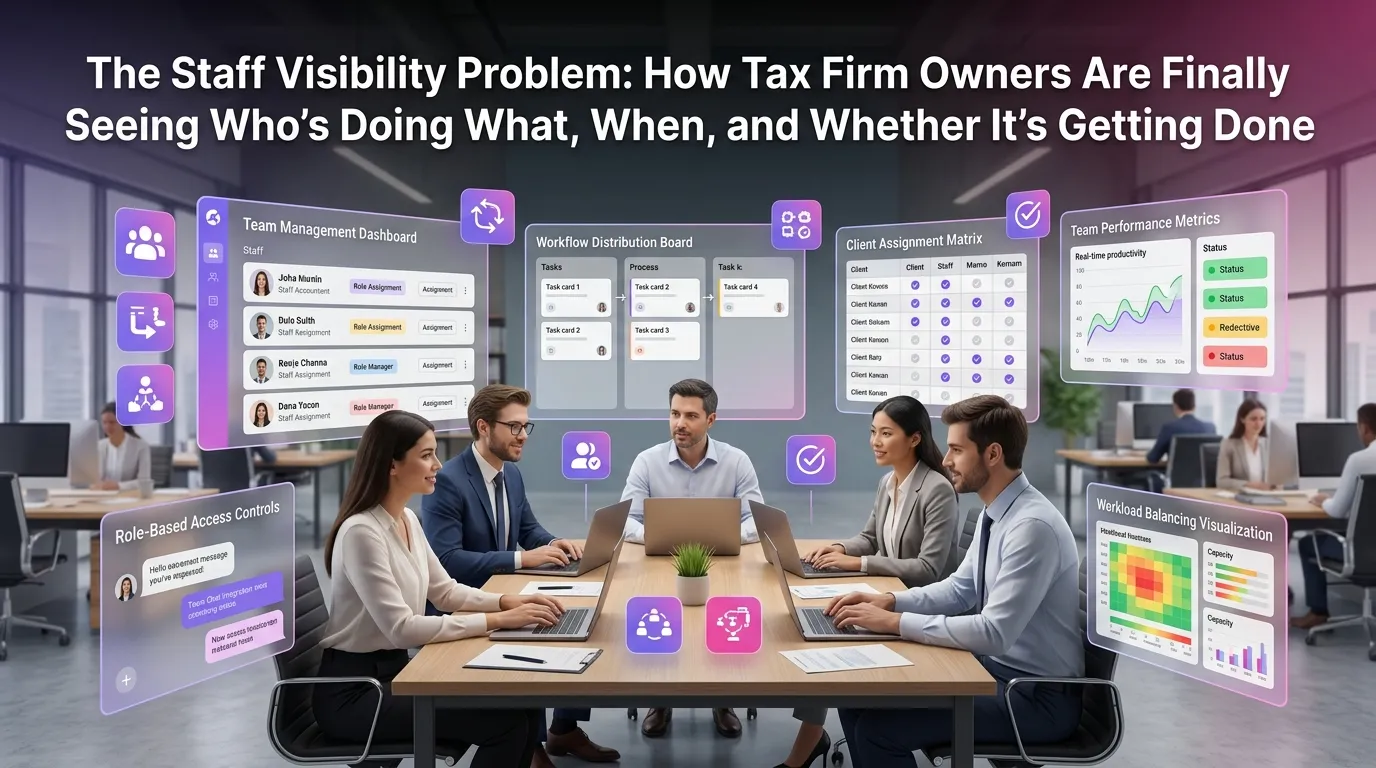
If you've ever ended a workday wondering whether a client's return was actually reviewed, whether a deadline was quietly missed, or whether your busiest staff member is carrying three times the load of everyone else — you're not alone. Team management for tax firms is one of the most underappreciated operational challenges in the industry. Unlike law firms or medical practices, most tax firms grew organically, built on trust and intuition rather than systems. And for a long time, that worked. But as client rosters grow, remote work becomes standard, and filing deadlines compress, intuition is no longer enough.
The firms that are pulling ahead aren't necessarily hiring more people. They're finally seeing what's happening inside their own operations — and using that visibility to work smarter. Here's how modern tax practice management tools are solving the staff visibility problem for good.
Why Tax Firm Owners Struggle to See What's Actually Happening
Most tax firm owners aren't blind to their team — they're just working with blurry vision. Status updates come through hallway conversations, email threads, or a shared spreadsheet that nobody updates consistently. The picture you get is incomplete, delayed, and often filtered through whoever is loudest or most available.
This isn't a people problem. It's a systems problem. When your workflow lives in a combination of sticky notes, email inboxes, and memory, there's no reliable source of truth for what's in progress, what's stalled, and what's dangerously close to a deadline.
According to the American Institute of CPAs (AICPA), practice management and workflow efficiency consistently rank among the top operational concerns for accounting firm leaders. The firms that struggle most are typically those still relying on informal communication as their primary management tool.
The Hidden Cost of Invisible Work
When work is invisible, problems compound silently. A return sits in someone's queue for four days because they weren't sure it was assigned to them. A manager assumes a task is done because no one mentioned it. A client calls to ask for an update, and you have to track down three people before you can give them an answer.
These friction points don't just slow you down — they erode client trust and staff morale simultaneously. Employees who feel unclear about priorities become less productive. Clients who feel uninformed become harder to retain.
What Real Team Management for Tax Firms Looks Like
Effective team management for tax firms goes far beyond assigning tasks. It means having a live, accurate view of every return, every client matter, and every team member's workload — without having to ask anyone for a status update.
The best practice management systems create what's called a "single source of truth." Every task, deadline, and handoff lives in one place, updated in real time, and visible to the right people. Managers can see at a glance what's overdue, what's in review, and what's waiting on a client response.
Key Visibility Features That Change How Firms Operate
Not all workflow tools are built for tax firms specifically. Generic project management platforms like Trello or Asana can help, but they lack the context that makes tax work unique — filing deadlines, return statuses, document collection workflows, and multi-step review processes.
Here's what purpose-built visibility looks like in a tax firm context:
- Real-time task dashboards — See every open item across your team, filterable by staff member, client, due date, or status.
- Workload distribution views — Identify immediately when one preparer has 40 open items while another has 12.
- Deadline tracking with alerts — Automated reminders that escalate as deadlines approach, so nothing slips through silently.
- Status-based workflows — Returns move through defined stages (assigned, in preparation, in review, awaiting client, filed), giving everyone a shared language for where things stand.
- Audit trails — A full history of who touched what and when, which matters enormously for quality control and compliance.
A Journal of Accountancy study on accounting firm productivity found that firms with structured workflow systems reported significantly fewer missed deadlines and higher staff satisfaction scores than those relying on informal coordination methods.
The Workload Imbalance Problem No One Talks About
Here's a scenario that plays out in tax firms every busy season: your most experienced preparer is quietly drowning while a newer staff member has capacity they don't know how to fill. Neither one mentions it. You don't find out until someone burns out or a deadline slips.
Workload imbalance is one of the most common — and most preventable — causes of staff turnover in tax firms. When people consistently feel overloaded or underutilized, they look elsewhere. And replacing a trained tax preparer mid-season is about as costly as it gets.
How Visibility Solves the Imbalance Before It Becomes a Crisis
When you can see each team member's open task count, estimated completion times, and upcoming deadlines in a single view, redistribution becomes a management decision rather than a guessing game. You can proactively shift work before someone hits a wall.
This kind of visibility also empowers staff. When everyone can see the queue and understand the priorities, team members can self-organize more effectively. Senior preparers can flag bottlenecks. Reviewers can sequence their work intelligently. The manager becomes a facilitator rather than a dispatcher.
Remote and Hybrid Teams: Where Visibility Matters Most
The shift toward remote and hybrid work in accounting has been significant and largely permanent. A growing number of tax firms now have staff working across multiple locations, time zones, or schedules. This creates a visibility gap that informal communication simply cannot bridge.
When your team isn't in the same room, you lose the passive awareness that comes from physical proximity — seeing someone at their desk, overhearing a conversation, noticing that the stack of folders on someone's desk keeps growing. That ambient information has to be replaced with intentional systems.
Building a Connected Remote Tax Team
The firms that manage remote teams well aren't just using video calls. They're using platforms that make work visible regardless of where it's being done. Assignments are logged. Progress is tracked. Handoffs are documented. Communication is tied to specific tasks rather than floating in an email thread somewhere.
This is exactly the kind of infrastructure that a tax firm automation platform like TaxFlow is designed to provide. Rather than bolting together a dozen tools that don't talk to each other, firms get a unified environment where task management, deadline tracking, and team communication all live together.
Compliance, Quality Control, and the Role of Accountability
There's another dimension to staff visibility that often gets overlooked: compliance and quality control. The IRS holds tax preparers to professional standards, and firms are responsible for the accuracy and completeness of the returns they file. When you can't see who reviewed a return or whether a quality control step was completed, you have a liability exposure problem.
Audit trails and review workflows aren't just management conveniences — they're professional safeguards. A system that tracks every action, every approval, and every sign-off creates a defensible record of your firm's due diligence. That matters in the event of a client dispute, an IRS inquiry, or an internal quality review.
Making Quality Control a Visible, Repeatable Process
The most effective quality control systems aren't checklists on paper — they're embedded into the workflow itself. Returns can't advance to the next stage until a review step is marked complete. Approvals are logged with timestamps and user IDs. Exceptions are flagged automatically.
When quality control is built into how work moves through your firm, it stops being something you remind people to do and starts being something that simply happens — consistently, every time.
From Reactive to Proactive: Changing How You Manage
Most tax firm managers spend a significant portion of their time in reactive mode — responding to questions, chasing down statuses, putting out fires. This isn't a failure of management skill. It's a failure of management infrastructure.
When you have real-time visibility into your team's work, the nature of your job changes. Instead of spending your morning asking "where are we on the Johnson return?", you open your dashboard, see it's in review, and move on. You can spend that recaptured time on business development, client relationships, or actually reviewing work yourself.
This shift — from reactive coordinator to proactive leader — is what practice management technology makes possible. And it's one of the most significant quality-of-life improvements firm owners report after implementing a proper workflow system.
What to Look for in a Team Management Solution for Tax Firms
Not every tool will serve every firm. Before investing in a platform, it's worth evaluating a few key criteria specific to tax practice needs.
- Tax-specific workflow templates — Does the system understand the difference between a 1040, a 1065, and a 1120-S? Does it support the unique stages of tax preparation?
- Scalability — Will it work for a 3-person firm and still serve you when you grow to 15?
- Client-facing features — Can clients submit documents, sign off on organizers, and receive status updates through the same platform?
- Reporting and analytics — Can you pull reports on team productivity, deadline compliance, and workflow bottlenecks?
- Integration capability — Does it connect with your tax preparation software, document management system, and billing tools?
If you're ready to explore what the right platform can do for your firm, you can start your free trial of TaxFlow and see these capabilities in action with your own team's data.
Frequently Asked Questions
What is team management for tax firms, and why is it different from general project management?
Team management for tax firms refers to the systems and processes used to assign, track, and oversee tax preparation work across a staff team. It differs from general project management because tax work involves specific compliance deadlines, multi-step review requirements, regulatory accountability, and client document workflows that generic tools aren't designed to handle. Purpose-built tax practice management platforms account for these nuances.
How can I tell if my tax firm has a staff visibility problem?
Common signs include frequently asking staff for status updates verbally or by email, discovering missed deadlines after the fact, difficulty identifying who is overloaded or underutilized, and inconsistent quality control across returns. If you can't answer "what is every member of my team working on right now?" without making several phone calls, you likely have a visibility gap.
Will a workflow platform work for a small tax firm with just a few employees?
Absolutely. In fact, small firms often benefit the most from workflow visibility because there's less margin for error and fewer people to catch mistakes before they become problems. Most modern platforms, including TaxFlow, are designed to scale from solo practitioners to multi-partner firms. You can view our pricing plans to find a tier that fits your team size and budget.
How does staff visibility help with remote or hybrid tax teams?
When team members aren't physically co-located, managers lose the ambient awareness of who is working on what. A workflow platform replaces that awareness with structured, real-time data — task assignments, progress updates, deadline status, and communication logs — all accessible regardless of where team members are working.
How long does it take to implement a team management system in a tax firm?
Implementation time varies by firm size and the complexity of your existing workflows. Many firms are up and running with basic workflow templates within a day or two. Full adoption — including staff training, workflow customization, and integration with existing tools — typically takes two to four weeks. Starting with a free trial period is an effective way to evaluate fit before committing. You can also explore our blog for onboarding tips and best practices from other tax firms.
Ready to Finally See What's Happening in Your Firm?
The staff visibility problem isn't a personnel issue — it's an infrastructure issue. And it's one that modern tax practice management technology is purpose-built to solve. When you can see who's doing what, when it's due, and whether it's getting done, you stop managing by guesswork and start leading with confidence.
TaxFlow by MultidexTech gives tax firm owners and managers the real-time visibility, workflow automation, and team accountability tools they need to run a tighter, more profitable practice. Whether you're managing a team of three or thirty, the right systems make all the difference.
Try TaxFlow free for 14 days — no credit card required. See firsthand how purpose-built team management for tax firms can transform your operations, reduce your stress, and give you back the time you've been spending chasing status updates. Start your free trial today and experience the clarity your firm has been missing.
Related Posts
The Delegation Blueprint: How Tax Firm Owners Are Using Team Management Tools to Assign Work, Track Progress, and Stop Being the Bottleneck
11 min read
The Team Visibility Problem: How Tax Firms Are Using Role-Based Management to Assign Work, Track Progress, and Scale Without the Chaos
13 min read

The Org Chart That Runs Itself: How Tax Firms Are Using Role-Based Team Management to Scale Without Supervision Bottlenecks
11 min read